
Table of Contents
- 1. An Ancient Delta Teeming with Megafauna
- 2. The Straight-Tusked Elephant Feast
- 2.1. Processing the Carcass
- 2.2. The Tiny Flint Tool Paradox
- 3. Overcoming Limits with Bone Engineering
- 3.1. Manufacturing Bone Tools
- 3.2. A Natural Trap or an Intentional Hunt?
- 4. Identifying the Prehistoric Craftsmen
- 4.1. Rome’s Prehistoric Corridor
- 5. Conclusion
- 6. Frequently Asked Questions
- 6.1. How old is the Casal Lumbroso site, and how was it dated?
- 6.2. What kind of elephant was found at the site?
- 6.3. Why did the early humans use bone tools instead of stone?
- 6.4. Which human species lived in Italy 400,000 years ago?
- 6.5. What does this discovery tell us about early human behavior?
400,000-Year-Old Elephant Tools Change Our View of Early Humans
Long before modern humans ever walked the European continent, prehistoric hominins were already proving themselves to be master survivalists, engineers, and cooperative social groups. A remarkable new archaeological discovery just outside of Rome, Italy, reveals that early humans living roughly 404,000 years ago successfully butchered a massive prehistoric elephant, harvested its meat for sustenance, and meticulously crafted its bones into specialized tools.
The breakthrough site, known as Casal Lumbroso, is located in northwestern Rome. Published in the scientific journal PLOS ONE, the discovery offers one of the most comprehensive and detailed portraits ever captured of human ancestors during the Middle Pleistocene—a climatically dynamic epoch when Europe fluctuated between bitter ice ages and lush, warm interglacial periods. The finding upends previous assumptions about the intellectual and technical limits of these early hominins, demonstrating an astonishing degree of problem-solving ingenuity.
400,000-Year-Old Elephant Tools Change Our View of Early Humans

An Ancient Delta Teeming with Megafauna
To understand how this prehistoric event unfolded, researchers from Sapienza University of Rome reconstructed the ancient ecosystem of Casal Lumbroso. By analyzing local geological layers and fossilized plant remains, scientists determined that 400,000 years ago, this specific area was a highly humid, densely wooded river delta situated along the ancient path of the Tiber River.
The environment was a sanctuary for diverse wildlife, operating as a thriving prehistoric oasis during a warm interglacial phase. The layers of earth surrounding the site hold a rich paleontological record. Alongside the elephant remains, archaeologists found the fossilized bones of:
Rhinoceroses
Bison
Ancient deer species
Prehistoric wolves and canids
Water-dwelling turtles and amphibians
A wide variety of ancient birds


This biological wealth attracted groups of early humans, who used the waterways and dense vegetation to hunt, forage, and scavenge for survival.
The Straight-Tusked Elephant Feast
At the center of the Casal Lumbroso excavation is the partial skeleton of a straight-tusked elephant (Palaeoloxodon antiquus), a colossal creature that dwarfed modern African elephants. Standing up to 13 feet tall at the shoulder, a single adult male could weigh over 10 tons.
Processing the Carcass
A detailed forensic examination of the more than 300 elephant skeletal fragments recovered at the site revealed that the animal was systematically processed by hominins shortly after its death. The bones show numerous impact fractures and impact marks made while the bone tissue was still fresh and elastic. These marks provide definitive proof that early humans were intentionally striking the massive limbs to shatter the heavy bone walls, allowing them to extract the highly nutritious, calorie-dense marrow inside.
Interestingly, very few bones display the classic microscopic slice marks typically left behind by heavy butchery knives. Archaeologists believe this absence reveals a clever adjustment to environmental constraints rather than a lack of butchering skill.
The Tiny Flint Tool Paradox
Excavations at the site yielded more than 500 stone tools, mostly carved from locally sourced flint. However, the vast majority of these implements were incredibly small, measuring less than 30 millimeters (about 1.2 inches) in length.
While these miniature flake tools were exceptionally sharp and perfectly suited for slicing through soft meat, muscle, and skin, they were far too small and fragile to handle heavy-duty tasks like separating major joints or hacking through thick cartilage. Furthermore, because large, durable stones were naturally scarce in this river delta region, the hominins could not easily manufacture large stone handaxes.
Overcoming Limits with Bone Engineering
Faced with a massive 10-ton animal carcass and a distinct lack of large stone tools, these prehistoric innovators came up with an elegant solution: they decided to turn the elephant’s own skeleton into the heavy-duty machinery they lacked.
Manufacturing Bone Tools
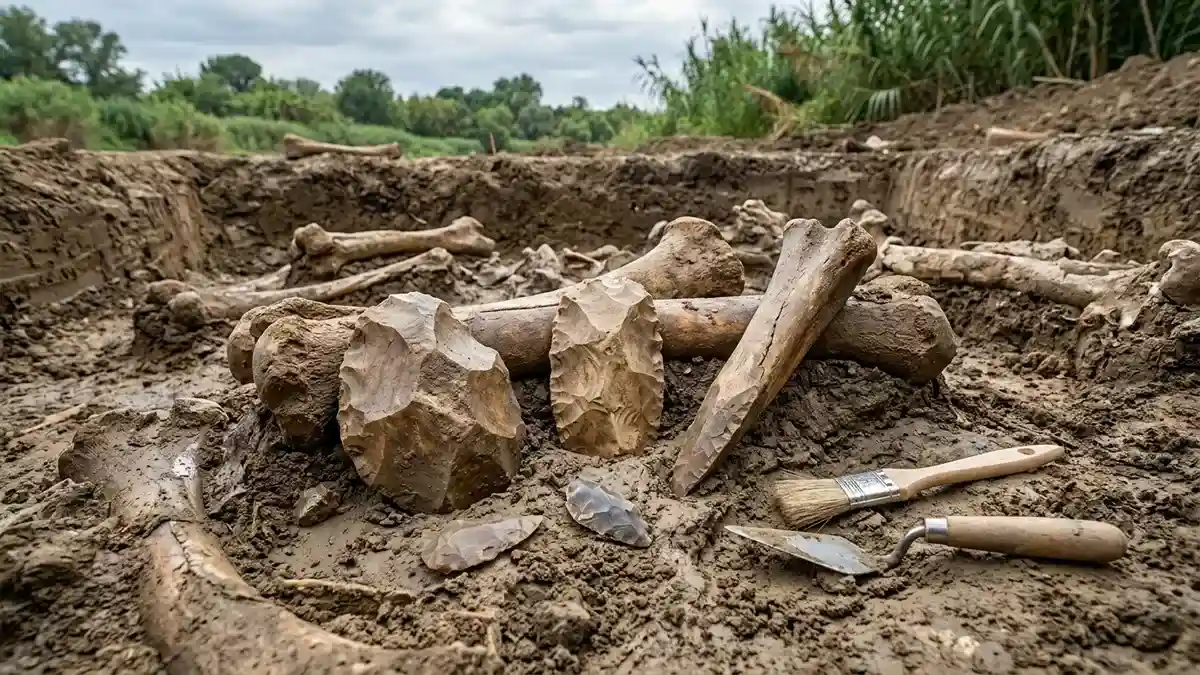
Rather than simply discarding the shattered pieces of elephant bone after eating the marrow, the hominins selected specific, heavy fragments of the elephant’s long bones. They intentionally flaked and shaped these thick pieces of bone, utilizing the exact same percussion techniques normally reserved for shaping stone.
By modifying the raw bone tissue, they created large, durable, and heavy-duty scrapers, choppers, and wedges. This combination of utilizing miniature stone tools for precision cutting and recycling massive animal bones for heavy-duty structural work demonstrates an extraordinary level of behavioral flexibility and technological adaptation.
A Natural Trap or an Intentional Hunt?
Given the immense size of Palaeoloxodon antiquus, researchers believe it is highly probable that this specific elephant died of natural causes or became accidentally immobilized. The marshy, muddy conditions of the Tiber River delta could easily trap a heavy, aging, or injured elephant, leaving it vulnerable.
However, archaeologists have not entirely ruled out the possibility that a well-coordinated band of early humans intentionally drove the giant beast into the deep mud to isolate it. Regardless of whether the animal was actively hunted or opportunistically scavenged, the sheer logistics of processing such a monumental amount of meat before it spoiled required a highly organized social structure, clear communication, and shared technical knowledge.
Identifying the Prehistoric Craftsmen
Who exactly were the toolmakers of Casal Lumbroso? Because Homo sapiens (modern humans) would not evolve for hundreds of thousands of years, and classic Neanderthals were still millennia away from appearing on the landscape, the prime candidates are two earlier human species: Homo heidelbergensis or late populations of Homo erectus.
Both ancestral lineages are well-documented throughout Europe during this timeframe. The sophisticated tool-crafting and resource management on display at Casal Lumbroso indicate that these archaic human species possessed cognitive abilities, planning skills, and food-processing expertise that far exceed what scientists previously attributed to humans of this era.
Rome’s Prehistoric Corridor
The Casal Lumbroso site does not stand alone. It belongs to a prestigious cluster of Middle Pleistocene archaeological sites located in central Italy near present-day Rome, which includes other world-famous locations like Castel di Guido and La Polledrara di Cecanibbio.
Together, this network of ancient sites proves that the Italian peninsula was a critical geographic corridor for early human evolution. During the region’s warm climatic phases, our ancestors repeatedly converged on these fertile valleys, using their intelligence, collective cooperation, and raw determination to conquer the challenges of a wild, changing world.
Conclusion
The ancient delta of Casal Lumbroso serves as a powerful testament to human resilience. When confronted with a monumental resource but limited raw materials, our ancient ancestors did not give up—they innovated. By turning an elephant’s skeleton into a toolkit, these early Europeans left behind an enduring legacy of resourcefulness that continues to challenge our understanding of human history.
Frequently Asked Questions
How old is the Casal Lumbroso site, and how was it dated?
The site is approximately 404,000 years old. Scientists achieved rare dating accuracy by analyzing distinct layers of volcanic ash that settled directly above and below the archaeological remains, providing a secure geological time stamp.
What kind of elephant was found at the site?
Archaeologists uncovered the remains of Palaeoloxodon antiquus, commonly known as the straight-tusked elephant. These extinct giants were significantly larger than modern elephants, often weighing up to 10 tons.
Why did the early humans use bone tools instead of stone?
The local river delta lacked large, sturdy stones suitable for creating heavy handaxes. Because their stone flint tools were small (under 30 millimeters), the hominins innovated by shaping the thick, heavy leg bones of the elephant into the large cutting and scraping tools they needed.
Which human species lived in Italy 400,000 years ago?
Modern humans (Homo sapiens) and Neanderthals had not yet evolved at this time. The toolmakers at Casal Lumbroso were most likely Homo heidelbergensis or Homo erectus, both of which populated Europe during the Middle Pleistocene.
What does this discovery tell us about early human behavior?
It proves that early humans possessed advanced cognitive abilities, social cooperation, and technological adaptability. The coordinated effort required to process a massive carcass and fashion bone tools shows they were highly resourceful problem-solvers.