
Table of Contents
**Rare 2,500-Year-Old Votive Statue Bases Unearthed in Cyprus Sanctuary**
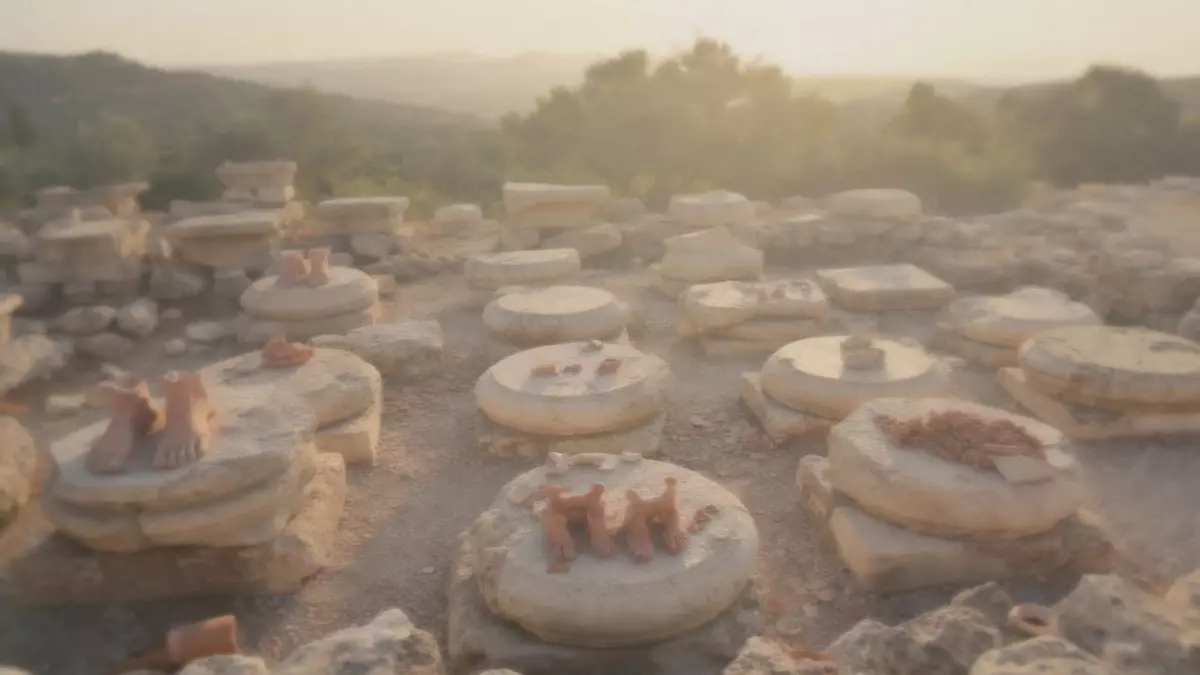
Archaeologists have just revealed an extraordinary find at a remote sanctuary in Cyprus that has rewritten our understanding of ancient religious practices. More than 20 limestone votive statue bases—many still exactly where they stood over 2,500 years ago—have been uncovered at the Sanctuary of Apollo in Frangissa, near the village of Pera Oreinis. These carefully preserved foundations offer the first clear evidence of how worshippers accumulated offerings inside Cypriot sanctuaries across centuries.
Led by Matthias Recke of Goethe University Frankfurt and Philipp Kobusch of the University of Rostock, the latest excavation season (the fifth at the site) delivered some of the strongest proof yet that the sanctuary was active during the Archaic period. This rural sanctuary was first brought to light in 1885 by German archaeologist Max Ohnefalsch Richter, but his work remained poorly documented and the precise location was later forgotten. Modern fieldwork, guided by precise GPS and historical records, relocated the site and let researchers excavate both previously dug areas and untouched sections.
Rare 2,500-Year-Old Votive Statue Bases Unearthed in Cyprus Sanctuary
The newly found bases stood out because they had never been disturbed since antiquity. Earlier excavations had already removed hundreds of these same limestone platforms and reused them as fill material when the sanctuary was deliberately backfilled. Inside those old backfill layers, the current team recovered more than 100 additional fragments—proof that the original site had been carefully leveled and covered long ago.
Several of the newly discovered limestone bases still held the feet of the statues that once stood upon them. Terracotta feet and pieces of clay figurines were also recovered, giving archaeologists their first archaeological proof in Cyprus that worshippers placed terracotta votive figures on specially crafted stone platforms rather than setting them directly on the ground or inside natural rock-cut niches.
### How Offerings Built Up Over Time
The arrangement of these bases tells a fascinating story of gradual accumulation. In some spots, the stones were packed so tightly that they formed layered piles—older bases placed beneath newer ones—while still leaving plenty of space for both sets of statues to remain visible. This pattern represents the clearest evidence yet for the steady buildup of offerings inside the sanctuary.
Careful analysis of the soil layers shows that at certain moments, groups of bases were deliberately buried beneath fresh leveling deposits. Workers then raised the ground level and installed an entirely new collection of offerings on top. Researchers believe this major reorganization happened near the end of the Archaic period, likely as the sanctuary reached its peak popularity.
Excavators are now investigating the reasons behind these large-scale changes. Some traces suggest possible destruction or damage during that era, though a lack of available space may also have played a role as more and more worshippers brought new gifts. Either way, the site captured the dynamic life of a working sanctuary.
### First Evidence of the Sanctuary’s Archaic Phase
The discoveries also produced the first undisturbed deposits of Archaic pottery since modern excavations began. Until now, researchers had only pieced together clues from scattered sculpture fragments found in earlier seasons. These new statue bases and pottery layers finally give direct archaeological proof of intense activity during the Archaic period (roughly 600–500 BCE).
The site now offers an unusually well-preserved window into how Cypriot sanctuaries developed from the Archaic era into the Hellenistic period. By studying the exact placement of every base and the sequence of soil layers, archaeologists can reconstruct the ritual practices and social customs of worshippers who visited this remote sanctuary over several centuries.
Support for the project came from the Amricha Foundation in Leipzig and Argo Frankfurt.
### Frequently Asked Questions About the Cyprus Votive Statue Bases Discovery
**1. What exactly are votive statue bases?**
Votive statue bases are the stone platforms carved specifically to hold the feet of dedicatory statues or figurines. At this sanctuary, archaeologists found more than 20 of these limestone bases still in their original positions, many with the terracotta feet still attached.
**2. Why were these bases important for understanding Cyprus sanctuaries?**
They are the first archaeological evidence in Cyprus showing that terracotta votive figures were deliberately placed on prepared stone bases rather than simply set on the ground or in natural rock niches. This arrangement reveals precise ritual behavior that had never been documented before.
**3. How does the layering of bases show the sanctuary’s history?**
The bases were stacked in layers over centuries, with older groups deliberately buried under new leveling deposits. This pattern proves the site was actively used and reorganized multiple times, giving a clear timeline of growth from the Archaic period onward.
**4. When did the major changes to the sanctuary take place?**
Analysis of the soil layers points to a major reorganization near the end of the Archaic period. Some damage or space constraints may have prompted the rebuilding, after which a fresh set of offerings was installed on the elevated surface.
**5. Are there any other finds at the site besides the statue bases?**
Yes—more than 100 fragments from earlier excavations, terracotta feet, clay figurine pieces, and the first undisturbed Archaic pottery deposits. Together these items confirm the sanctuary’s peak activity during the Archaic era and its continued use into later periods.
**6. How did the location of the sanctuary get forgotten for so long?**
Max Ohnefalsch Richter’s 1885 excavations were only briefly documented. Without accurate maps or clear descriptions, the exact site near Pera Oreinis was lost for over a century until modern GPS and historical research relocated it.
**7. What can visitors expect if they visit the Sanctuary of Apollo in Frangissa today?**
The site is protected and accessible through guided tours arranged by the Cyprus Department of Antiquities. The preserved base arrangements remain one of the best examples in Cyprus for understanding how ancient sanctuaries were used and maintained over centuries.
This remarkable discovery not only deepens our knowledge of Cypriot religious life but also highlights the importance of careful, modern excavation techniques in unlocking the secrets of the past. The Sanctuary of Apollo at Frangissa continues to teach us about the enduring power of devotion in the ancient world.