
Table of Contents
- 1. Elite Status Unearthed: The Gold-Embellished Footwear
- 2. Preserved Medieval Industrial Zone and Workshops
- 3. The Forensic and Sourcing Phase of Research
- 4. Conclusion
- 5. Frequently Asked Questions
- 5.1. Why is the gold-decorated shoe fragment considered so rare?
- 5.2. What was the purpose of the millet-drying structure found at the site?
- 5.3. How does dark, carved pottery help archaeologists date the site?
- 5.4. What connection did Třebíč have with Znojmo?
- 5.5. Where can the public view the artifacts from this excavation?
Rare Gold-Decorated Shoe Found in Medieval Czech Town
A multi-year archaeological investigation in the historic center of Třebíč, Czech Republic, has uncovered a trove of medieval artifacts that reshape our understanding of the town’s twelfth-century origins. Situated in the region of Moravia, west of Brno, the extensive excavation campaign on Karlovo and Martinského squares has reached its final analytical phase, recently securing the prestigious Patrimonium pro futuro award from the National Heritage Institute for its contributions to regional history.
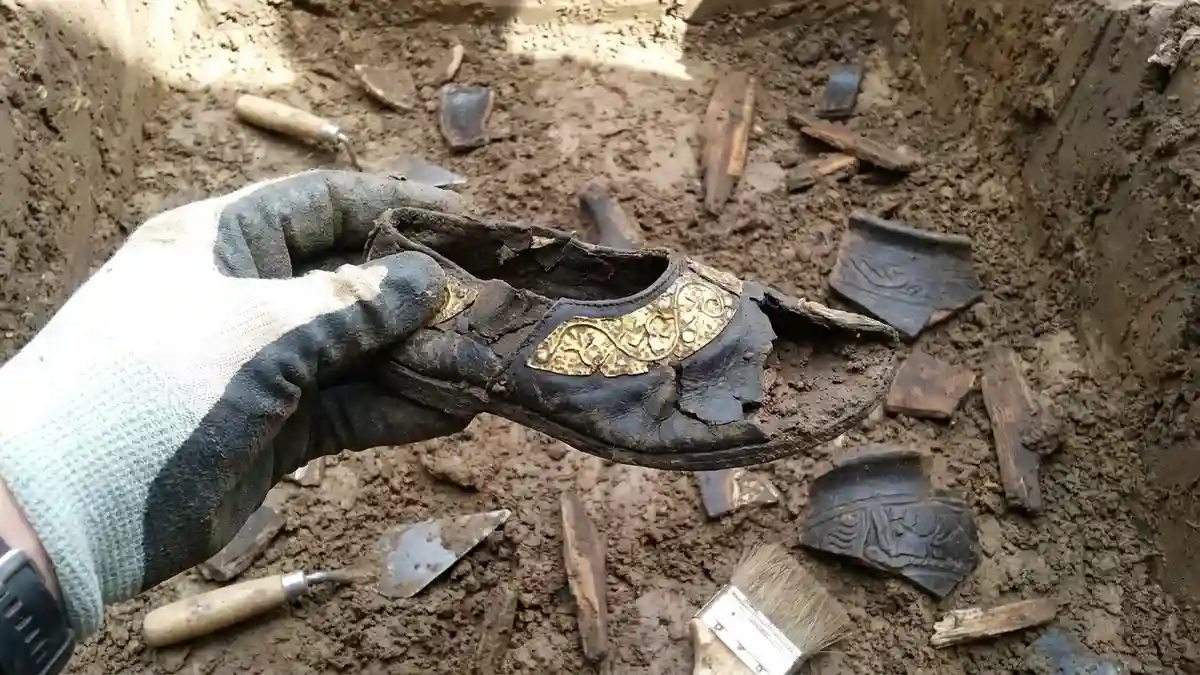
Among the subterranean discoveries, researchers found an entire preserved network of wooden workshops alongside high-status luxury items. The most remarkable find is a fragment of a leather shoe adorned with genuine gold decoration—an artifact so rare it indicates that high-ranking elites or prominent administrative officials inhabited the settlement far earlier than previously assumed.
Rare Gold-Decorated Shoe Found in Medieval Czech Town
Elite Status Unearthed: The Gold-Embellished Footwear
The discovery of the upper portion of a late 12th-century leather shoe detailed with pure gold motifs stunned the excavation team. Finding organic materials like leather preserved for over eight centuries is already an uncommon archaeological occurrence, but gold-ornamented footwear from this era is exceptionally rare across Central Europe. Prior to the Třebíč discovery, similar high-status footwear fragments had only been documented in a handful of major medieval hubs, such as Wrocław, Poland.
                  [Medieval Footwear Status Hierarchy]
  _________________________________________________________________
 | Elite Status:   | Gold-decorated leather, ultra-rare archaeologically |
 | Standard Class: | Plain carved leather, utilitarian construction     |
 | Common Class:   | Simple wrap shoes, woven fibers, or wooden clogs    |
  _________________________________________________________________
In medieval European iconography and illuminated manuscripts, gold-decorated shoes are depicted exclusively on royalty, high-ranking clergy, and the highest strata of the nobility. The presence of such a luxury item in Třebíč suggests that the early 13th-century settlement was not merely a cluster of agrarian homesteads. Instead, it served as a significant administrative or economic center, potentially maintaining close structural ties with the nearby ducal seat of Znojmo.
Preserved Medieval Industrial Zone and Workshops
Beneath the modern pavement of the town squares, archaeologists exposed a well-organized layout of industrial and domestic wooden structures dating back to the town’s infancy. The layout demonstrates that early Třebíč possessed a highly structured, self-sustaining economy capable of supporting specialized manufacturing and trade.
The excavated architectural remains include:

Blacksmith’s Workshop: Containing slag and metalworking debris, indicating local tool production and repair.
Bakery and Grain Facilities: Featuring specialized infrastructure, including an intact millet-drying facility designed to process and preserve staple grains against spoilage.
Timber-Processing Space: Providing evidence of localized carpentry, lumber management, and construction preparation.
Animal Stables: Providing structural evidence of livestock management and transport security within the urban core.

To aid in dating these architectural layers, researchers relied heavily on numerous fragments of dark, intricately carved pottery from the early 13th century. Because these specific ceramic styles were manufactured and utilized for only a few decades before production trends shifted, they serve as excellent chronological markers for mapping out exactly how fast the settlement expanded.
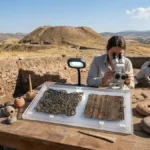
While many of the recovered artifacts have already transitioned into the permanent exhibitions at the Třebíč Museum, a significant portion of the material remains undergoing laboratory analysis.
The Forensic and Sourcing Phase of Research
As the field excavation concludes, the scientific focus has shifted toward laboratory analysis, cataloging, and sourcing materials to understand the town’s broader trade connections.
Among the sensitive items currently undergoing anthropological study are human remains linked to medieval executions. Forensic analysis of these skeletons aims to clarify historical judicial practices, execution methods, and the social standing of the condemned within the early Moravian community.
Simultaneously, geoarchaeologists are tracing the raw materials utilized by the town’s earliest builders and craftsmen. By analyzing the chemical composition of the recovered artifacts, specialists are determining the geographical origins of:
Graphite and Clay: Used in pottery manufacturing, specialized industrial mortars, and durable floor coatings.
Building Stone: Sourced to pinpoint the precise quarries used to construct the town’s earliest permanent foundations.
This provenance data will ultimately provide a detailed picture of the region’s trade networks, revealing how early Třebíč interacted with, supplied, or dominated the surrounding medieval landscape.
Conclusion
The excavations at Třebíč have successfully bridged the gap between historical text and physical reality, proving that the 12th-century Moravian settlement was an organized, economically diverse, and socially complex hub. From the gritty realities of blacksmithing and grain processing to the elite spheres symbolized by a gold-trimmed shoe, the site offers an invaluable record of daily life, class division, and industrial organization at the dawn of high medieval urbanism.
Frequently Asked Questions
Why is the gold-decorated shoe fragment considered so rare?
Leather rarely survives centuries in subsoil conditions without decomposing. Furthermore, shoes decorated with real gold motifs were reserved exclusively for top-tier medieval elites. Finding physical evidence of such luxury outside of massive medieval capitals is an extraordinary rarity in Central European archaeology.
What was the purpose of the millet-drying structure found at the site?
Millet was a primary dietary staple in medieval Moravia. Because damp grains rot quickly in storage, drying facilities were critical pieces of agricultural infrastructure. They used controlled, indirect heat to lower the moisture content of harvested grain, ensuring long-term food security for the settlement.
How does dark, carved pottery help archaeologists date the site?
Styles of medieval pottery changed rapidly due to shifting technology and consumer preferences. Because this specific type of dark, carved pottery was only produced and utilized for a narrow window of a few decades in the early 13th century, finding it in a specific soil layer tells archaeologists exactly when that layer was formed.
What connection did Třebíč have with Znojmo?
While the exact political structure is still being studied, the presence of high-status administrative items like the gold shoe suggests Třebíč may have operated under the administrative influence or partnership of Znojmo, which was a vital regional power center and ducal seat during the early 1200s.
Where can the public view the artifacts from this excavation?
A vast array of the recovered artifacts, including early medieval pottery, tools, and daily household items, have been cleaned, conserved, and integrated into the permanent historical exhibitions at the Třebíč Museum.