
Table of Contents
- 1. The Falling Cliff of Bagicz
- 2. Outfitting a “Princess” for the Afterlife
- 3. The 100-Year Dating Contradiction
- 4. Dendrochronology: Nature’s Ultimate Chronometer
- 5. The “Hard Water Effect” and the Seafood Trapping Trick
- 6. Where Did the Princess Come From?
- 7. Frequently Asked Questions
- 7.1. Why was she originally called a “princess”?
- 7.2. What is the difference between radiocarbon dating and dendrochronology?
- 7.3. How does a fish diet ruin a carbon dating test?
- 7.4. What was the Wielbark culture?
- 7.5. Where is the coffin of the Princess of Bagicz now?
Tree Rings Resolve Mystery of Poland’s Roman-Era “Princess” Log Coffin
A interdisciplinary scientific investigation has finally resolved a century-old dating conflict surrounding one of Poland’s most famous archaeological treasures: the “Princess of Bagicz.” Discovered at the turn of the 20th century, this rare Roman-era log coffin burial has long puzzled historians due to wildly contradictory timelines. Now, by using tree rings to cut through the confusion, scientists have unlocked the true chronology of the grave—while exposing a fascinating environmental anomaly that threw off previous carbon dating tests.
The study, published in the journal Archaeometry, demonstrates how an ancient person’s local diet can accidentally trick modern laboratory equipment, proving why multiple scientific disciplines are required to accurately piece together the past.
Tree Rings Resolve Mystery of Poland’s Roman-Era Princess Log Coffin
The Falling Cliff of Bagicz
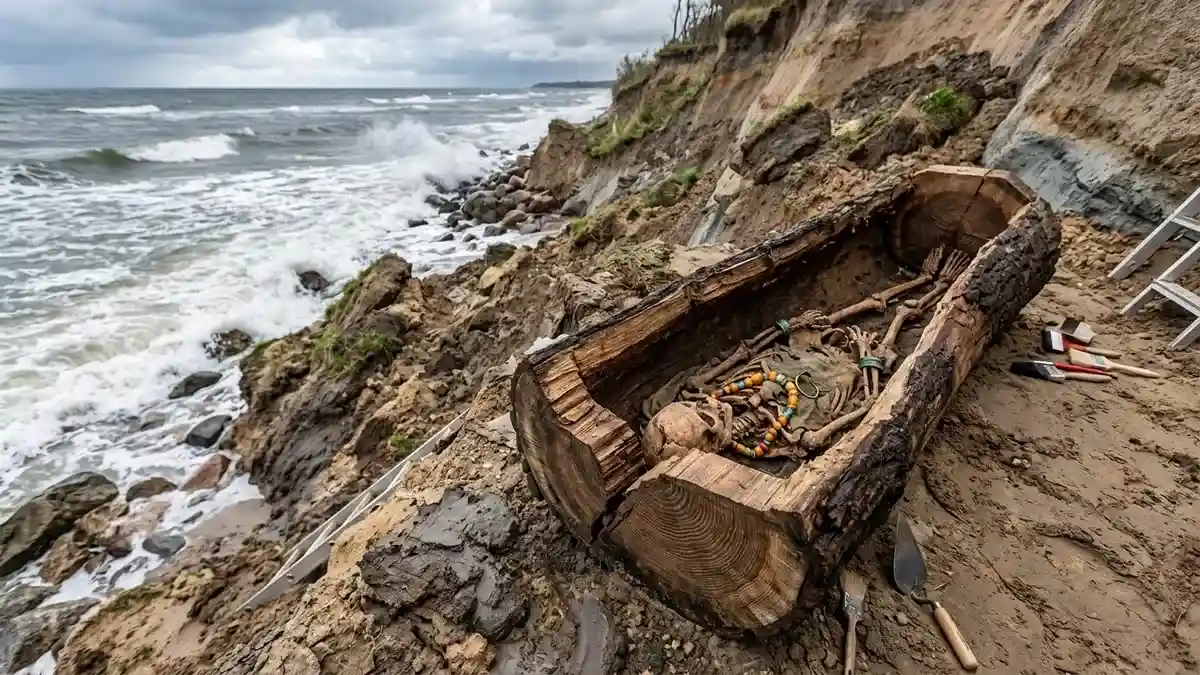
The story of the Princess began in 1898 along the coastal cliffs near Bagicz in northwestern Poland. The Pomeranian shoreline is notoriously unstable, with heavy Baltic waves and winter winds eroding the coast by as much as one meter every single year. This aggressive natural erosion eventually caused a chunk of the cliffside to collapse, exposing a hollowed-out oak log coffin buried deep within the earth.

Inside the log sat the remarkably preserved skeleton of a young woman. Archaeologists quickly tied the burial to the Wielbark culture, an Iron Age society active across northern Poland between the 1st and 4th centuries CE. The Wielbark people were known for unique mortuary practices, frequently burying their dead in hollowed logs or graves meticulously lined with organic twigs.
Because the acidic, sandy soil of the Pomerania region quickly destroys organic matter, wood almost never survives here. This oak coffin survived against all odds, standing as the only well-preserved specimen of its kind recovered from the region.
Outfitting a “Princess” for the Afterlife
The sheer wealth of the artifacts buried alongside the young woman led early researchers to believe she was a member of royal or elite status, affectionately dubbing her the “Princess of Bagicz.”

[Grave Goods Found Inside the Oak Log]
├── Ornaments: 1 Bronze Fibula (brooch) & 1 Fine Pin
├── Jewelry: 2 Matching Bronze Bracelets
├── Adornments: 1 Necklace of Imported Glass & Amber Beads
└── Organic matter*: 1 Small Wooden Stool & 1 Cattle Hide Cover
    (*Faded/Destroyed during early 1898 excavation handling)
While early reports claimed she was buried on top of a cattle hide and accompanied by a small wooden stool, those delicate organic items crumbled shortly after exposure to the air. However, her jewelry survived perfectly. She wore a bronze fibula (a decorative clasp used to fasten clothing), a fine pin, two matching bronze bracelets, and a striking necklace strung with beads made of glass and precious local Baltic amber.
While early 19th-century historians assumed her wealthy grave was isolated—a classic sign of royalty—subsequent archaeological digs revealed she was actually part of a much larger, organized community cemetery.
The 100-Year Dating Contradiction
For decades, determining exactly when the “Princess” lived was an archaeological battleground. The timeline was split across two conflicting methodologies:

+-------------------------------------------------------------+
|              THE 100-YEAR DATELINE DISCREPANCY              |
+----------------------+--------------------------------------+
| Methodology          | Resulting Timeline                   |
+----------------------+--------------------------------------+
| Typological Styling  | 110 CE – 160 CE                      |
| (1980s Art Analysis) | (Mid-Roman Iron Age)                 |
+----------------------+--------------------------------------+
| Radiocarbon Dating   | 113 BCE – 65 CE                      |
| (2018 Tooth Sample)  | (Pre-Roman / Late Iron Age)          |
+----------------------+--------------------------------------+
In the 1980s, historians analyzed the stylistic design of her bronze jewelry and amber beads. This method, known as typological dating, placed her burial between 110 and 160 CE.
However, in 2018, scientists conducted advanced radiocarbon ($^{14}\text{C}$) dating on one of her teeth. The laboratory results spit out a vastly different timeline, dating her death between 113 BCE and 65 CE with high statistical probability. The two methods were at war, separated by nearly a century.
Dendrochronology: Nature’s Ultimate Chronometer
To settle the dispute once and for all, the current research team turned away from the human remains and focused their attention directly on the ancient lumber. They applied dendrochronology—the science of analyzing and counting the annual growth rings inside wood—to the exceptionally preserved oak log coffin.
[Dendrochronological Alignment]
Standard Regional Oak Timeline:  ||| | || |||| | ||| | |||||
Bagicz Coffin Tree-Ring Pattern:      | || |||| | ||| (Felled ~120 CE!)
By measuring the precise width of the oak’s growth rings and cross-referencing the pattern against established historical climate timelines for Northern Europe, the team found a perfect match. The data revealed that the massive oak tree used to craft the coffin was cut down around 120 CE (with a tiny error margin of just seven to eight years).
This tree-ring breakthrough perfectly validated the original 1980s jewelry analysis, proving the coffin was built in the early second century CE. But it left one glaring question: Why did the radiocarbon testing on her tooth say she was 100 years older?
The “Hard Water Effect” and the Seafood Trapping Trick
The research team solved the mystery of the faulty carbon dating by analyzing the stable isotopes within the woman’s bones to see what she ate during her lifetime. The results showed she consumed massive amounts of animal protein, with a heavy emphasis on freshwater fish and river organisms.
This dietary preference triggered a well-known scientific anomaly called the reservoir effect (specifically, the “hard water effect”).
[How the Hard Water Effect Confused the Carbon Date]
1. Ancient limestone dissolves -> Releases ultra-ancient, carbon-depleted carbonate into rivers.
2. Aquatic ecosystem -> Fish and river organisms absorb this "old" carbon.
3. The Princess's diet -> She regularly eats local freshwater fish.
4. Modern Radiocarbon Test -> Her bones test as 100 years older than her true death date.
The rivers and lakes of northwestern Poland flow through areas rich in ancient, dissolved limestone. This limestone contains ancient carbon that is entirely depleted of radioactive $^{14}\text{C}$. When fish, snails, and aquatic plants live in this “hard water,” they absorb this artificially old carbon signature into their bodies.
Because the young woman ate a diet heavy in these freshwater fish, her body built its bones and teeth using that ancient, depleted carbon. When modern scientists tested her tooth in 2018, the machine read the old limestone carbon, making her appear to have died a century before the oak tree was ever chopped down.
Where Did the Princess Come From?
With her true era established, scientists turned to strontium isotope analysis to figure out her geographic origins. Strontium signatures absorb from local soil and water into tooth enamel during childhood, acting as a geological signature of a person’s hometown.
Her specific strontium values closely mirror signatures found across parts of southern Scandinavia, including the island of Öland. This initially led researchers to wonder if she was an early Viking-precursor migrant crossing the Baltic Sea.
However, ancient glacial deposits from the last Ice Age left identical geological footprints across the local Pomerania region of Poland. Because the soil signatures of her burial site match the soil signatures of Scandinavia, scientists cannot definitively prove whether she was a well-traveled immigrant or a local Pomeranian woman.
Regardless of her birthplace, the multidisciplinary study successfully rescued the Princess of Bagicz from a chronological limbo, providing a vital warning to future archaeologists about the hidden traps of relying solely on a single dating method.
Frequently Asked Questions
Why was she originally called a “princess”?
When her grave was pulled from the eroding cliffside in 1898, it was found entirely alone and packed with elite luxury goods, such as bronze bracelets, imported glass, and valuable amber necklaces. In 19th-century archaeology, wealthy, isolated graves were automatically assumed to belong to royalty. Modern excavations have since proved she was simply buried in a civilian community cemetery.
What is the difference between radiocarbon dating and dendrochronology?
Radiocarbon dating measures the decay of the radioactive carbon-14 isotope in organic materials (like bones or charcoal) to estimate when an organism died. Dendrochronology, on the other hand, is the physical science of counting and matching the unique patterns of annual growth rings inside ancient wood against an absolute master calendar of historical tree growth.
How does a fish diet ruin a carbon dating test?
If a fish lives in a river fed by ancient limestone, it absorbs “old carbon” that has zero radiocarbon left in it. If a human eats that fish constantly, their body absorbs that old carbon to build bones. When modern laboratories test those bones, the lack of radiocarbon makes the skeleton appear centuries older than it actually is. This is known as the freshwater reservoir effect.
What was the Wielbark culture?
The Wielbark culture was an Iron Age societal group that flourished in what is now northern and eastern Poland from the 1st to the 4th centuries CE, frequently associated with early Germanic tribes like the Goths. They are highly recognizable in the archaeological record for their intricate metal jewelry, lack of weapons in graves, and use of organic materials like log coffins.
Where is the coffin of the Princess of Bagicz now?
Following its discovery in 1898, the historic oak log coffin and her accompanying bronze and amber jewelry were preserved and placed on public display in local regional museums in Poland, where it remains an essential artifact for studying Roman Iron Age interactions along the Baltic Coast.