
Table of Contents
- 1. The Resilient Hunters of the Baltic Coast
- 2. Inside the Shared Graves of Ajvide
- 3. Moving Beyond the Nuclear Family
- 3.1. The Protectress Who Wasn’t Mom
- 3.2. Reunited in Death
- 3.3. The Rest of the Shared Graves
- 4. Mapping the Wider Island Network
- 5. Expanding the Prehistoric Narrative
- 6. Frequently Asked Questions
- 6.1. Why is the Pitted Ware Culture called by that name?
- 6.2. Why did these people remain hunter-gatherers when farming was popular?
- 6.3. How do geneticists determine the exact degree of family relationships?
- 6.4. What does “disarticulated bones” mean in a burial context?
- 6.5. Is the Ajvide cemetery unique to Sweden?
Ancient DNA Reveals Extended Family Ties in 5,500-Year-Old Stone Age Graves
A profound archaeological investigation on the Swedish island of Gotland is completely altering our understanding of prehistoric social structures. By analyzing ancient DNA from a 5,500-year-old cemetery, a team of geneticists and archaeologists has managed to reconstruct the intricate family trees of Europe’s last hunter-gatherers.
The findings reveal that these Stone Age communities possessed an incredibly sophisticated understanding of their genealogical lines. Rather than organizing their society purely around the standard nuclear family, these coastal people maintained deep, meaningful social and ceremonial bonds with their extended kin—bonds that directly dictated how they were laid to rest.
Ancient DNA Reveals Extended Family Ties in 5,500-Year-Old Stone Age Graves
The Resilient Hunters of the Baltic Coast
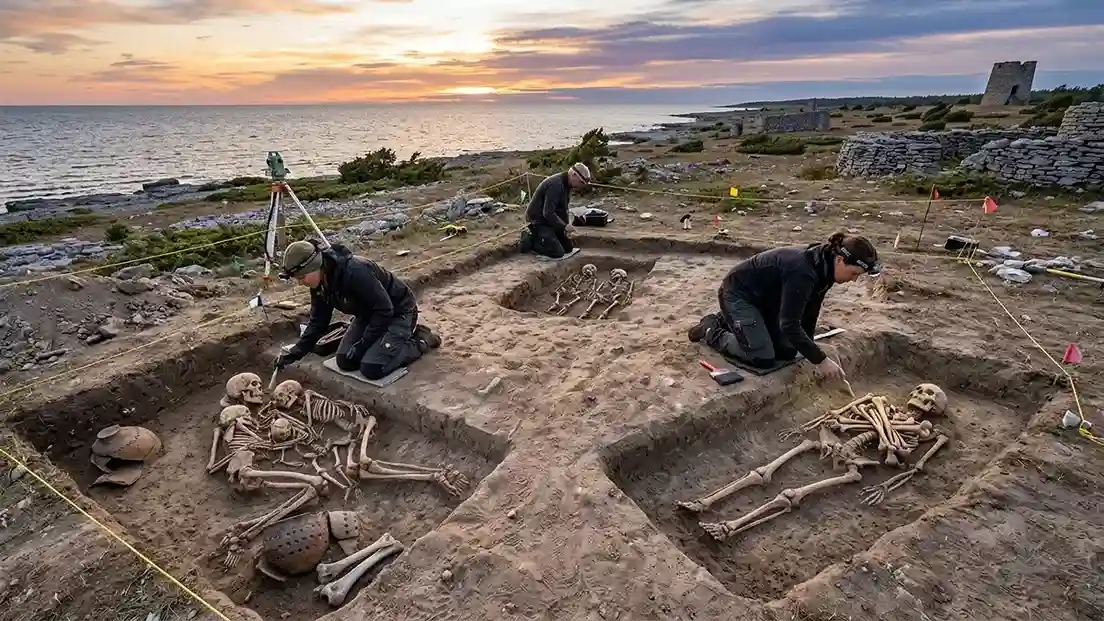
The focus of this landmark study is the sprawling archaeological site of Ajvide, located on the western coast of Gotland in the Baltic Sea. Ajvide is widely recognized as one of Scandinavia’s most significant Stone Age treasures, yielding an abundance of incredibly well-preserved artifacts, animal bones, and human remains.
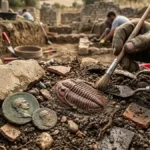
The people who lived and died here belonged to the Pitted Ware Culture, a distinct population that flourished in southern Scandinavia between 3500 and 2300 BCE. What makes the Pitted Ware Culture so fascinating to anthropologists is their stubborn rejection of the status quo.
[The European Neolithic Divide]
Central/Southern Europe: =======> Organized Agriculture & Farming Lifestyles
Baltic Coast (Pitted Ware): ====> Maritime Foraging, Deep-Sea Fishing, Seal Hunting
By 3500 BCE, agriculture and farming lifestyles had swept across the vast majority of continental Europe. Yet, the Pitted Ware communities of Gotland actively chose to stick to their ancient traditions, carving out a prosperous maritime existence centered almost entirely around fishing, foraging, and hunting seals.
Inside the Shared Graves of Ajvide
The Ajvide burial ground contains at least 85 known flat-earth graves. While the majority of these resting places feature single occupants, eight specific graves stand out because they contain the remains of two or more individuals buried simultaneously or sequentially.
 10th-Century Bronze Cross Found in Germany Reveals Early Christian Influence on Slavic Tribes
To map out the biological connections within these shared tombs, a collaborative team of researchers from Uppsala University and the University of Oulu extracted genomic material from the teeth and skeletal remains of 10 individuals buried across four shared graves. They then compared this data with the existing genomes of 24 other Pitted Ware individuals found across Gotland.
+-------------------------------------------------------------+
|            GENETIC MEASUREMENTS OF ANCIENT KINSHIP          |
+----------------------+--------------------------------------+
| Degree of Relation   | Percentage of Shared DNA             |
+----------------------+--------------------------------------+
| First-Degree         | ~50% (Parents, Full Siblings, Kids)  |
| Second-Degree        | ~25% (Half-Siblings, Aunts, Uncles)  |
| Third-Degree         | ~12.5% (First Cousins, Great-Aunts)  |
+----------------------+--------------------------------------+
The genetic results, published in the journal Proceedings of the Royal Society B, were definitive: every single shared grave examined contained biological relatives. However, the exact configuration of these relationships shattered previous archaeological assumptions.
Moving Beyond the Nuclear Family
For decades, archaeologists assumed that multi-person prehistoric graves represented standard nuclear families—such as a mother buried alongside her children following a sudden illness. The ancient DNA from Ajvide paints a much more complex picture of community care and fostering.
The Protectress Who Wasn’t Mom
In one of the most emotionally evocative graves at the site, archaeologists found the skeleton of a young woman who died in her twenties. Nestled protectively on either side of her were two very young children: a four-year-old boy and a 1.5-year-old girl.
While a visual assessment of the grave layout strongly suggested a tragic maternal scene, the DNA analysis told an entirely different story:
The two young children were indeed full biological siblings.
The adult woman was not their mother.
Genetically, she shared roughly 25% of her DNA with the children, making her their paternal aunt (their father’s sister) or a paternal half-sister.
This layout provides powerful evidence for an extended childcare network. This woman held significant, protective responsibility for these siblings in life—and presumably in death—acting as a primary caregiver even though she was not their biological mother.
Reunited in Death
A second dramatic burial configuration contained a teenage girl, aged roughly 12 to 14, laid flat on her back. Stacked directly on top of and beside her chest was a jumbled, disarticulated cluster of bones belonging to an adult male.
The DNA tests verified a clear first-degree, parent-offspring relationship, confirming the man was her biological father. Because the father’s skeletal remains were entirely scrambled and bundled together, archaeologists deduce that he had died much earlier at a different location.
When his young daughter passed away years later, members of the community took the extraordinary step of exhuming the father’s older bones, bundling them up, and reburying them alongside his daughter. This deliberate ritual underscores a deep cultural desire to preserve family continuity across generations.
The Rest of the Shared Graves
The remaining two co-burials further highlighted the immense social value placed on wider kinship circles, with both graves heavily featuring children alongside more distant relatives:
The Cousin Grave: A third shared burial pit contained two children—a boy and a girl. Their genomic data showed they shared approximately one-eighth of their DNA, identifying them as third-degree relatives, most likely first cousins.
The Great-Aunt Burial: The final examined grave paired a young girl aged 8 to 10 with a young adult woman. They were also confirmed to be third-degree relatives, pointing to a family connection such as a great-aunt or a cousin.
Mapping the Wider Island Network
By analyzing sex chromosomes, the team was able to precisely identify the biological sex of the buried children, a task that is traditionally impossible using standard bone analysis since child skeletons do not display clear gender variations.
The macro-genetic data also revealed that the Pitted Ware population on Gotland carried a unique dual genetic heritage. They derived roughly 80% of their ancestry from older Mesolithic hunter-gatherers and about 20% from Neolithic farming groups that had migrated into neighboring regions.
“Finding close biological relatives scattered across completely different archaeological sites on Gotland indicates a highly connected network. These distinct coastal bands were regularly interacting, traveling, and intermarrying with one another to maintain a healthy island-wide population.”
— Uppsala University Archaeogenetics Team
Expanding the Prehistoric Narrative
Well-preserved multi-burial sites from hunter-gatherer societies are incredibly rare global finds, making the pristine conditions at Ajvide an invaluable baseline for ancient sociology. The pilot study has successfully proven that kinship in the Stone Age extended far past the walls of a single household, heavily shaping their spiritual and mortuary decisions.
The international research team is far from finished. With the pilot study yielding such profound insights, scientists now plan to run advanced genomic sequencing on more than 70 additional individuals recovered from the Ajvide cemetery. This massive undertaking promises to completely map out the mobility, survival strategies, and profound emotional lives of northern Europe’s final hunter-gatherers.
Frequently Asked Questions
Why is the Pitted Ware Culture called by that name?
The culture is named after its highly distinctive ceramic pottery style. Archaeologists tracking these ancient communities consistently uncover clay cooking and storage vessels that are heavily decorated with unique, deep pits and geometric finger-impressions pushed into the clay before firing.
Why did these people remain hunter-gatherers when farming was popular?
The Pitted Ware people occupied an incredibly rich maritime ecological niche. The waters around the island of Gotland were teeming with fish and massive seal colonies, which provided a highly predictable and abundant source of protein, fats, and materials. Because their coastal foraging lifestyle was so successful, they felt no economic pressure to abandon their traditional ways for the labor-intensive demands of farming.
How do geneticists determine the exact degree of family relationships?
Scientists measure relatedness by calculating the precise percentage of identical single-nucleotide polymorphisms (SNPs) shared between two DNA samples. Because the human genome shuffles predictably during reproduction, parents and children share 50% (first-degree), aunts and nieces share 25% (second-degree), and first cousins share 12.5% (third-degree) of their genetic material.
What does “disarticulated bones” mean in a burial context?
Disarticulated bones refer to skeletal remains that are no longer arranged in a natural, anatomically correct structure. This occurs when an individual passes away and decomposes elsewhere, and their dry bones are later gathered up, bundled together, and transported to a final communal resting place long after the soft tissue has faded away.
Is the Ajvide cemetery unique to Sweden?
Yes, Ajvide is exceptionally rare due to its preservation level. While other Stone Age flat-earth cemeteries exist across Northern Europe, very few feature the specific soil chemistry and lack of modern agricultural disruption that allowed delicate human bones and teeth to survive intact for 5,500 years, making it a crown jewel for ancient DNA extraction.