
Table of Contents
- 1. Unearthing a 3.5-Ton Treasure Trove from the Seabed
- 2. Dating a Lost Voyage Through Ceramic Fingerprints
- 3. The Anatomy of an Island-Bound Chinese Junk
- 4. Proving the Intended Destination: Why Temasek?
- 5. Shattering the Myth of a Sleepy Fishing Village
- 6. A Golden Reference Collection for Global Archaeology
- 7. Frequently Asked Questions
- 7.1. What does the word “Temasek” mean?
- 7.2. Why is Jingdezhen porcelain so famous and valuable?
- 7.3. What is the difference between celadon and blue-and-white porcelain?
- 7.4. How did the archaeologists manage to retrieve 3.5 tonnes of pottery?
- 7.5. Where can I see the artifacts from the Temasek Wreck today?
14th-Century Shipwreck Rewrites Singapore’s Precolonial History
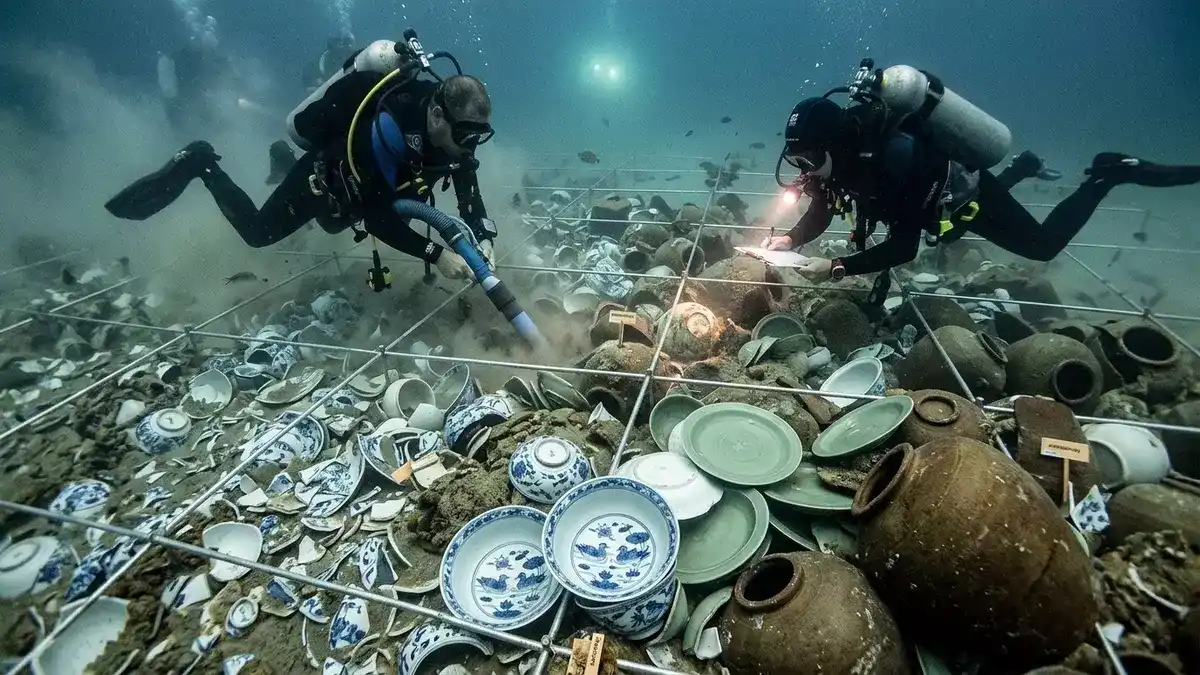
A monumental maritime excavation off the coast of Singapore has brought to light the oldest known shipwreck ever discovered in the nation’s territorial waters. Dubbed the Temasek Wreck, the vessel sank over six centuries ago, leaving behind a massive cargo of imperial-grade Chinese ceramics. The recovery provides irrefutable physical proof that 14th-century Singapore was not a sleepy, isolated fishing village as long-running historical myths claimed, but rather a wealthy and dynamic global trading port.
Dating between 1340 and 1352, the ill-fated merchant vessel went down during an era when the island was known natively as Temasek. Acting as a thriving maritime gateway (or entrepôt), this ancient settlement served as a critical nexus connecting regional Southeast Asian trade lanes with long-distance networks spanning all the way to the Middle East.
14th-Century Shipwreck Rewrites Singapore’s Precolonial History
Unearthing a 3.5-Ton Treasure Trove from the Seabed
The intensive underwater recovery project spanned four years, running from 2016 to 2019. Working carefully against tricky currents and low visibility, a dedicated team of marine archaeologists managed to salvage roughly 3.5 tonnes (7,700 pounds) of ancient ceramic artifacts from the ocean floor.
 Ancient Birch Tar Reveals How Europe’s First Farmers Chewed, Cooked, and Crafted 6,000 Years Ago
While the vast majority of the recovered items consist of fractured shards smashed by centuries of shifting currents, scientists successfully brought up a spectacular assortment of completely intact or nearly pristine vessels.
[Temasek Wreck Ceramic Cargo Profile]
├── High-Value Porcelain: 136 kg of Jingdezhen Blue-and-White Ware
├── Elite Tableware: Longquan Celadon & Shufu/Qingbai Plates
├── White Porcelain: Dehua Whiteware & Fujian Greenware
└── Bulk Containers: Heavy Cizao Brown Stoneware Storage Jars
Most notably, the haul contains approximately 136 kilograms (300 pounds) of rare, high-grade blue-and-white porcelain originating from China’s legendary Jingdezhen kilns. This represents the single largest concentration of Yuan dynasty blue-and-white porcelain ever recovered from a single documented shipwreck anywhere on Earth.
Dating a Lost Voyage Through Ceramic Fingerprints
The artifact collection was analyzed by maritime expert Dr. Michael Flecker of Heritage SG, a specialized research division under the Singapore National Heritage Board. His comprehensive study, published in the Journal of International Ceramic Studies, meticulously scrutinized the decorative motifs, firing technologies, and factory origins of the pottery to narrow down the exact timeline of the vessel’s final journey.
Several premium blue-and-white porcelain bowls feature an incredibly specific, repeated artistic design: mandarin ducks swimming peacefully through a flowering lotus pond.
Art historians know that the mass production of this precise waterfowl motif was restricted to a remarkably brief historical window during the twilight of the Mongol-led Yuan dynasty. Shortly after this window, widespread civil unrest and rebellions disrupted China’s southern kiln industries, altering ceramic styles completely. This tight stylistic boundary allows experts to confidently pin the ship’s sinking to the exact mid-14th century window of 1340–1352.

The Anatomy of an Island-Bound Chinese Junk
Although the tropical water chemistry and hungry marine woodborers completely devoured the ship’s wooden hull centuries ago, the unique composition of the remaining cargo leaves little doubt about the vessel’s identity. The specific assortment of items points directly to a large Chinese merchant junk.
Geographic indicators suggest the ship was initially loaded and cleared for departure at the bustling megaport of Quanzhou in southeastern China, a prominent starting point for the maritime Silk Road.
+-------------------------------------------------------------+
|              CARGO SPLIT: LUXURY VS. COMMODITY              |
+----------------------+--------------------------------------+
| Ceramic Category     | Practical Trade Function             |
+----------------------+--------------------------------------+
| Fine Jingdezhen Ware | High-end luxury tableware for elites |
| Longquan Celadon     | Premium status symbols & dinnerware  |
| Brown Cizao Jars     | Heavy industrial storage for food    |
|                      | and bulk commodities                 |
+----------------------+--------------------------------------+
The dual nature of the manifest proves the ship was a high-capacity merchant vessel designed to maximize profit. It carried ultra-luxurious dinnerware destined for wealthy elites alongside massive, thick-walled brown stoneware jars from the Cizao kilns, which were packed with perishable foodstuffs, spices, or liquid commodities traded in bulk.
Proving the Intended Destination: Why Temasek?
To figure out exactly where the merchant captain was steering his valuable ship, researchers cross-referenced the shipwreck’s ceramics against thousands of broken pottery fragments uncovered during urban land excavations across mainland Singapore.
The structural and artistic matches were stunning. The specific floral patterns, sizing, and clay recipes of the smaller bowls and elegant flanged-neck vases pulled from the ocean floor matched fragments unearthed at the historic palace grounds of Fort Canning Hill and other downtown historical sites.
Even more revealing was what the shipwreck did not contain. During the 14th century, Chinese potters manufactured massive blue-and-white platters measuring 40 to 50 centimeters in diameter specifically tailored for communal dining customs in India and the Middle East.
Not a single large platter was found within the Temasek Wreck’s extensive cargo block; all the recovered dishes measure under 35 centimeters across—a size optimized specifically for the Southeast Asian and local Temasek markets. This deliberate omission confirms that the vessel was not passing through to the Indian Ocean; its journey was meant to end right in Singapore.
Shattering the Myth of a Sleepy Fishing Village
For nearly two centuries, standard history textbooks and popular accounts painted precolonial Singapore as a blank canvas—a small, low-tech fishing village of a few scattered huts until Sir Stamford Raffles arrived to establish a British trading post in 1819.
The Temasek Wreck has permanently shattered that colonial-era narrative. A massive merchant vessel packed with multiple tonnes of high-value, highly sensitive porcelain does not navigate treacherous shallow reefs to trade with a handful of isolated fishermen.
The sheer volume and exorbitant value of the cargo prove that 14th-century Temasek possessed an affluent, well-organized consumer class capable of buying international luxury items. It was a sophisticated, globally connected urban center thriving nearly five centuries before the British ever set foot on the island.
A Golden Reference Collection for Global Archaeology
Because the Temasek Wreck went down rapidly due to a sudden maritime disaster, it created a pristine, sealed time capsule. Every single item on board was manufactured, packed, and shipped at the exact same moment in human history.
This provides global archaeologists with a priceless baseline reference collection. For decades to come, researchers digging up un-dated or poorly documented Chinese porcelain fragments at other archaeological sites around the world will use the cataloged patterns of the Temasek Wreck to precisely date their own discoveries.
Frequently Asked Questions
What does the word “Temasek” mean?
Temasek is the ancient Javanese and Old Malay name for Singapore, translating roughly to “Sea Town” or “Sea Port.” It was heavily documented in early regional epics and Chinese travelogues as a vital island trading center before the settlement was renamed Singapura (“Lion City”) in the late 14th century.
Why is Jingdezhen porcelain so famous and valuable?
Jingdezhen is widely recognized as the “Porcelain Capital” of the world. Located in China’s Jiangxi province, the area boasts massive natural deposits of high-quality kaolin clay. During the Yuan and Ming dynasties, imperial artisans perfected the use of imported cobalt pigments to create vibrant blue paintings on pure white clay, creating a luxury product desired by kings and emperors worldwide.
What is the difference between celadon and blue-and-white porcelain?
Blue-and-white porcelain features intricate paintings using bright cobalt blue pigment over a bright white clay body, covered by a clear glaze. Celadon (specifically from the Longquan kilns) features a distinctive, thick iron-based glaze that fires into a jade-like, semi-translucent green or blue-green finish, highly prized for its smooth texture and elegant simplicity.
How did the archaeologists manage to retrieve 3.5 tonnes of pottery?
The marine salvage operation required a multi-year effort utilizing commercial divers, grid-mapping technology, and specialized underwater vacuums known as water dredges. This equipment carefully cleared away layers of shifting seabed silt and sand without scratching the fragile ceramics underneath, allowing archaeologists to register each item’s exact spot before lifting it to the surface.
Where can I see the artifacts from the Temasek Wreck today?
Following their recovery, the artifacts underwent an intensive multi-year desalination and conservation process to pull destructive sea salt out of the porous clay. The cleaned, stabilized ceramics are now curated by the Singapore National Heritage Board and are progressively displayed in prominent national exhibitions and local historical museums.