
Table of Contents
- 1. Unearthing an Egyptian Treasure in the Heart of Jerusalem
- 1.1. The Composition of Pure Wealth
- 2. The Portrait of a Sovereign Queen
- 3. The Spoils of War: From Alexandria to Judea
- 4. Rewriting Jerusalem’s Economic Timeline
- 5. The Rise, Reign, and Tragic End of Queen Berenice II
- 5.1. The Constellation of a Queen
- 6. Conclusion: A Living Piece of History Goes on Display
- 7. Frequently Asked Questions
- 7.1. Where exactly was the gold coin found?
- 7.2. What makes this specific coin so rare?
- 7.3. How pure is the gold inside the artifact?
- 7.4. How does this discovery change the history of Jerusalem?
- 7.5. What is the meaning behind the constellation Coma Berenices?
Ancient Gold Coin Discovery Overturns Long-Held Historical Beliefs
An extraordinary archaeological breakthrough in the heart of the Middle East is forcing historians to completely rewrite the economic timeline of ancient Jerusalem. During a meticulous excavation within the City of David National Park, researchers unearthed a minuscule but incredibly significant gold coin dating back more than 2,200 years.
This artifact represents a major milestone for biblical and Mediterranean archaeology. It marks the first time this specific type of currency has ever been recovered within a scientifically controlled excavation site outside the borders of Egypt. The discovery not only sheds light on the vast reaches of the ancient Egyptian Ptolemaic Empire but also fundamentally challenges long-held assumptions regarding the wealth and status of Jerusalem during the Hellenistic era.
Ancient Gold Coin Discovery Overturns Long-Held Historical Beliefs
Unearthing an Egyptian Treasure in the Heart of Jerusalem
The stunning find occurred at the famous Givati Parking Lot excavation site, an ongoing archaeological dig known for yielding multi-layered treasures from Jerusalem’s deep past. Nestled within an undisturbed ancient layer of earth, the coin emerged from the dirt in near-pristine condition.
The Composition of Pure Wealth
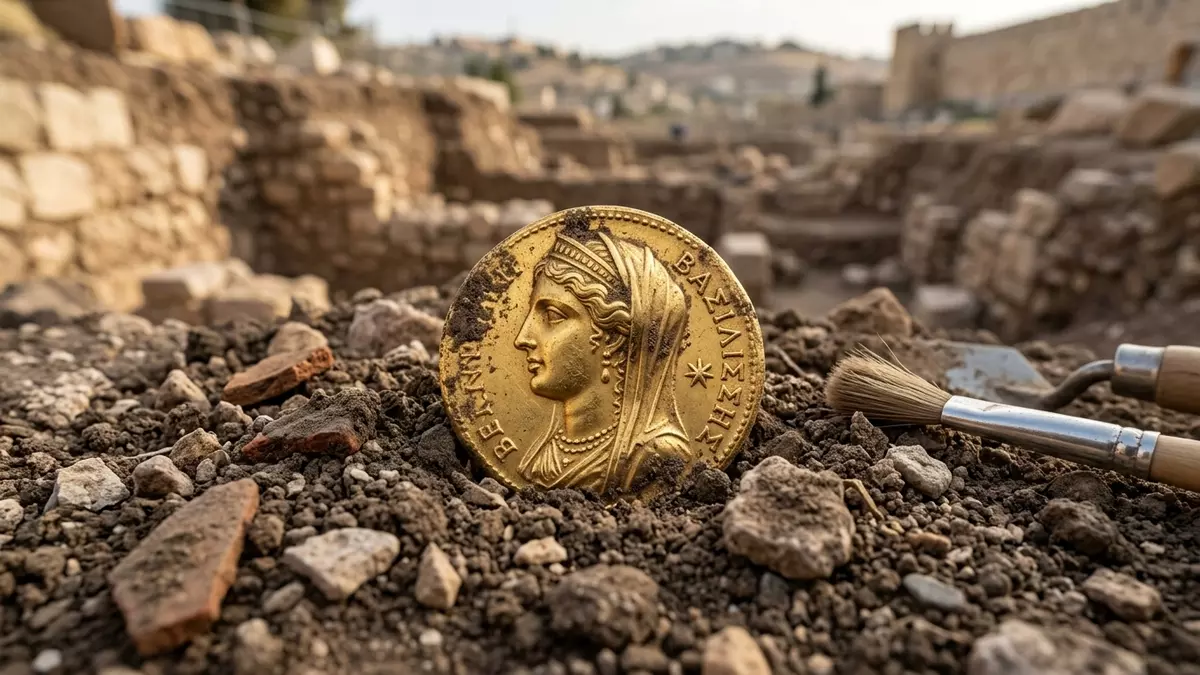
Upon closer inspection and laboratory testing, numismatists (coin experts) identified the artifact as an ancient quarter-drachma. What immediately set this coin apart from standard regional finds was its astonishing metallurgical purity:
Gold Content: The coin is composed of an incredible 99.3% pure gold, an exceptionally high level of refinement for pre-industrial metallurgy.
Chronology: It has been securely dated to a tight five-year window between 246 BCE and 241 BCE.
Rarity: Only about 20 verified specimens of this exact coin type are known to exist worldwide. Crucially, every single previous example was found inside Egypt, making this Jerusalem discovery a historic global first.
The Portrait of a Sovereign Queen
Beyond its material value, the imagery stamped onto the coin’s surface provides a masterclass in ancient political propaganda. The artifact honors Queen Berenice II, a powerful monarch who co-ruled Egypt alongside her husband, King Ptolemy III.
 Ancient Birch Tar Reveals How Europe’s First Farmers Chewed, Cooked, and Crafted 6,000 Years Ago
On the front (obverse) side, Queen Berenice II is depicted in elegant profile. She wears a royal diadem, a sheer traditional veil, and an ornate necklace, showcasing the high-level artistry of imperial mints.
It is the back (reverse) side of the coin, however, that carries the most significant political weight. It features a beautifully engraved cornucopia—the horn of plenty, a universal ancient symbol representing fertility, agricultural abundance, and economic prosperity. The horn is flanked by two radiant stars and a bold inscription written in Greek block letters: ΒΑΣΙΛΙΣΣΗΣ, which translates directly as “of Queen Berenice.”
Historians emphasize that this design choice was highly unusual for the patriarchal Hellenistic world. In the vast majority of ancient currency, royal women were depicted merely as passive consorts to their more powerful husbands. On this coin, however, Berenice is framed explicitly as an independent, sovereign ruler in her own right, holding absolute political authority.
The Spoils of War: From Alexandria to Judea
Where did this ultra-pure piece of gold originate, and how did it end up buried in the soil of Jerusalem?
Archaeological researchers believe the quarter-drachma was minted in the Egyptian capital of Alexandria, the sprawling intellectual and financial epicenter of the Ptolemaic Kingdom. The timing of its production perfectly aligns with the conclusion of the Third Syrian War—a monumental military conflict that pitted the Ptolemaic Kingdom of Egypt against their bitter rivals, the Seleucid Kingdom of Syria.
During this war, Ptolemaic forces launched massive campaigns throughout the Levant. Historians theorize that this gold coin was part of a prestigious, state-sponsored donative reward system. High-purity gold coins were minted specifically to be distributed as financial bonuses or honorary medals to victorious soldiers and high-ranking military officers returning home from the Syrian front lines. One of these decorated individuals likely traveled south to Jerusalem, carrying their wealth with them.
Rewriting Jerusalem’s Economic Timeline
While the coin provides invaluable data for Egyptian history, its true impact lies in what it reveals about the city where it was found.
For generations, the prevailing academic consensus held that after the Babylonian army thoroughly destroyed the First Temple in 586 BCE, Jerusalem entered a prolonged period of severe urban decay. Conventional textbooks described the city during the subsequent Persian and early Hellenistic periods as a small, impoverished, and isolated mountain town. Scholars assumed it possessed little to no regional economic influence and lacked any real connections to international trade networks.
This new gold discovery, alongside a growing collection of mid-3rd-century BCE luxury artifacts recovered at the Givati Parking Lot, shatters that bleak historical picture. High-purity gold currency did not circulate in backwater villages. The presence of an elite, Alexandrian-minted commemorative coin proves that Jerusalem was a thriving, economically active urban center integrated directly into the high-stakes financial networks of the global Mediterranean empires.
The Rise, Reign, and Tragic End of Queen Berenice II
The woman immortalized on the coin was one of the most fascinating and influential figures of the ancient world. Born around 267 BCE, Berenice II was a royal trailblazer from her youth. Following the death of her father, she initially ruled the wealthy independent territory of Cyrenaica (located in modern-day Libya) entirely on her own.
When she eventually chose to marry King Ptolemy III, her strategic alliance successfully brought her vast, resource-rich homeland back under the centralized control of the Egyptian crown. Throughout her joint reign, she was deeply integrated into the state’s official royal cult, honored by her subjects as a living goddess, and celebrated for her deep cultural and religious patronage.
The Constellation of a Queen
Berenice’s fame even extended into the night sky. According to historical legend, when her husband departed for the dangerous battlefields of the Third Syrian War, she vowed to cut off her beautiful, long hair and dedicate it to the temple of Aphrodite if he returned safely.
When the hair mysteriously vanished from the temple altar shortly after the king’s safe return, the court astronomer calmed the royal family by declaring that the gods had pulled the tresses into the heavens. To this day, that specific star cluster is still formally recognized by modern astronomers as the constellation Coma Berenices (Berenice’s Hair).
Tragically, her brilliant life ended in calculated violence. In 221 BCE, shortly after her husband passed away and her young son ascended the throne, Berenice II was abruptly assassinated in a palace coup orchestrated by the ruthless imperial regent Sosibius, who viewed the powerful queen mother as a threat to his own political survival.
Conclusion: A Living Piece of History Goes on Display
Ultimately, this tiny gold quarter-drachma serves as a powerful reminder that history is never completely set in stone. A single accidental drop by an ancient traveler over two millennia ago has provided modern archaeologists with the exact evidence needed to dismantle decades of historical misconceptions about ancient Judea.
To celebrate this monumental find, the Israel Antiquities Authority has announced that the Queen Berenice coin, alongside an array of exquisite Hellenistic gold jewelry uncovered during the same excavation season, will be officially placed on public display. The artifacts will headline the upcoming Annual City of David Research Conference, allowing the public to look face-to-face at the gold that reshaped the history of Jerusalem.
Frequently Asked Questions
Where exactly was the gold coin found?
The coin was discovered during a scientific excavation at the Givati Parking Lot, which is located within the borders of the City of David National Park in Jerusalem.
What makes this specific coin so rare?
Only about 20 examples of this quarter-drachma coin are known to exist globally. More importantly, this discovery marks the first time that this exact type of coin has ever been unearthed outside of Egypt, proving that these elite imperial currencies traveled much further than previously assumed.
How pure is the gold inside the artifact?
Laboratory testing confirmed that the coin is manufactured from nearly pure gold, registering at an astonishing 99.3% purity. This reflects the highly sophisticated refining capabilities of royal Hellenistic mints in Alexandria.
How does this discovery change the history of Jerusalem?
For decades, historians believed that 3rd-century BCE Jerusalem was a small, poor, and isolated town following its earlier destruction by Babylon. Finding an ultra-rare, high-value gold coin proves that Jerusalem was actually an active, wealthy participant in international trade and empire logistics during the Hellenistic period.
What is the meaning behind the constellation Coma Berenices?
The constellation, known as “Berenice’s Hair,” was named in honor of Queen Berenice II. According to ancient accounts, she cut off her hair as a religious offering to ensure her husband’s safe return from the Third Syrian War. When the hair went missing from the temple, the court astronomer claimed the gods had placed it in the stars.