
Table of Contents
**Trepanned Giant Found in Viking Mass Grave Near Cambridge**
Archaeologists have made a startling discovery at Wandlebury Country Park, just south of Cambridge, England. A training excavation uncovered a chilling Viking-era mass grave packed with dismembered remains and the skeleton of an unusually tall young man who survived ancient brain surgery. This find sheds fresh light on the brutal conflicts that shaped early medieval Britain during a time of Viking invasions and shifting power.
The site, long known for its Iron Age hillfort, continues to reveal layers of violent history. What began as a routine student dig quickly turned into one of the most intriguing archaeological stories of the year.
Trepanned Giant Found in Viking Mass Grave Near Cambridge
### The Discovery at Wandlebury Country Park
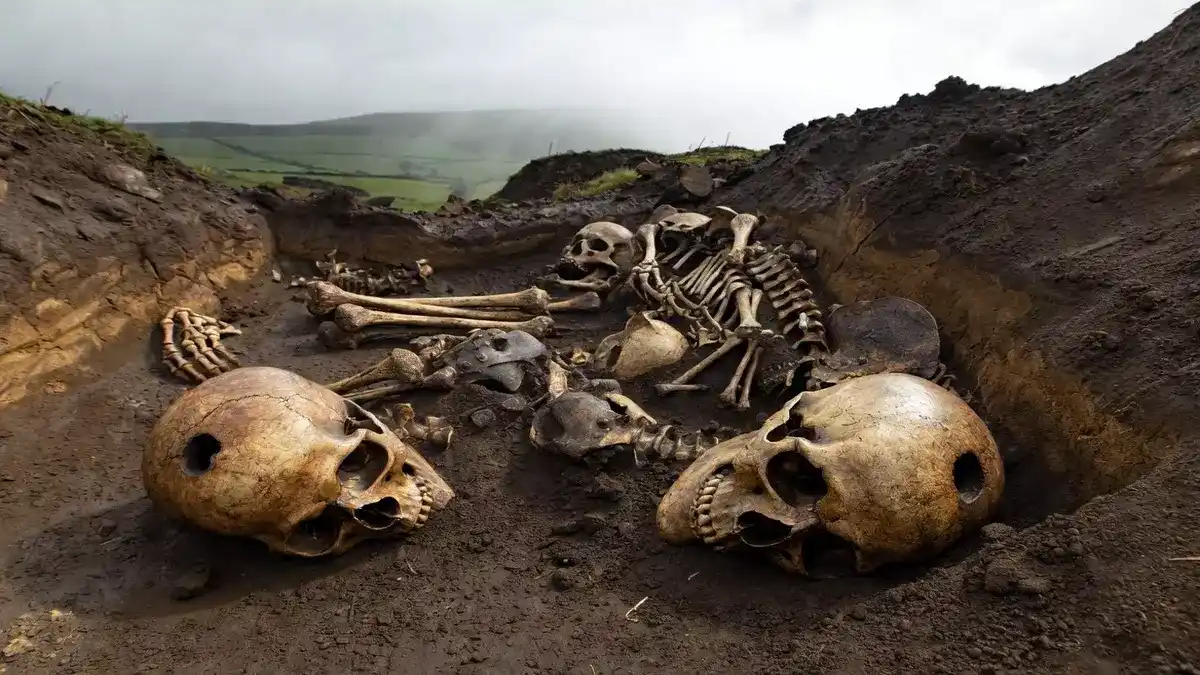
In the summer of 2025, Cambridge University archaeologists and undergraduate students were conducting a training excavation near the ancient Iron Age hillfort at Wandlebury. As they dug, a narrow pit emerged—roughly four meters long and one meter wide—filled with a chaotic mix of human bones.
The pit contained remains from at least ten young adult males. Some skeletons lay in anatomical position, while others appeared as loose bones, including clusters of skulls separated from bodies and piles of leg bones. Clear cut marks on several remains, including evidence of beheading, told a grim story of deliberate violence. Many bodies were positioned face down, with arm placements hinting that their wrists may have been bound at the time of death.

This wasn’t a typical battlefield burial. The pattern of injuries and the way the bodies were handled suggested execution or punishment rather than deaths from open combat. Surface changes on some bones indicated they may have been displayed briefly before burial, pointing to a public or ritualistic element in this frontier landscape.
### Viking Conflicts and the Historical Context
Radiocarbon dating places the burial between the late eighth and late ninth centuries AD, a period of intense turmoil in eastern England. This was the height of Viking activity, with Norse forces raiding, conquering, and settling across Anglo-Saxon territories.
Cambridge sat near a volatile boundary between Anglo-Saxon kingdoms like Mercia and East Anglia, which fell under Viking control around 870 AD during the campaigns of the Great Heathen Army. Written sources, including the Anglo-Saxon Chronicle, describe Viking armies sweeping through the region, leading to battles, raids, and political upheaval.
Wandlebury’s location made it a strategic gathering place for centuries, from its origins as an Iron Age hillfort built around 400 BC by tribes like the Iceni. The hillfort featured impressive banks, ditches, and ramparts, serving as a center of power and defense long before the Vikings arrived. Earlier discoveries at the site, including skeletons exposed by a storm in 1976, hinted at repeated use during turbulent times.
The mass grave adds powerful evidence to this narrative of conflict. Unlike standard warrior burials with weapons or armor, this pit reflects the darker side of warfare: summary justice, possible executions of captives or rebels, and hasty disposal of bodies in a prominent location.
### The Story of the Trepanned Giant
Among the remains, one individual stands out dramatically. This young man, aged roughly 17 to 24, towered at about 1.95 meters (around 6 feet 5 inches)—exceptionally tall compared to the average early medieval male height of about 1.68 meters. His long, thick arm and leg bones suggest he suffered from gigantism, likely caused by a pituitary gland tumor that triggered excessive growth hormone during his adolescent years.
Even more remarkable is the evidence of survival after major surgery. His skull features a round hole approximately three centimeters wide on the rear left side. New bone growth around the edges confirms he lived for some time after the procedure. Experts identify this as trepanation, an ancient surgical technique where a section of the skull is removed to relieve pressure, treat head trauma, epilepsy, or severe headaches.
Trepanation has been documented across many cultures worldwide, from prehistoric times through the Middle Ages. In this case, it appears to have been a deliberate medical intervention to ease intracranial pressure from his condition. The fact that he survived the operation speaks to skilled practitioners and community care in his society—impressive for the era.
His remains were found flung face down into the pit, adding a poignant layer to his story: a man who overcame significant health challenges only to meet a violent end during regional strife.
### What the Bones Reveal About Life and Death
The mix of complete skeletons and disarticulated parts paints a complex picture. While some wounds align with close-quarters fighting, the overall pattern—severed heads and limbs grouped together—leans toward post-battle processing or formal execution. This could represent defeated enemies, local dissidents, or a combination of both in a border zone rife with tension.
Ongoing laboratory analysis promises more answers. Researchers are conducting ancient DNA testing to explore genetic origins, possible family relationships, and whether the group consisted of locals, Vikings, or a mix. Isotope analysis will reveal details about their diets and where they grew up, helping reconstruct individual life stories from this turbulent frontier.
Geophysical surveys are also planned to search for additional features from the same period, potentially uncovering more about how Wandlebury functioned as a site of power, ritual, and conflict.
### Why This Find Matters Today
Discoveries like this bridge the gap between legend and reality in Viking Age history. They humanize the era often romanticized in sagas and media, showing the harsh realities of invasion, resistance, and daily survival. The “giant” with his trepanned skull particularly captivates modern imaginations, highlighting medical ingenuity amid brutality.
Wandlebury Country Park, now a peaceful green space managed by Cambridge Past, Present & Future, continues to yield secrets. Its rich layers—from Iron Age defenses to Roman activity and medieval violence—make it a key location for understanding Britain’s multi-layered past.
This excavation not only trains the next generation of archaeologists but also enriches our understanding of how communities dealt with trauma, both physical and societal. It reminds us that behind every bone is a person with a story of resilience, conflict, and ultimately, remembrance.
### Conclusion
The Viking Age mass grave at Wandlebury offers a rare, intimate glimpse into a violent chapter of English history. From the executed warriors to the remarkable trepanned giant who lived with—and survived—a serious medical condition, these remains challenge us to think deeply about the human cost of conquest and the surprising sophistication of early medieval society. As further tests unfold, this discovery will undoubtedly reshape our view of life on the Anglo-Saxon-Viking frontier and inspire new respect for the people who shaped modern Britain.
Future work at the site and continued analysis will keep adding pieces to this fascinating puzzle, proving that even centuries later, the ground still holds powerful stories waiting to be told.
## FAQ
**What is trepanation and why was it performed on the giant skeleton?**
Trepanation involved drilling or cutting a hole in the skull to relieve pressure, often from trauma, tumors, or conditions like headaches and seizures. In this case, it addressed symptoms likely caused by gigantism from a pituitary tumor. The healed bone shows the individual survived the procedure.
**How does this mass grave connect to Viking history?**
Radiocarbon dating aligns it with the late 8th-9th centuries, when Viking armies, including the Great Heathen Army, invaded eastern England around 865-870 AD. The location near Cambridge was a contested border area, making executions or battle-related burials plausible.
**Were the men in the grave Vikings or Anglo-Saxons?**
DNA and isotope tests are underway to determine origins. The group may include locals, invaders, or both, reflecting the complex mixing during this period of conflict and settlement.
**Why was Wandlebury significant historically?**
The site hosted an important Iron Age hillfort with defensive earthworks, serving as a gathering place for centuries. Its strategic position made it relevant through Roman times and into the Viking Age.
**What other finds have been made at Wandlebury?**
Previous discoveries include skeletons from a similar period exposed in 1976. The area has yielded evidence of Iron Age occupation, Roman activity, and multiple burial events, highlighting its long-term importance.
**Will more details be released about the remains?**
Yes. The Cambridge Archaeological Unit plans further publications, and the find has been featured in documentaries like *Digging for Britain*. Ongoing scientific analysis will provide deeper insights into diet, kinship, and mobility.