
Table of Contents
**Spain’s Largest Helmet Hoard Proven Medieval, Not Roman**
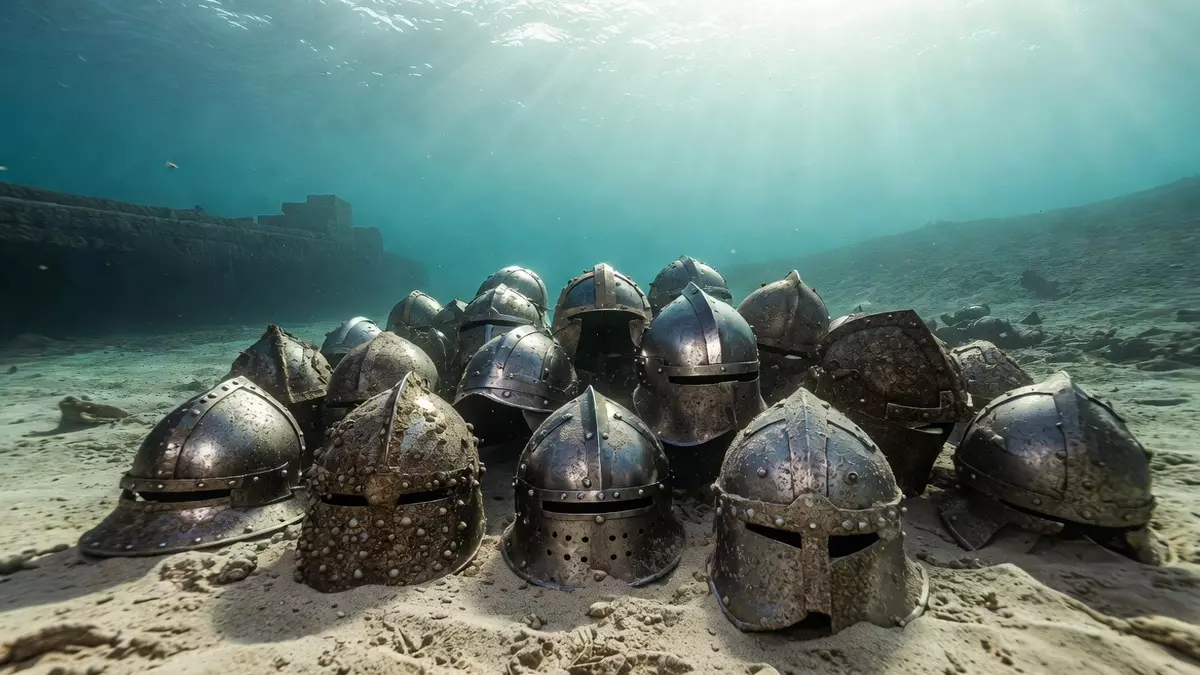
A remarkable underwater discovery off Spain’s eastern coast has rewritten what archaeologists believed about one of the biggest collections of ancient helmets ever found in the western Mediterranean. Once thought to be Roman relics from antiquity, 43 iron helmets recovered from the seabed near Benicarló have now been firmly dated to the late 1300s and early 1400s through advanced radiocarbon analysis.
This stunning redating transforms our understanding of medieval military equipment and trade during a turbulent time in European history. The find offers a rare, well-preserved snapshot of armor used by ordinary soldiers rather than elite knights.
Spain’s Largest Helmet Hoard Proven Medieval, Not Roman
 Rare 19th-century bone dental bridge found in Portugal points to early cosmetic tooth replacement
### The Accidental Discovery That Stumped Experts
In 1990, local fishermen working near Piedras de la Barbada, just off the Valencian coast, snagged their nets on two large, heavy masses of corroded metal. What they pulled up turned out to be something extraordinary: dozens of iron helmets fused together by centuries of marine concretions.
Archaeologists who examined the haul were initially puzzled. With 43 individual helmets, the assemblage ranks as the largest known group of medieval helmets from the western Mediterranean. Many features looked vaguely like Late Roman military gear, yet other details suggested a much later date. The distinctive shapes didn’t match well-known examples in museum collections, leaving experts debating their origins for more than three decades.

The helmets were found in relatively shallow water, about six meters deep, close to what appears to have been an old jetty. Evidence points to a single unfortunate incident during loading or unloading operations. Part of a larger shipment simply slipped into the sea, where shifting sands quickly buried and protected the cargo from further damage and dispersal.
### Radiocarbon Dating Solves the Mystery
The breakthrough came from careful scientific study of organic material still preserved inside several helmets. Fragments of textile lining—likely padded caps worn beneath the iron shells—survived thanks to protective layers of marine sediment and concretions.

Researchers extracted samples from these textiles and sent them to two independent laboratories for radiocarbon dating. The results consistently placed the helmets in the second half of the 14th century through the early 15th century. Statistical modeling confirmed four of the five dates, with the outlier likely resulting from minor contamination after the helmets entered the water.
This new evidence aligned perfectly with detailed typological analysis and comparisons to medieval iconography. The helmets represent a transitional phase in European armor development, before standardized designs became common later in the 15th century. Their unique forms help explain why classification proved so difficult for so long.
### Inside the Benicarló Helmets: Design and Daily Use
Unlike ornate helmets made for nobility or heavy cavalry, these pieces were practical equipment for ordinary infantry. Produced in smaller workshops and distributed through regional trade networks, they reflect the everyday realities of medieval warfare rather than battlefield glory.
Photogrammetry studies have allowed researchers to examine the helmets from every angle, revealing three distinct groups within the collection. Some remain on display at the Museo de Bellas Artes de Castellón, while others can be seen at the Museo de la Ciudad de Benicarló. Interior views show remarkable preservation, including layers of original textile, corrosion products, and the intact metal structure.
The helmets’ construction suggests they were mass-produced for militias, armed companies, and local defense forces. Finds like this are exceptionally rare because common soldiers’ gear rarely survives in large quantities. This assemblage provides invaluable insight into what average fighting men wore during a period of rising conflict.
### Mediterranean Trade and Maritime Danger in the Late Middle Ages
The helmets weren’t local stockpile items. Evidence strongly indicates they formed part of a commercial shipment moving along established Mediterranean trade routes. Connections between the Valencian coast and major Italian trading hubs like Genoa appear central to this network.
The late 14th and early 15th centuries were marked by increasing political tension and maritime insecurity across the western Mediterranean. Piracy surged along the Spanish coast, prompting coastal communities to bolster their defenses. Demand for reliable military equipment grew as towns and regions prepared for potential attacks.
Losing such a valuable cargo would have been a significant blow, highlighting the risks of sea trade even in established routes. The helmets’ presence on the seabed near a loading area tells a story of routine commerce interrupted by a simple accident rather than dramatic battle or pirate raid.
### Why This Discovery Matters for History and Archaeology
This find does more than correct a decades-old misclassification. It demonstrates the power of combining modern scientific techniques with traditional archaeological methods. Radiocarbon dating of preserved textiles inside metal artifacts opens new possibilities for dating other challenging underwater finds.
The Benicarló helmets fill a gap in our knowledge of late medieval armor evolution. They show how equipment for regular troops developed during a time when warfare was becoming more professionalized and widespread. The collection preserves a “time capsule” moment around the year 1400, capturing what was actually in circulation before later standardization.
For historians of medieval Spain and the broader Mediterranean world, this assemblage illuminates trade patterns, military preparedness, and material culture during an era of both opportunity and danger. It also underscores the importance of protecting underwater cultural heritage sites that continue to yield surprises centuries later.
### Broader Implications for Underwater Archaeology
Underwater sites like Piedras de la Barbada often preserve organic materials better than terrestrial ones due to stable, oxygen-poor conditions. The successful dating of textile linings in these helmets sets a precedent for future research on corroded metal artifacts.
Advanced imaging techniques, including photogrammetry, have allowed detailed documentation without risking further damage to the fragile pieces. This multidisciplinary approach—radiocarbon science, material analysis, historical context, and digital preservation—represents the best of modern archaeology.
As climate change and coastal development threaten more underwater sites, discoveries like this remind us of the hidden history waiting beneath the waves. Spain’s Mediterranean coast continues to reveal chapters of European history that reshape our understanding of the past.
### Conclusion: A New Chapter in Medieval Military History
What began as a puzzling fisherman’s catch has become one of the most significant medieval armor finds in recent decades. These 43 helmets, once mistaken for Roman relics, now stand as powerful evidence of late medieval life, trade, and conflict in the western Mediterranean.
Thanks to radiocarbon dating and careful study, we can finally appreciate their true place in history. The Benicarló hoard doesn’t just correct the record—it enriches our picture of the ordinary soldiers who shaped the medieval world through their service and sacrifice.
This discovery invites us to look closer at other long-misunderstood artifacts and consider how new technologies continue to illuminate even the most unexpected corners of the past.
### FAQ: Spain’s Medieval Helmet Discovery
**How were the helmets originally misidentified as Roman?**
Early examinations noted some design similarities to Late Roman military equipment. Without organic material for dating and limited comparable medieval examples, experts reasonably placed them in antiquity until new scientific analysis proved otherwise.
**What makes this the largest medieval helmet hoard in the western Mediterranean?**
The collection contains 43 complete or nearly complete iron helmets recovered together from a single event. Most medieval armor finds involve far smaller numbers, especially for common infantry gear.
**How did radiocarbon dating work on these underwater artifacts?**
Researchers analyzed preserved textile fragments from inside the helmets. Marine concretions protected the organic material, allowing accurate carbon-14 testing that placed manufacture and use in the late 14th to early 15th centuries.
**Where can people see the Benicarló helmets today?**
Portions of the collection are displayed at the Museo de Bellas Artes de Castellón and the Museo de la Ciudad de Benicarló in Spain. Digital models and photogrammetry images also make the artifacts accessible to researchers worldwide.
**What does this discovery tell us about medieval trade?**
The helmets appear to have been part of a commercial shipment likely connected to Italian trading centers such as Genoa. Their quantity and uniform purpose suggest organized arms trading rather than individual ownership.
**Could similar finds still be waiting underwater?**
Absolutely. The Mediterranean seabed holds countless undiscovered or misidentified artifacts. Improved technology and systematic surveys continue to reveal new insights into ancient and medieval maritime history.