

Table of Contents
**Tree Rings Solve Mystery of Ancient Polish Princess Burial**
In the late 19th century, fierce winds and relentless waves along Poland’s Baltic coast uncovered a remarkable secret from the Roman Iron Age. A hollowed-out oak log coffin, containing the remains of a young woman adorned with fine jewelry, tumbled from an eroding cliff near the village of Bagicz in northwestern Poland. Dubbed the “Princess of Bagicz,” this extraordinary find has captivated archaeologists for over a century. Recent scientific breakthroughs have finally pinned down her burial date with remarkable precision.
This story blends dramatic discovery, cutting-edge science, and insights into ancient European life. By combining tree-ring dating, isotope analysis, and traditional archaeology, researchers have resolved a puzzling timeline conflict and shed new light on the Wielbark culture that once thrived in the region.

Tree Rings Solve Mystery of Ancient Polish Princess Burial
### The Dramatic Discovery on Poland’s Shif
ting Shoreline
Coastal erosion in Pomerania is unforgiving. The shoreline retreats by up to one meter annually, constantly reshaping the landscape and revealing hidden history. In 1898, this natural force exposed the Princess of Bagicz’s final resting place. The well-preserved oak log coffin stood out immediately—wooden burial containers rarely survive in the area’s sandy, acidic soils.
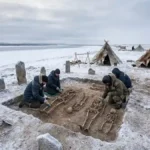
Inside lay the skeleton of a young woman, accompanied by elegant grave goods: a bronze fibula (a decorative cloak pin), two bronze bracelets, and a striking necklace of glass and amber beads. Early accounts also noted a small wooden stool and cattle hide, though these organic items did not endure. The richness of the burial and its apparent isolation led researchers to speculate she held elite status—hence the “princess” nickname.
Subsequent digs revealed a larger nearby cemetery, showing she was part of a community rather than a solitary high-status figure. Still, her log coffin remains the only well-preserved example of its kind from Pomerania’s Roman Iron Age sites.
### Understanding the Wielbark Culture and Burial Traditions
The Wielbark culture flourished between the 1st and 4th centuries CE in what is now northern Poland and beyond. Named after a major cemetery site, this archaeological culture is linked to Germanic peoples, possibly including early Goths migrating from Scandinavia.
Unlike neighboring groups that favored cremation, Wielbark people often practiced inhumation—burying the body intact. Log coffins or twig-lined graves were common, reflecting deep connections to the natural world and beliefs about the afterlife. The culture’s material remains include distinctive jewelry, weapons in some male graves (though these decreased over time), and evidence of trade networks stretching across Europe.
The Princess of Bagicz burial perfectly exemplifies these traditions. Her amber beads highlight connections to Baltic trade routes, prized for their beauty and symbolic value in ancient societies. Such finds help archaeologists reconstruct social hierarchies, gender roles, and daily life in pre-medieval Northern Europe.
### The Dating Dilemma: Conflicting Evidence
For decades, determining exactly when the Princess lived proved challenging. In the 1980s, experts analyzed the style of her grave goods and estimated the burial occurred between approximately 110 and 160 CE. This aligned with the peak of Wielbark activity during the Roman Iron Age.
Then, in 2018, radiocarbon dating on one of her teeth produced a surprisingly early range: 113 BCE to 65 CE. This created nearly a century-long discrepancy. How could the artifacts and the biological remains point to such different periods?
This mismatch highlighted limitations in single-method dating for ancient remains, especially in regions with unique environmental conditions.
### Breakthrough with Dendrochronology: Precision from Tree Rings
A 2026 study published in the journal *Archaeometry* brought clarity through dendrochronology—the science of tree-ring dating. Researchers, led by Marta Chmiel-Chrzanowska and colleagues, examined the oak coffin directly. By extracting a small core and comparing its growth rings to regional master chronologies, they determined the tree was felled around 120 CE, with an uncertainty of just seven to eight years.
This result strongly supports the original archaeological dating based on artifacts and places the burial firmly in the early second century CE. Dendrochronology offers such precision because trees produce annual rings influenced by local climate, creating unique “fingerprints” that can be matched across samples.
The technique not only dates the coffin but also provides environmental context—revealing what growing conditions were like when the oak matured in ancient Pomeranian forests.
### Why Radiocarbon Dating Went Astray
With the coffin’s date confirmed, scientists turned to explaining the older radiocarbon result. Stable isotope analysis of the woman’s bones revealed a diet rich in animal protein, including significant freshwater fish consumption.
Many lakes and rivers in the area feature “hard water” due to dissolved limestone and ancient carbon. Fish and other aquatic life absorb this older carbon, which then passes up the food chain. Humans eating these organisms end up with tissues that appear older when radiocarbon dated—a phenomenon known as the reservoir effect.
This dietary influence, combined with the moderately hard local waters, likely caused the radiocarbon date to skew centuries earlier than her actual lifetime. The case serves as a powerful reminder for archaeologists worldwide: context matters. Diet, environment, and lifestyle must factor into interpretations of radiocarbon results, particularly for coastal or riverine populations.
### Tracing Her Origins Through Strontium Isotopes
The team also used strontium isotope analysis on her remains to explore mobility. The values matched signatures found in parts of Scandinavia, such as the island of Öland, as well as local glacial deposits in Pomerania. This overlap makes it challenging to definitively label her a migrant or local, but it underscores the interconnected nature of Wielbark communities, possibly involving movement along the Baltic.
Such studies illuminate broader patterns of migration, trade, and cultural exchange during the Roman period, when the empire’s influence rippled into “Barbaricum”—the lands beyond its frontiers.
### Why Multiple Scientific Methods Matter
The Princess of Bagicz project exemplifies modern archaeology’s multidisciplinary power. No single technique provided the full picture:
– **Artifact typology** offered a solid initial range.
– **Radiocarbon dating** highlighted dietary complications.
– **Dendrochronology** delivered precise felling dates.
– **Isotope analyses** revealed diet and possible origins.
Together, they paint a richer portrait of life and death in the Roman Iron Age. This approach helps avoid errors and builds more reliable chronologies for understanding cultural changes, climate impacts, and human adaptations.
### Broader Implications for European Prehistory
Resolving the Princess’s timeline contributes to our knowledge of the Wielbark culture’s development. It confirms continued use of traditional log coffin burials into the 2nd century CE and highlights the role of elite women in these societies. Her grave goods suggest access to specialized craftspeople and long-distance trade in amber and glass.
In a larger sense, the study underscores vulnerabilities of coastal archaeological sites to climate change and erosion. As sea levels rise and storms intensify, many more discoveries—and losses—may occur along the Baltic and similar shores. Proactive documentation and advanced science become essential for preserving these irreplaceable windows into the past.
The findings also demonstrate how seemingly minor environmental factors, like water chemistry, can profoundly affect scientific data. Lessons learned here will refine dating methods for other ancient burials across Europe and beyond.
### Conclusion: A Timeless Tale Brought into Focus
The “Princess” of Bagicz, once shrouded in dating uncertainty, now stands as a well-placed figure in the tapestry of Roman-era Northern Europe. Thanks to tree rings and collaborative science, we know her community laid her to rest around 120 CE in a carefully crafted oak coffin, honoring her with symbols of status and connection.
This discovery reminds us of archaeology’s evolving nature—from chance coastal finds to high-tech laboratories. It celebrates human ingenuity across millennia: the ancient artisans who hollowed the log, the mourners who placed beads around her neck, and today’s researchers decoding rings, isotopes, and artifacts to keep her story alive.
As new technologies emerge, more mysteries from Poland’s ancient past—and our shared human heritage—will come into sharper view.
### FAQ: The Princess of Bagicz and Her Burial
**What made the Princess of Bagicz burial so unique?**
Her oak log coffin is the only well-preserved example from the region’s sandy soils. Most Wielbark wooden burials degrade quickly, making this find exceptionally rare.
**How did tree rings help date the coffin?**
Dendrochronologists matched the oak’s growth rings to established regional sequences, pinpointing when the tree was cut down around 120 CE with high accuracy.
**Why did radiocarbon dating give an earlier result?**
Her diet heavy in freshwater fish from hard-water sources introduced older carbon, creating a “reservoir effect” that made her remains appear older than they were.
**Was the Princess actually royalty?**
The term “princess” reflects the high-quality grave goods and initial perception of isolation. Later finds showed she belonged to a larger cemetery, suggesting elevated but community-based status.
**What does this reveal about the Wielbark culture?**
It confirms inhumation practices with log coffins, trade networks for amber and bronze, and the value of multidisciplinary science for understanding diet, mobility, and chronology in Iron Age Europe.
**How does climate change threaten sites like Bagicz?**
Accelerated coastal erosion endangers countless unexcavated burials. Studies like this one emphasize the urgency of documenting and protecting vulnerable archaeological resources.
**Can similar techniques be applied elsewhere?**
Absolutely. Combining dendrochronology, isotopes, and traditional methods is becoming standard for resolving dating conflicts in wetland, coastal, or forested ancient sites worldwide.