
Table of Contents
- 1. The June Discovery: Breaking a 2,600-Year-Old Seal
- 2. Inside the Chamber: Warriors, Wealth, and Grave Goods
- 3. Reconstructing the Orientalizing Period
- 4. A Shield Against Looters: Local Community Protection
- 5. The Next Phase: High-Tech DNA and Isotopic Mapping
- 5.1. Anthropological and Pathological Profiling
- 5.2. Isotopic Mapping
- 5.3. Ancient DNA (aDNA) Testing
- 6. Frequently Asked Questions
- 6.1. Why are intact Etruscan tombs considered so rare?
- 6.2. Where is the San Giuliano necropolis located?
- 6.3. What is “bucchero” pottery?
- 6.4. What does the presence of an iron spearhead indicate?
- 6.5. What is the next step for the artifacts found inside the 2026 tomb?
Back-to-Back Miracle: Second Intact Etruscan Tomb Discovered in Italy
Against all archaeological odds, a second pristine, unlooted Etruscan tomb has been discovered at the San Giuliano necropolis in central Italy. Found just a few meters away from a similar spectacular discovery made exactly one year ago, this newly opened chamber offers an incredibly rare, untouched glimpse into an ancient civilization whose historical record has been systematically erased by centuries of grave-robbing.
Back-to-Back Miracle Second Intact Etruscan Tomb Discovered in Italy
The June Discovery: Breaking a 2,600-Year-Old Seal
The remarkable find occurred on June 9, 2026, within the Caiolo sector of the sprawling burial grounds, located roughly 70 kilometers northwest of Rome. Researchers operating under the San Giuliano Archaeological Research Project—a collaborative effort led by Baylor University—spotted the ancient burial mound during their summer field season.
As the excavation crew cleared away centuries of accumulated earth and debris, they made a breathtaking discovery: the heavy stone slab sealing the tomb’s portal was firmly resting in its original placement. The structure showed no structural cracks, tool marks, or signs of forced entry. It had remained completely undisturbed since the late seventh century BCE.
This back-to-back success has stunned the international archaeological community. Across the rocky San Giuliano plateau, experts have cataloged more than 600 distinct tombs. Yet, prior to the project’s first breakthrough in June 2025, every single known burial structure across the landscape had been infiltrated and emptied by tomb raiders (tombaroli) at some point following the Roman conquest of the region in the third century BCE.
Inside the Chamber: Warriors, Wealth, and Grave Goods
While the intact tomb excavated in 2025 was a massive family vault containing four bodies laid out on intricately carved stone beds alongside more than 100 elite objects, the newly opened 2026 chamber is noticeably more modest in size.
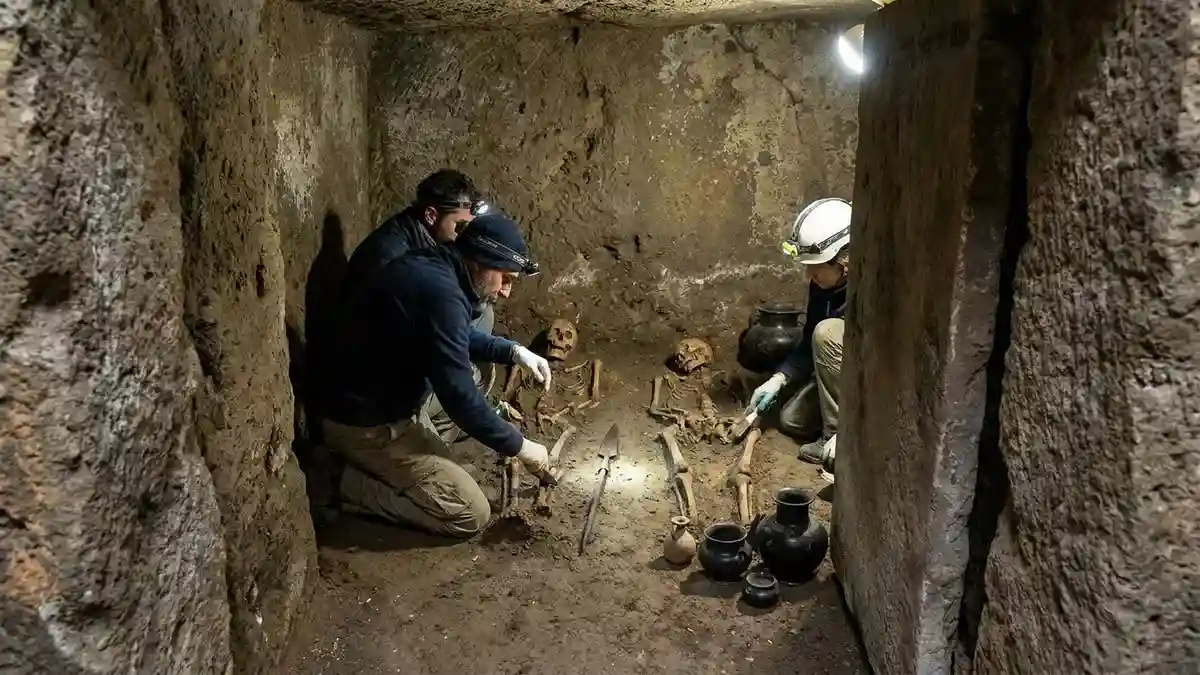
Initial spatial mappings indicate the tomb served as the final resting place for at least two individuals. Soil has naturally seeped into the chamber over the millennia, partially burying the floor, but key cultural details are already plainly visible:
The Warrior Status: Archaeologists identified the presence of an iron spearhead resting directly alongside one of the partial skeletal remains, strongly implying that at least one of the occupants was a male warrior.
The Luxury Vessels: Several well-preserved artifacts sit out in the open, including large storage jars, delicate black bucchero drinking cups (the signature ceramic style of Etruscan elite society), and an aryballos—a tiny, specialized flask used to hold precious oils, ointments, or imported perfumes.
Preserved Skeletal Remains: Crucially, portions of the ancient skeletons have survived the damp underground conditions, providing a clean source of organic material for impending laboratory testing.
+-------------------------------------------------------------------+
|               SAN GIULIANO INTACT TOMB COMPARISON                 |
+-------------------+-----------------------+-----------------------+
| Feature           | 2025 Discovery        | 2026 Discovery        |
+-------------------+-----------------------+-----------------------+
| Occupants         | 4 Individuals         | At least 2 Individuals |
| Grave Goods Count | 100+ items            | Smaller, elite cache  |
| Defining Artifact | Silver hairpins, iron | Iron spearhead, oil   |
|                   | weapons, bronze ornaments| aryballos, buchero    |
+-------------------+-----------------------+-----------------------+
Reconstructing the Orientalizing Period
The pristine state of these neighboring graves provides an unparalleled scientific opportunity to reconstruct Etruscan funerary traditions during the Orientalizing period (roughly 750 to 575 BCE). This was an era of intense cultural transformation, characterized by shifting social hierarchies and booming trade networks between Etruria, Greece, and the Near East.
Because no modern looters or ancient Roman soldiers scrambled the interiors, scientists can meticulously map out the exact micro-spatial arrangement of the artifacts. Observing precisely how items were placed relative to the bodies gives researchers clues about the family’s social status, local religious rituals, and personal belief systems regarding the afterlife.
Comparing the larger, hyper-wealthy 2025 tomb to the smaller, targeted 2026 burial allows experts to analyze how different aristocratic families within the exact same neighborhood organized their funerary spaces during the late seventh century BCE.
A Shield Against Looters: Local Community Protection
The recovery of these twin treasures highlights a highly successful collaboration between the Italian Ministry of Culture, regional archaeological superintendents, and the local citizens of nearby Barbarano Romano.
Grave robbing has plagued central Italy for generations, but project leaders credit intense community support, local pride, and vigilant neighborhood monitoring for keeping modern looters completely away from the Caiolo sector while the scientific teams were off-site.
The Next Phase: High-Tech DNA and Isotopic Mapping
The field team will spend the remainder of the 2026 excavation season carefully consolidating the tomb’s structural walls. The delicate ceramic vessels that remain half-buried in the floor mud will not be pulled out roughly on-site. Instead, they will be block-excavated within soil jackets and transported to a controlled laboratory environment to ensure no microscopic trace evidence is lost.
Once safely in the lab, both the artifacts and the biological remains will undergo an extensive array of advanced scientific analyses:
Anthropological and Pathological Profiling
Osteologists will closely inspect the skeletal fragments to determine the precise age of death, signs of physical trauma, and indicators of chronic health conditions or dietary stress.
Isotopic Mapping
By testing stable isotopes preserved within the dental enamel of the teeth, scientists can map the chemical signatures of the water and food the individuals consumed during childhood. This data will reveal whether these people were born and raised locally on the San Giuliano plateau or if they migrated from other regions of the Mediterranean.
Ancient DNA (aDNA) Testing
Genetic sequencing will be performed on the bones to definitively confirm the biological sex of the occupants, map their ancestral lineages, and determine if the individuals buried within the same tomb—and between the two separate tombs—shared direct familial bonds.
The discovery of two unviolated tombs hidden within the exact same sector strongly suggests that more untouched chambers may still be concealed beneath the brush of the San Giuliano plateau, waiting to tell their stories.
Frequently Asked Questions
Why are intact Etruscan tombs considered so rare?
For over two millennia, nearly all Etruscan cemeteries have been heavily targeted by grave robbers, starting from the ancient Roman era right through to modern-day black-market looters. Finding a tomb with its entry stone completely undisturbed is an exceptional rarity.
Where is the San Giuliano necropolis located?
The necropolis is situated on a volcanic plateau within the Caiolo area near the town of Barbarano Romano, approximately 70 kilometers northwest of Rome, Italy.
What is “bucchero” pottery?
Bucchero is a distinctively dark, shiny, black ceramic type produced by Etruscan artisans. It was highly prized for its glossy finish, which was designed to mimic the appearance of expensive oxidized silver or bronze metalwork.
What does the presence of an iron spearhead indicate?
The iron spearhead found next to one of the skeletons strongly indicates that the deceased was a male occupant who likely held a warrior or high-ranking elite status within Etruscan society.
What is the next step for the artifacts found inside the 2026 tomb?
To preserve fragile residues, the remaining half-buried ceramic pieces will be carefully extracted under precise laboratory conditions. Afterward, both the artifacts and the human bones will undergo deep chemical, genetic, and isotopic analysis.