
Table of Contents
- 1. The Intersection of Utility and Art in the Byzantine Empire
- 2. Anatomy of a Masterpiece: Designing the Sandaled Foot Lamp
- 2.1. Compact Dimensions and Ingenious Engineering
- 2.2. The Ankle Reservoir and Sacred Cover
- 3. Decoding the Multilayered Symbolism of the Foot
- 3.1. The Gammadion Cross and Good Fortune
- 3.2. The Sacred Journey of Christian Pilgrimage
- 3.3. Health, Protection, and Divine Healing
- 4. “A Lamp Unto My Feet”: The Scriptural Connection
- 5. Preserving Byzantine History at The Metropolitan Museum of Art
- 6. Conclusion
- 7. Frequently Asked Questions
- 7.1. What exactly is the Byzantine foot lamp made of?
- 7.2. How big is the lamp, and can it still hold oil?
- 7.3. Why is there a swastika on the bottom of the sandal?
- 7.4. Where was this artifact discovered, and where is it kept now?
- 7.5. What is the primary biblical meaning behind the lamp’s design?
1,600-Year-Old Christian Foot Lamp Inspires Believers Today
In the ancient Mediterranean world, illumination was far more than a practical necessity; it was a profound canvas for spiritual expression. While the vast majority of citizens in the Byzantine Empire relied on simple, mass-produced clay dishes to pierce the evening darkness, elite artisans frequently crafted breathtaking works of art out of molten metal. Among the rarest and most captivating survivors of this golden age is a 1,600-year-old bronze oil lamp meticulously shaped like a human right foot wearing a traditional sandal.
Preserved within the permanent collection of the Metropolitan Museum of Art, this extraordinary artifact offers a fascinating window into the minds of early Christians. Far from being a mere novelty item, this miniature masterpiece intertwines daily utility, advanced metallurgy, and deep theological symbolism. For modern observers, it provides an intimate look at how early believers integrated their faith into the most mundane aspects of domestic life.

1,600-Year-Old Christian Foot Lamp Inspires Believers Today
The Intersection of Utility and Art in the Byzantine Empire
To understand the significance of this artifact, one must look to its origins in fifth-century Syria, a vibrant cultural and economic hub of the early Byzantine Empire. During this era, the region was undergoing a massive cultural transformation as classical Roman traditions blended with the rapidly expanding influence of Christianity.

For over three thousand years, the basic design of the oil lamp had remained virtually unchanged: a simple reservoir for oil and a small spout to hold a burning wick. However, as the Byzantine elite sought to display both their wealth and their devotion, utilitarian objects were elevated into high art. Bronze casting allowed for intricate detail, durability, and a reflective quality that amplified the lamp’s flame.
Artisans of the period took great delight in crafting whimsical and symbolic shapes, ranging from mythological creatures to exotic animals. Yet, anatomical shapes—specifically the human foot—remained exceedingly rare. The creation of a foot-shaped lamp required a sophisticated understanding of both human anatomy and complex multi-part mold casting, making this specific survival a luxurious testament to ancient craftsmanship.
Anatomy of a Masterpiece: Designing the Sandaled Foot Lamp
+--------------------------+-------------------------------------------------------+
| Artifact Dimension       | Measurement Details                                   |
+--------------------------+-------------------------------------------------------+
| Lamp Total Length        | 3.25 inches (8.3 centimeters)                         |
| Suspension Chain Length  | Over 17 inches (43.5 centimeters)                     |
| Material Composition     | Cast Bronze                                           |
| Place of Origin          | Ancient Syria (Byzantine Empire)                      |
| Approximate Era          | Fifth Century AD                                      |
+--------------------------+-------------------------------------------------------+
Compact Dimensions and Ingenious Engineering
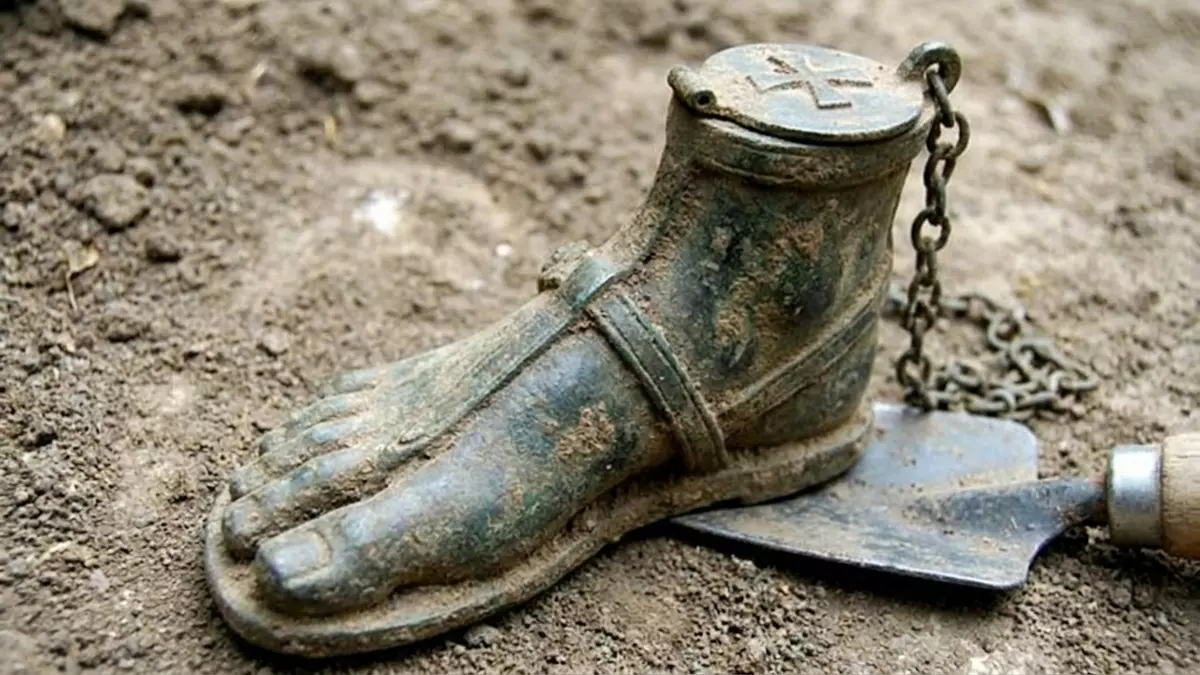
Defying expectations of a life-sized anatomical model, this miniature sculpture measures a mere 3.25 inches (8.3 centimeters) in length. Despite its diminutive size, the level of realism achieved by the ancient coppersmith is remarkable. The lamp was engineered to hang elegantly from a ceiling or a wall bracket, featuring a remarkably preserved suspension chain that extends over 17 inches (43.5 cm) in length, terminating in a sturdy hook.

The functional layout of the lamp is brilliantly integrated into the foot’s natural anatomy. The right big toe serves as the primary focal point of utility, resting directly against the open spout where the linen wick would emerge. When lit, the flame would appear to emanate directly from the tip of the toe, casting a warm, flickering glow across the bronze surface.
The Ankle Reservoir and Sacred Cover
At the rear of the sculpture, where the ankle meets the heel, the artisan placed a wide, circular opening designed to receive pours of olive oil to fuel the flame. To protect the precious fuel from dust and accidental spills, the opening is fitted with a perfectly formed flat lid.
Serving as an unmistakable declaration of the owner’s religious identity, the top of this lid features a prominent Christian cross. According to landmark research published in 1969 by Vera Ostoia, a distinguished curator of medieval art at The Met Cloisters, this structural cross serves as the definitive anchor identifying the object as an intentional piece of early Christian material culture.

Decoding the Multilayered Symbolism of the Foot
For the early Christian community, visual art was rarely purely decorative. Almost every line, pattern, and shape carried a deeper allegorical meaning designed to instruct the faithful and ward off evil.
The Gammadion Cross and Good Fortune
One of the most intriguing aspects of the artifact is located on the underside of the bronze sandal. The sole is intricately decorated with a geometric symbol known today as a swastika, but recognized in the Byzantine world as a gammadion cross.
Long before the symbol was tragically co-opted and distorted in the 20th century, the gammadion—so named because it resembles four letters of the Greek alphabet gamma ($\Gamma$) joined at their bases—was a ubiquitous emblem of:
Cosmic order and balance
Good fortune and divine blessing
The widespread dispersion of the Gospels to the four corners of the earth
When stamped onto the sole of a shoe, it literally represented walking in safety and spiritual prosperity.
The Sacred Journey of Christian Pilgrimage
During the fifth century, the practice of pilgrimage was exploding across the Christian world. Thousands of believers traveled vast distances across rugged terrain to visit holy sites in Jerusalem, Egypt, and Syria. The physical foot became an immediate, powerful symbol of this arduous spiritual journey.
Owning a lamp shaped like a traveling foot was a proud nod to the identity of the pilgrim. It served as a reminder that the Christian life itself was an ongoing journey, a holy march out of the darkness of the world and toward the eternal kingdom of God.
Health, Protection, and Divine Healing
In the ancient Mediterranean, votive offerings shaped like body parts were frequently dedicated to deities in hopes of receiving physical healing. Scholars at the Metropolitan Museum of Art suggest that this foot lamp may have retained some of these traditional protective connotations.
By illuminating their homes with a foot-shaped light, the inhabitants may have been invoking divine protection over their household’s physical health, asking God to guide their steps safely away from disease, injury, and spiritual stumbling blocks.
“A Lamp Unto My Feet”: The Scriptural Connection
Beyond the immediate visual associations with travel and health, the artifact almost certainly references one of the most beloved passages in the Hebrew Scriptures. In her definitive 1969 study, curator Vera Ostoia emphasized that early Christians frequently viewed functional domestic objects through the lens of biblical metaphor.
“Thy word is a lamp unto my feet, and a light unto my path.” — Psalm 119:105
In a society devoid of electricity, navigating unlit ancient streets at night was incredibly hazardous. A small personal foot lamp literally kept a traveler from tripping over stones or falling into open drainage ditches.
By transforming this exact metaphor into a physical bronze object, the creator of the lamp provided a powerful visual sermon. The burning wick represented the illuminating power of God’s word, guiding the believer’s moral choices and lighting their daily path through a chaotic world. To the early Christian mind, light was the ultimate symbol of spiritual enlightenment, truth, and the triumph of immortality over the darkness of death.
Preserving Byzantine History at The Metropolitan Museum of Art
Today, this incredible artifact resides safely within the walls of the Metropolitan Museum of Art in New York City, where it continues to enchant historians and museum-goers alike. Because it is rendered in high-quality bronze, it survived the ravages of time, soil corrosion, and political upheaval that claimed so many other fragile treasures of the Byzantine Empire.
Museums play an indispensable role in safeguarding these small fragments of human history. By studying the intricate details of the sandaled foot lamp—from the delicate thongs of the sandal tied around the ankle to the soot-stained spout—modern researchers can piece together the daily rituals, artistic priorities, and deep-seated religious convictions of a society that flourished more than a millennium ago.
Conclusion
The 1,600-year-old bronze foot lamp stands as a stunning example of how ancient people successfully married practical engineering with profound theological expression. It reminds us that to the early Christians, faith was not an abstract concept reserved exclusively for church buildings or formal liturgies. Instead, it was something to be held in the hand, filled with oil, and lit in the darkness of one’s own home. By walking in the light of their beliefs, the creators of this beautiful object left behind an enduring legacy that continues to shine brightly today.
Frequently Asked Questions
What exactly is the Byzantine foot lamp made of?
The lamp is cast entirely from bronze, an alloy primarily consisting of copper and tin. Bronze was highly prized in the Byzantine Empire for its durability, shiny golden-brown appearance when polished, and its ability to capture intricate artistic details during the molding process.
How big is the lamp, and can it still hold oil?
The lamp is quite small, measuring just 3.25 inches (8.3 cm) long, which makes it significantly smaller than an actual adult human foot. While it remains structurally intact and capable of holding oil in its hollow interior reservoir, it is strictly preserved as a museum artifact and is no longer filled or lit.
Why is there a swastika on the bottom of the sandal?
In the fifth-century Byzantine context, this symbol was known as a gammadion cross. It carried entirely positive connotations, representing good luck, cosmic harmony, and the blessings of Christ. It has no connection whatsoever to the hateful political ideologies that adopted the symbol many centuries later.
Where was this artifact discovered, and where is it kept now?
The artifact originates from ancient Syria, which was a prosperous territory of the Byzantine Empire during the fifth century. It is currently preserved, studied, and occasionally displayed at the Metropolitan Museum of Art in New York City.
What is the primary biblical meaning behind the lamp’s design?
Scholars strongly link the lamp to Psalm 119:105: “Thy word is a lamp unto my feet, and a light unto my path.” The object serves as a physical embodiment of this scripture, illustrating how divine truth guides a believer’s daily steps and protects them from spiritual darkness.