
Table of Contents
- 1. A Century-Old Cold Case Solved by Modern Science
- 2. Inside the Hoard: Wealth, Weapons, and Transcontinental Trade
- 2.1. The Broken Sword from the South
- 3. Staged Devotion: Safekeeping vs. Ritual Offering
- 4. Preserving the Past for Future Generations
- 5. Frequently Asked Questions
- 5.1. Where exactly was the Bronze Age hoard found?
- 5.2. How old are the artifacts and what do they weigh?
- 5.3. What types of objects were discovered in the treasure?
- 5.4. Why do archaeologists believe the treasure was a ritual offering?
- 5.5. What is the historical link to the potato harvest of 1900?
Largest Bronze Age Hoard in Upper Lusatia Discovered Near Görlitz, Germany
In a monumental development for European archaeology, researchers working in eastern Germany have unearthed one of the most massive and significant Bronze Age treasures in regional history. Discovered in Klein Neundorf, a suburb of Görlitz in the state of Saxony, the extraordinary cache contains 310 separate pieces of beautifully preserved bronze. Dating back to the 9th century BCE, the entire collection weighs more than 16 kilograms (roughly 35 pounds).
This historic find officially ranks as the largest Bronze Age hoard ever recorded in the region of Upper Lusatia and stands proudly as the second-largest Bronze Age discovery in the entire state of Saxony. The massive haul of tools, weapons, and ornaments is providing historians with a sweeping new look into the sophisticated trade networks, technological mastery, and mysterious spiritual rituals that defined Central European society nearly 3,000 years ago.
Largest Bronze Age Hoard in Upper Lusatia Discovered Near Görlitz, Germany

A Century-Old Cold Case Solved by Modern Science
The story of this spectacular discovery actually began more than a century ago, fueled by a trail of tantalizing clues left in the local soil. In 1900, a group of children harvesting potatoes in a rural field chanced upon three ancient bronze daggers. Tragically, one of the blades disappeared shortly after its discovery, a second vanished during the chaotic final months of World War II, and only a single dagger survived to be preserved inside the Görlitz Museum.
In 1902, the children’s father donated a prehistoric bronze socketed axe to the same museum, which he had also pulled from the family farmland. For decades, these scattered surface finds led local historians to suspect that a massive, undisturbed archaeological deposit lay hidden deep beneath the agricultural landscape.
That long-standing suspicion was finally vindicated through a meticulously planned modern excavation. Dr. Jasper von Richthofen, director of the Görlitz Collections, teamed up with the Saxon State Office for Archaeology and a dedicated group of certified local volunteers to scan the historic site. The breakthrough occurred when metal detectorist Henry Herrmann flagged a cluster of ancient bronze sickle fragments.
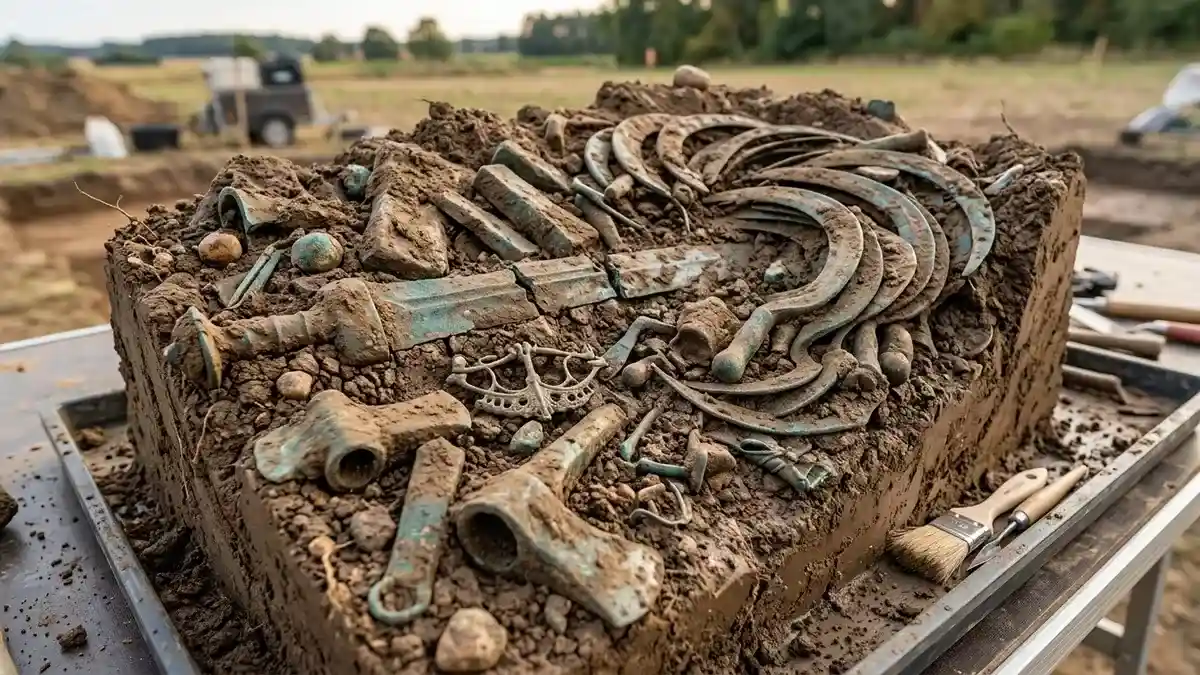
Initial digging quickly revealed 108 individual bronze items that had been scattered and damaged over the decades by modern tractor plowing. However, as the team dug deeper, they hit the jackpot: a dense, tightly packed, completely undisturbed cluster of artifacts locked in their original historical positions. To prevent any damage to the fragile arrangement, the entire deposit was carefully carved out of the earth as a single, massive soil block and transported to a specialized laboratory, where it underwent delicate micro-excavation and cleaning over a span of seven months.
Inside the Hoard: Wealth, Weapons, and Transcontinental Trade
The sheer variety of the 310 salvaged pieces provides an unprecedented catalog of late Bronze Age craftsmanship, spanning across multiple sectors of ancient daily and spiritual life.
The collection features a diverse array of categories:
Agricultural and Specialized Tools: The bulk of the hoard consists of practical tools, including 136 beautifully formed sickles and 50 heavy-duty axes, which were central to clearing forests and harvesting crops.
Elite Garment Fittings and Jewelry: The team recovered a highly notable Spindlersfeld-type brooch—an elaborate, decorative safety pin used by wealthy elites to fasten heavy winter cloaks.
Raw Metallurgy: Multiple unworked raw bronze ingots were found mixed among the finished goods, representing raw currency and valuable manufacturing material.
The Broken Sword from the South
The most fascinating weapon recovered from the soil block is a rare bronze sword. The weapon was found broken into four separate pieces. Crucially, forensic microscopic analysis proved that two of these fractures occurred in antiquity, right before the burial took place. This means the sword was intentionally shattered by its original owner as part of a deliberate, symbolic destruction ritual.
When meticulously reassembled by laboratory conservators, the complete sword measures just 44 centimeters (about 17 inches) in length. Its unique pommel is constructed from two outer bronze shells that originally enclosed a decorative organic disc made from bone or ivory, which has long since rotted away. Because this highly specific style of sword design is native to southern Germany, its presence in eastern Saxony proves that the ancient residents of Görlitz were actively engaged in long-distance, luxury trade networks connecting communities across vast stretches of Central Europe.
Staged Devotion: Safekeeping vs. Ritual Offering
By analyzing the strict layout of the soil block, researchers determined that the ancient inhabitants dug a neat, precise pit measuring roughly 30 to 35 centimeters wide and 50 centimeters deep. While no organic container like a wooden chest or leather sack survived the millennia, distinct impressions left in the compacted clay prove that the 310 items were not tossed in haphazardly. Instead, they were arranged with extreme care, sorted into small, meticulous groups.
Because bronze was an incredibly rare, precious, and labor-intensive alloy during the 9th century BCE, burying 16 kilograms of it represented an astronomical financial sacrifice for a farming community. Scholars are confident that this treasure was not buried for standard safekeeping or hidden during an emergency. If a smith or merchant were simply hiding their inventory from thieves, they would not have intentionally snapped a priceless status sword into pieces. Instead, the hoard represents a massive, highly coordinated communal ritual offering dedicated to the gods or ancestral spirits.
“Already 3,000 years ago, the people in this area practiced various craft techniques and were in contact beyond their immediate area. These precious artifacts are now able to tell us much more about this era.” — Michael Kretschmer, Saxony’s Minister-President
Preserving the Past for Future Generations
The massive collection is currently undergoing state-of-the-art restorative treatment and intensive scientific analysis. Teams of scientists are conducting advanced use-wear tests and corrosion mapping to determine if the tools were actively used in the fields or if they were manufactured pristine specifically to be buried as offerings. The historical significance of the find has already sparked a dedicated doctoral research project at the prestigious Ludwig Maximilian University in Munich.
Once the exhaustive conservation work and documentation are complete, the spectacular hoard will return home. It is slated to anchor a custom, high-profile exhibition in the city of Görlitz, allowing the public to look directly into the eyes of a lost culture that buried its greatest wealth in the soil nearly three millennia ago.
Frequently Asked Questions
Where exactly was the Bronze Age hoard found?
The hoard was discovered in Klein Neundorf, a suburban district of the city of Görlitz, located in the eastern German state of Saxony near the border.
How old are the artifacts and what do they weigh?
The 310 pieces of bronze date back to the 9th century BCE, making the treasure roughly 3,000 years old. The combined weight of the collection is over 16 kilograms (35 pounds).
What types of objects were discovered in the treasure?
The vast collection contains 136 agricultural sickles, 50 axes, a highly decorative Spindlersfeld-type brooch, raw metal ingots, garment fittings, and a rare bronze sword that was ritually broken into four pieces before burial.
Why do archaeologists believe the treasure was a ritual offering?
Because the objects were organized neatly in small groups and included a valuable status sword that was intentionally broken in antiquity, scientists believe the cache was buried as a sacred religious offering to the gods rather than a temporary hiding spot for safekeeping.
What is the historical link to the potato harvest of 1900?
In 1900, local children harvesting potatoes in the exact same area found three ancient bronze daggers, and their father later found a bronze axe. These initial discoveries created a century-long suspicion that a much larger, coordinated treasure remained hidden beneath the farmland.