
Table of Contents
- 1. A Surviving Relic of a Lost Culture
- 2. The High-Stakes Recovery of Cueva de Las Jimenas
- 3. Rewriting the Decorative History of the Auaritas
- 4. Frequently Asked Questions
- 4.1. Who were the original inhabitants of La Palma?
- 4.2. Why was this discovery kept secret for over a year?
- 4.3. What makes Phase IVb pottery historically significant?
- 4.4. How did the vessel survive being crushed by cave rocks?
- 4.5. Can the public view the recovery process?
Rare 15th-Century Indigenous Ceramic Vessel Uncovered in La Palma
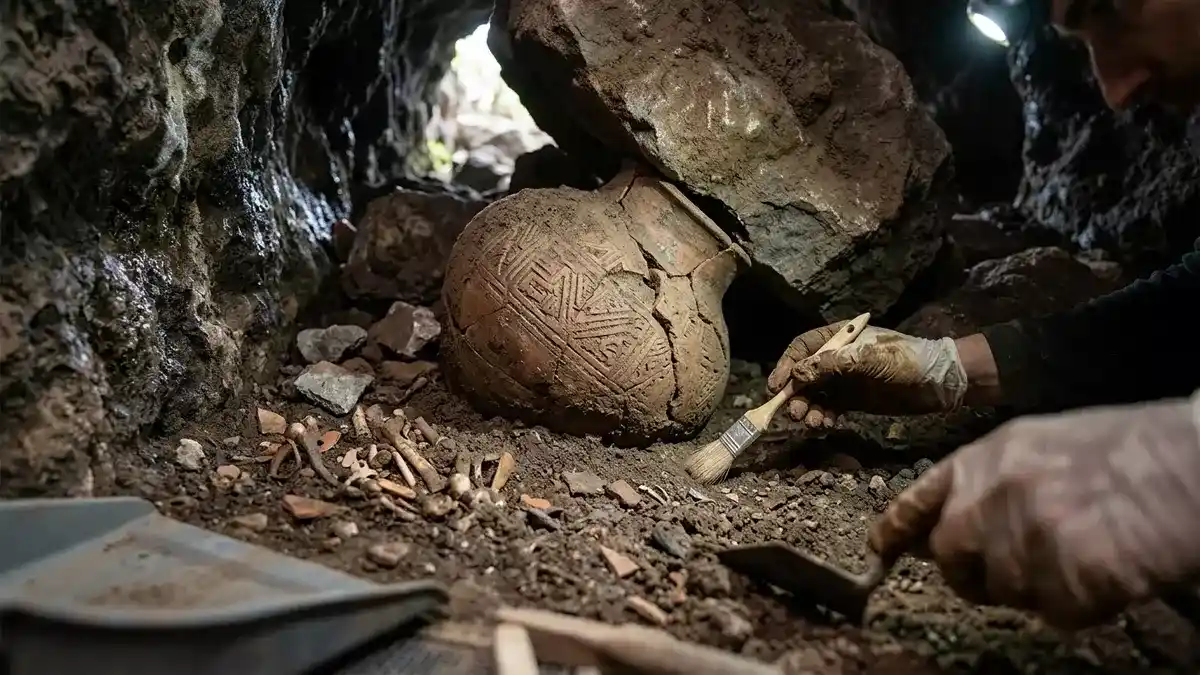
Archaeologists working on the island of La Palma in the Canary Islands have unearthed a rare, nearly intact ceramic vessel dating back to the late 15th century—the volatile era of the Castilian conquest. Discovered within a secluded cave in the municipality of Tijarafe, the artifact is being celebrated as one of the most significant archaeological finds in the Canary archipelago in recent years, offering a direct material connection to the island’s original, systematically erased Indigenous inhabitants.
Rare 15th-Century Indigenous Ceramic Vessel Uncovered in La Palma
A Surviving Relic of a Lost Culture
Prior to Spanish colonization, La Palma was populated by the Auaritas, a distinct subgroup of the Guanches—the Berber-descended Indigenous peoples who inhabited the Canary Islands for millennia. When the Crown of Castile launched its military campaign to conquer the archipelago in the 1400s, the Auaritas faced devastating warfare, forced displacement, European diseases, and enslavement. Anthropologists often point to this brutal conquest as an early blueprint for the colonial strategies and cultural erasures that European powers would later inflict upon the Americas.
Because of this turbulent history, surviving artifacts from the final decades of sovereign Indigenous life are incredibly scarce. The newly discovered vessel belongs to what archaeologists classify as Phase IVb of La Palma’s ceramic chronology—the dominant artistic style being produced right as Spanish forces breached the island.

While typical Guanche pottery was strictly utilitarian, either entirely undecorated or featuring rudimentary fingernail impressions, this newly recovered piece stands out for its remarkably complex, ornate geometric patterns.
The High-Stakes Recovery of Cueva de Las Jimenas
The vessel was originally located in 2024 deep within the Cueva de Las Jimenas (Jimenas Cave), hidden along the rugged cliffs of the Barranco de Los Gomeros near the neighborhood of El Jesús. The cave system has a long history of human activity, serving local populations for centuries primarily as a sacred ancestral funerary site.
Because finding a complete, unbroken Indigenous vessel is an extraordinary rarity—the vast majority of discoveries consist of small, scattered shards—the Tijarafe City Council kept the discovery strictly confidential for over a year. The artifact was wedged in a dangerous, highly unstable section of the cave, partially pinned beneath heavy fallen boulders that had fractured its body and threatened to crush it entirely.
 Vikings (Quiz)
[2024: Cave Discovery] ──> Kept Secret for Protection ──> [Aug 2025: Delicate Stabilization & Extraction]
To prevent the piece from shattering, a specialized recovery mission was executed on August 11, 2025. Leading the effort was professional antiquities restorer Salomé González Rodríguez, who crawled into the tight rock fissure to carefully apply chemical consolidants to the fragile, cracked sections of the clay before attempting to lift it.
Following its successful extraction, the artifact was moved to a temporary conservation workshop. There, it underwent a meticulous process of microscopic cleaning, structural stabilization, and documentation using entirely reversible, museum-grade conservation techniques to safeguard its historic authenticity.
Rewriting the Decorative History of the Auaritas
The integrity and highly unusual stylistic choices of the Tijarafe vessel have sparked intense intrigue among regional historians. The unique layout of its decorative motifs deviates notably from standard Phase IVb patterns preserved in other regional collections.
| Heritage Attribute | Standard Guanche Pottery | The Tijarafe Vessel |
| Preservation State | Fragmented shards (tejos) | Nearly 100% complete and structurally sound. |
| Surface Finish | Plain, coarse, or lightly brushed | Elaborately decorated with unique geometric patterns. |
| Primary Context | Domestically scattered or lost | Intentionally placed in a high-status cave cemetery. |
Specialists suggest that these anomalous decorations may point to a previously undocumented local artistic guild unique to the Tijarafe valley, or perhaps represent a deliberate, rebellious revival of much older ancestral design traditions as Auarita potters pushed back against encroaching European cultural influences.
The vessel is currently held under the secure custody of the Ayuntamiento de Tijarafe. It remains the focus of ongoing scientific analysis, including advanced photogrammetry to build a flawless 3D digital model, and mineralogical clay testing to track the exact earth source where the Indigenous potter gathered the raw clay 550 years ago.
Frequently Asked Questions
Who were the original inhabitants of La Palma?
La Palma was originally inhabited by the Auaritas, a pastoralist Indigenous group belonging to the broader Guanche culture. They migrated to the Canary Islands from North Africa around 1,000 BCE and lived in isolation until European mariners began arriving in the late Middle Ages.
Why was this discovery kept secret for over a year?
Because complete Indigenous pottery vessels are incredibly valuable and prone to illegal looting, archaeologists and local officials hid the discovery until a professional team could safely stabilize, extract, and secure the artifact from the dangerous cave location.
What makes Phase IVb pottery historically significant?
Phase IVb represents the absolute final evolutionary stage of independent Indigenous ceramic art on La Palma. It captures the exact moment of cultural transition and conflict during the late 15th-century Spanish conquest of the island.
How did the vessel survive being crushed by cave rocks?
The vessel survived thanks to the intervention of professional restorers, who applied specialized structural consolidants to the cracked clay body directly inside the cave. This reinforced the fragile areas, allowing the team to safely clear the surrounding boulders without causing the artifact to collapse.
Can the public view the recovery process?
Yes. To celebrate the landmark find and educate the public on the island’s pre-colonial history, the local municipality produced a detailed documentary mapping the entire high-stakes cave extraction and laboratory restoration process.