
Table of Contents
**14,000-Year-Old Alaska Site Rewrites First Americans Story**
Archaeologists have uncovered compelling new evidence at a buried campsite in Alaska that illuminates how the earliest humans arrived in North America. The Holzman site in the middle Tanana Valley reveals repeated human occupation around 14,000 years ago, right at the end of the last Ice Age. This discovery strengthens our understanding of ancient migration routes, Ice Age survival strategies, and the technological foundations that later spread across the continent.
By examining stone tools, mammoth ivory artifacts, and camp remains, researchers are piecing together the daily lives of these pioneering hunters. The findings challenge old assumptions and highlight Interior Alaska as a vital homeland for the first Americans during a time of dramatic environmental change.
14,000-Year-Old Alaska Site Rewrites First Americans Story

### Discovering the Holzman Site in Alaska’s Tanana Valley
Located along Shaw Creek near its confluence with the Tanana River, the Holzman site sits in a resource-rich corridor that offered water, game, and quality stone materials. Excavations have exposed layered sediments that preserved multiple occupation floors, providing a rare window into human activity during the late Pleistocene.
The deepest and oldest layer dates to approximately 14,000 years ago. It contains evidence of campfires, bird bones, large mammal remains, and quartz flakes from tool-making. A nearly complete mammoth tusk found in this level suggests people actively used these massive animals for food, tools, and possibly raw materials. The setting near a river and creek made it an ideal stopping point for mobile groups tracking seasonal resources.
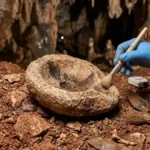
A slightly younger occupation level around 13,700 years ago shows an even more specialized focus. Dense concentrations of quartz fragments indicate intensive tool production, while abundant ivory-working debris points to skilled craftsmanship. These discoveries paint a picture of organized hunter-gatherers who returned to familiar locations over generations.
### Breakthrough in Ancient Ivory Tool Technology
One of the most exciting finds involves the earliest known mammoth ivory rods and blanks in the Americas. People at the Holzman site carefully carved long ivory sections into standardized forms, likely used as foreshafts for composite weapons. Microscopic analysis of cut marks and shaping traces confirms deliberate manufacturing rather than opportunistic use.
This ivory technology predates similar artifacts found in Clovis sites farther south by about a thousand years. Clovis people, famous for their iconic fluted stone spear points around 13,000 years ago, also relied heavily on organic tools. The Alaska evidence suggests that key elements of this toolkit developed in northern regions before spreading southward as populations expanded.
Such innovations were crucial for hunting large Ice Age animals like mammoths, bison, and caribou. Ivory foreshafts would have allowed hunters to create durable, repairable weapons suited to the challenging Arctic and subarctic environments of eastern Beringia.
### Stone Tool Traditions and Resource Strategies
Stone artifacts from the site add important details to the story. Most tools were crafted from local quartz, with occasional use of chert and siltstone. Analysis reveals careful raw material selection, organized core reduction sequences, and evidence of tool transport across the landscape. These patterns reflect highly mobile groups who knew the terrain intimately and maintained consistent technical traditions.
The presence of a large quartz bifacial chopper, heavy anvil stones, and in-situ tool kits demonstrates on-site manufacturing and maintenance. People cached materials and worked near small hearths, creating efficient activity areas within the camp. This level of planning points to experienced hunters adapted to the dynamic post-glacial world.
### Connections to Broader Migration Models
The timing of the Holzman occupations is particularly significant for understanding how humans first entered North America. By 14,000 years ago, people had established themselves in eastern Beringia—the land bridge region connecting Siberia and Alaska. The subsequent opening of ice-free corridors or coastal routes allowed southward movement between roughly 14,000 and 13,000 years ago.
Whether early migrants primarily followed the Pacific coast, traveled through interior ice-free corridors, or used a combination remains a topic of active research. Sites like Holzman show that sophisticated technologies and lifeways were already in place in the north, providing the cultural foundation for later Paleoindian traditions across the Americas.
The Tanana Valley has emerged as one of the most important regions for early American archaeology. Deep windblown sediments and permafrost have protected ancient surfaces, allowing researchers to document multiple sites older than 13,000 years. Holzman fits into this growing network and reinforces the idea that Interior Alaska served as a long-term homeland rather than a temporary waypoint.
### Life at the End of the Ice Age
The late Pleistocene was a period of profound transformation. Melting glaciers, shifting vegetation, and changing animal populations created both opportunities and challenges for human groups. The Holzman campers exploited a mix of resources: mammoth, birds, fish from the river, and likely plants available in the valley.
Repeated visits to the same location suggest deep knowledge of local ecology and seasonal cycles. People returned to reliable spots near water sources and raw material outcrops, establishing patterns that would influence later Indigenous adaptations across North America.
This evidence of sustained occupation helps counter earlier views of rapid, opportunistic migration. Instead, it supports models of gradual exploration and settlement by adaptable hunter-gatherers who carried sophisticated toolkits and environmental knowledge from Asia into the New World.
### Scientific Methods Powering the Discoveries
Careful excavation techniques, precise radiocarbon dating, and advanced microscopic analysis have been essential to interpreting the Holzman site. Researchers documented spatial relationships between artifacts, hearths, and features to reconstruct activity areas. Studies of use-wear on tools and ivory reduction sequences provide insights into manufacturing processes that are rarely preserved so clearly.
The site’s frozen ground and layered deposits create excellent preservation conditions, allowing organic materials like bone and ivory to survive for millennia. This contrasts with many open-air sites where such evidence quickly degrades.
### Implications for Understanding the Peopling of the Americas
The Holzman findings contribute to a shifting consensus about the earliest Americans. They demonstrate technological continuity from northern Beringian groups to southern Clovis populations, suggesting cultural transmission as people moved into new territories.
This research also underscores the importance of organic technologies. While stone points often dominate discussions, items like ivory rods, bone needles, and wooden implements were equally vital to survival. The full toolkit reflects sophisticated problem-solving in harsh Ice Age conditions.
As climate change continues to impact northern archaeology, sites like Holzman become even more valuable. They offer baselines for understanding how ancient peoples responded to environmental shifts—lessons that remain relevant today.
### Alaska’s Role in Early American Prehistory
Interior Alaska stands out as a cradle for many innovations seen later across the continent. The region’s rich archaeological record, including multiple pre-Clovis age sites, continues to reshape textbooks on the peopling of the Americas. Holzman adds a key chapter, linking everyday camp life with continent-wide cultural developments.
Future work in the Tanana Valley and surrounding areas will likely yield even more insights. Ongoing surveys, improved dating methods, and ancient DNA studies promise to clarify relationships between different early groups and their connections to modern Indigenous peoples.
### Why This Discovery Captivates Modern Audiences
Stories of the first Americans resonate deeply with people interested in human origins, exploration, and resilience. The Holzman site brings these ancient journeys to life through tangible artifacts—tools held by hands that crossed continents, ivory shaped under Ice Age skies, and campfires that warmed families in a changing world.
For Alaskans and visitors to the region, it highlights the deep time depth of human presence on this land. It also connects to living Native Alaskan cultures whose ancestors carried forward knowledge and traditions rooted in these distant pasts.
### Conclusion: A Pivotal Link in Human Migration History
The 14,000-year-old campsite at Holzman transforms our view of early human dispersal into North America. From mammoth ivory workshops to organized stone tool production, the site reveals skilled hunters who thrived in Beringia and laid the groundwork for cultures that would spread far and wide.
This discovery strengthens northern origins for key Paleoindian technologies and emphasizes Alaska’s central role in the peopling of the Americas. As researchers continue to study these fragile remains, we gain a clearer picture of the courage, ingenuity, and adaptability that defined humanity’s greatest migration.
The quiet banks of Shaw Creek hold stories of our shared past, reminding us how ancient footsteps in Alaska echo across the entire Western Hemisphere.
### FAQ: 14,000-Year-Old Alaska Campsite and Early Migration
**How old is the Holzman site and why is it important?**
The site dates to around 14,000 years ago with multiple occupation levels. It provides direct evidence of human activity in Alaska during the late Ice Age and offers clues about the roots of technologies seen in later cultures farther south.
**What makes the ivory artifacts at Holzman special?**
Researchers found the earliest known mammoth ivory rods and blanks in the Americas. These carefully crafted pieces predate similar Clovis-era tools and likely served as weapon components, showing advanced manufacturing skills.
**What types of stone tools were discovered?**
Most artifacts were made from local quartz, including bifacial choppers, scrapers, and flakes. Evidence shows organized production and transport of materials, reflecting mobile yet knowledgeable hunter-gatherers.
**How does this site fit into migration theories?**
It supports the idea that people were well-established in Beringia by 14,000 years ago before moving south. The technological links to Clovis suggest cultural continuity as groups explored new territories after the ice sheets retreated.
**Why is the Tanana Valley significant for archaeology?**
Excellent preservation in windblown sediments and permafrost has protected many early sites. The region is yielding some of the oldest well-documented human occupations in North America.
**What animals did these early Alaskans hunt?**
Evidence includes mammoth, birds, and other large mammals. The river valley setting provided diverse resources that supported repeated campsite use.