
Table of Contents
- 1. Piercing the Temple Floor: A Breakthrough for Assyrian Origins
- 2. Mineral Fingerprints: Tracing the Sacred Material
- 3. Southern Purification Meets Northern Mythology
- 4. An Elite Symbol of Cultural Pride
- 5. Frequently Asked Questions
- 5.1. What did archaeologists discover beneath the Ishtar Temple in Assur?
- 5.2. How does this discovery change the timeline of the city?
- 5.3. Where did the sand originally come from?
- 5.4. What was the religious purpose of placing sand under a temple?
- 5.5. Was this sand layer found under all the temples in Assur?
Sacred Sands of Assur: Hidden Layer Beneath Ishtar Temple Unveils City’s Holy Origins
A pioneering geological and archaeological investigation has unlocked the deepest secrets of Assur, Iraq, exposing a deliberately placed, one-meter-thick layer of imported sand directly beneath the foundations of the Ishtar Temple. The discovery establishes the earliest absolute date for the legendary city, proving it was a thriving urban powerhouse over 4,700 years ago, while revealing a fascinating blending of southern Mesopotamian purification rituals and northern mountain geology.
Sacred Sands of Assur Hidden Layer Beneath Ishtar Temple Unveils City’s Holy Origins
Piercing the Temple Floor: A Breakthrough for Assyrian Origins
Perched on the western banks of the Tigris River, Assur served as the beating political and spiritual heart of the Neo-Assyrian Empire during its first-millennium BCE golden age. However, its earliest roots in the third millennium BCE remained shrouded in mystery.
While excavations led by Walter Andrae between 1903 and 1914 originally uncovered the Ishtar Temple, the fragile state of the mudbrick ruins left the deepest, oldest foundational layers completely inaccessible to early 20th-century tools.

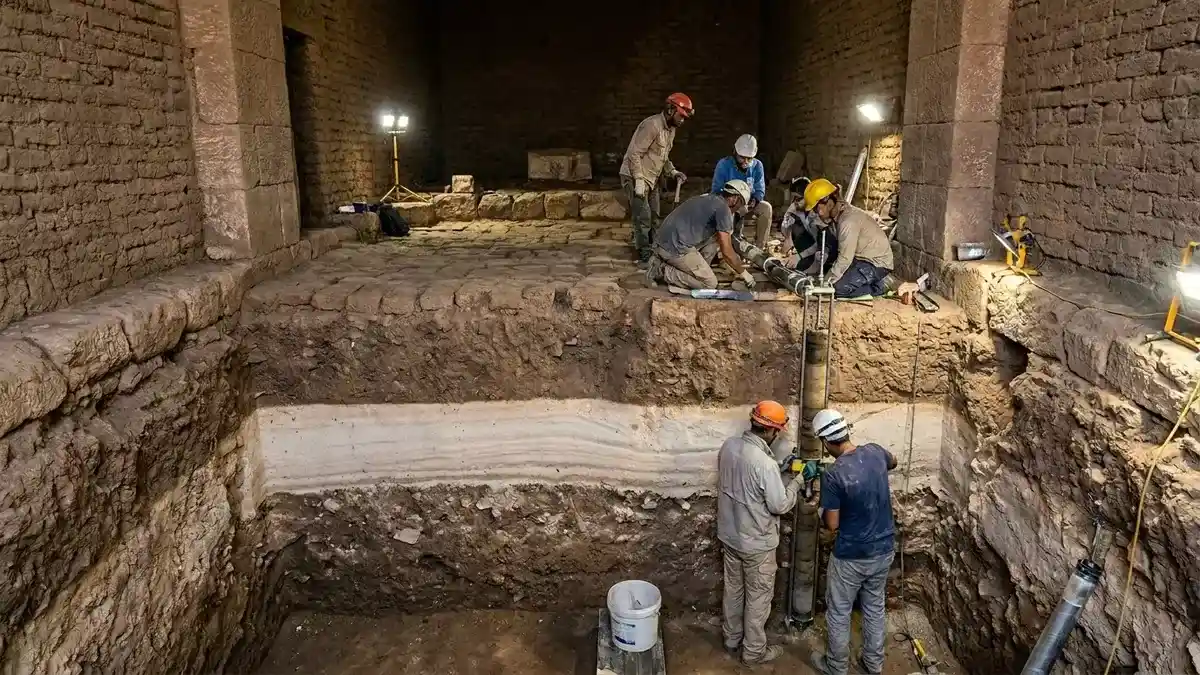
To bypass this hurdle, the modern Assur Excavation Project—based at the Ludwig Maximilian University of Munich—deployed high-precision, non-destructive sediment coring technology directly inside the temple’s inner sanctum (cella).
The drills pushed past centuries of construction to reach Temple H, the very first structural phase of the sanctuary. Beneath the mudbrick floor, scientists struck a perfectly clean, one-meter-thick layer of pure sand that was intentionally laid down by the city’s founders. High-precision radiocarbon dating of charcoal trapped immediately above this sand layer pinned the temple’s construction between 2896 and 2702 BCE—firmly anchoring Assur’s birth within the Early Dynastic I period.
Mineral Fingerprints: Tracing the Sacred Material
To determine whether the sand was simply scooped up from the adjacent Tigris riverbank out of convenience or transported from afar, scientists subjected the sediment cores to the first systematic mineralogical examination of archaeological sand ever performed in Iraq.
       [ THE EXTRACTION TRACEWAY ]
       Metamorphic Blueschist Facies (Zagros Mountains)
                         │
                         ▼ (Erosion & Wind Transport)
       Upper Miocene Injana Formation (Lesser Zab River)
                         │
                         ▼ (Targeted Human Gathering)
       Local Aeolian Dunes / Desert Sand Deposits
                         │
                         ▼ (Sacred Application)
       One-Meter-Thick Foundation Base (Ishtar Temple H)
The laboratory results exposed a highly exotic mineral profile. The sand was packed with rare minerals, including epidote-group minerals, glaucophane, zoisite, and lawsonite.
This chemical fingerprint is highly characteristic of blueschist-facies metamorphic rocks, which do not occur along the local Tigris River corridor. Instead, these minerals trace their origin back to the towering Zagros Mountains.
The city’s founders strategically gathered these specific grains from local desert sand dunes that had been naturally recycled over millions of years from the Upper Miocene Injana Formation and washed down via the Lesser Zab River. The selection of this fine, multi-mineral sand was a highly calculated choice based entirely on its clean geological properties rather than ease of access.
Southern Purification Meets Northern Mythology
The presence of this hidden sand matrix solves a major puzzle regarding how ancient religious ideas traveled across the cradle of civilization.
In southern Mesopotamia (ancient Sumer), placing a thick layer of pristine, clean sand beneath a temple’s foundation was a well-documented, fundamental religious ritual. It served to symbolically “purify” the chaotic, mundane earth, sealing away the dirty ground to create a clean, spiritually sterile platform worthy of a god’s house.
+-------------------------------------------------------------------------+
|                    MESOPOTAMIAN SYSTEMIC ARCHITECTURE                   |
+------------------------------------+------------------------------------+
| Ritual & Structural Feature        | Cultural & Political Meaning       |
+------------------------------------+------------------------------------+
| Southern Purification Rite         | Sand layer sterilizes and purifies |
| (Sumerian Tradition)               | the ground for sacred structures   |
| Northern Mineral Importation       | Connects the temple to the Zagros  |
| (Hurrian/Mountain Geology)         | mountain religious landscape       |
| Selective Ishtar Focus             | Exclusively found in Temple H;     |
| (Political/Symbolic Isolation)     | missing from Sin-Shamash complexes |
+------------------------------------+------------------------------------+
The discovery under Temple H represents the earliest absolute evidence of this purification ritual ever found in northern Mesopotamia. It proves that the very first inhabitants of Assur were deeply plugged into southern cultural networks, adopting advanced ceremonial architectures from the south while using minerals tied to the northern landscapes.
Furthermore, the sand’s specific connection to northern mountain rock signatures may have linked the early cult of Ishtar with Shawushka, the powerful Hurrian goddess of war and healing who was worshipped in the nearby mountain foothills, reflecting a beautiful, dual-cultural design strategy.
An Elite Symbol of Cultural Pride
Fascinatingly, the sediment cores proved that this specialized treatment was not a standard construction technique used throughout the city. Independent testing at other massive temple complexes in Assur—including the dual shrines of the Sin-Shamash and Anu-Adad complexes—revealed a total absence of foundational sand layers.
This selective application highlights the unique, elite status of the Ishtar Temple. Temple H was not just a house of worship; it was a powerful political statement and a monument of cultural identity. By investing massive communal labor to transport, lay down, and build upon this deep, sacred sand matrix, the founders of Assur sent a clear message to their neighbors: their city was an advanced, highly legitimate center of cosmic order, bridging the worlds of the northern mountains and the southern plains under the watchful eye of the goddess Ishtar.
Frequently Asked Questions
What did archaeologists discover beneath the Ishtar Temple in Assur?
Scientists discovered a deliberately placed, one-meter-thick layer of clean sand beneath the oldest foundational phase (Temple H) of the Ishtar Temple in Assur, Iraq.
How does this discovery change the timeline of the city?
Radiocarbon dating of organic charcoal found directly above the sand layer dates the temple’s construction between 2896 and 2702 BCE, providing the first absolute date for the city’s foundation and proving it was an active urban center over 4,700 years ago.
Where did the sand originally come from?
Mineral analysis revealed rare elements like glaucophane and lawsonite, which track back to blueschist metamorphic rocks from the Zagros Mountains. The sand was collected from local dunes that had been washed down from the mountains through the Lesser Zab River over millennia.
What was the religious purpose of placing sand under a temple?
In ancient Mesopotamian religion, laying down a deep bed of clean sand was a vital purification ritual. It served to symbolically isolate and cleanse the ground, separating the sacred structure of the temple from the mundane, unholy dirt below.
Was this sand layer found under all the temples in Assur?
No. Excavations at other major complexes in the city, such as the Sin-Shamash and Anu-Adad temples, showed no traces of sand foundations. This proves that the purification rite was selectively reserved for the Ishtar Temple as a high-status cultural and symbolic marker.