
Table of Contents
- 1. The Ingenuity of Roman Diatreta
- 1.1. From “Stop-Marks” to Studio Logos
- 2. Debunking the Myth of the Solitary Artisan
- 3. A Glassblower’s Perspective on Ancient Labor
- 4. Mapping a Multilingual Craft Network
- 5. The Legacy of Ancient Branding
- 6. Frequently Asked Questions
- 6.1. What are Roman cage cups (diatreta)?
- 6.2. How were these ancient glass vessels made?
- 6.3. What do the hidden symbols on the glass mean?
- 6.4. Why does this discovery change our understanding of Roman history?
- 6.5. How did researchers uncover these hidden signatures?
Ancient Roman Cage Cups Reveal Long-Lost Secrets of Master Glassmakers
A quiet afternoon at the Metropolitan Museum of Art recently led to a groundbreaking discovery that is completely rewriting the history of Roman engineering. While studying a private collection of late Roman diatreta—exquisite, double-walled glass cage cups—art historian and experienced glassblower Hallie Meredith noticed something everyone else had missed. What generations of scholars had brushed off as mere decorative flair on the back of a cup was actually a sophisticated, intentional pattern.
Dating back to the fourth through sixth centuries CE, these vessels represent the absolute pinnacle of ancient glassworking. For centuries, experts assumed these impossibly intricate objects were the solitary masterpieces of isolated geniuses. However, Meredith’s keen eye has revealed a hidden visual code, proving that the Roman luxury glass industry relied on highly coordinated, collaborative factory networks long before modern branding was ever thought to exist.
Ancient Roman Cage Cups Reveal Long-Lost Secrets of Master Glassmakers

The Ingenuity of Roman Diatreta
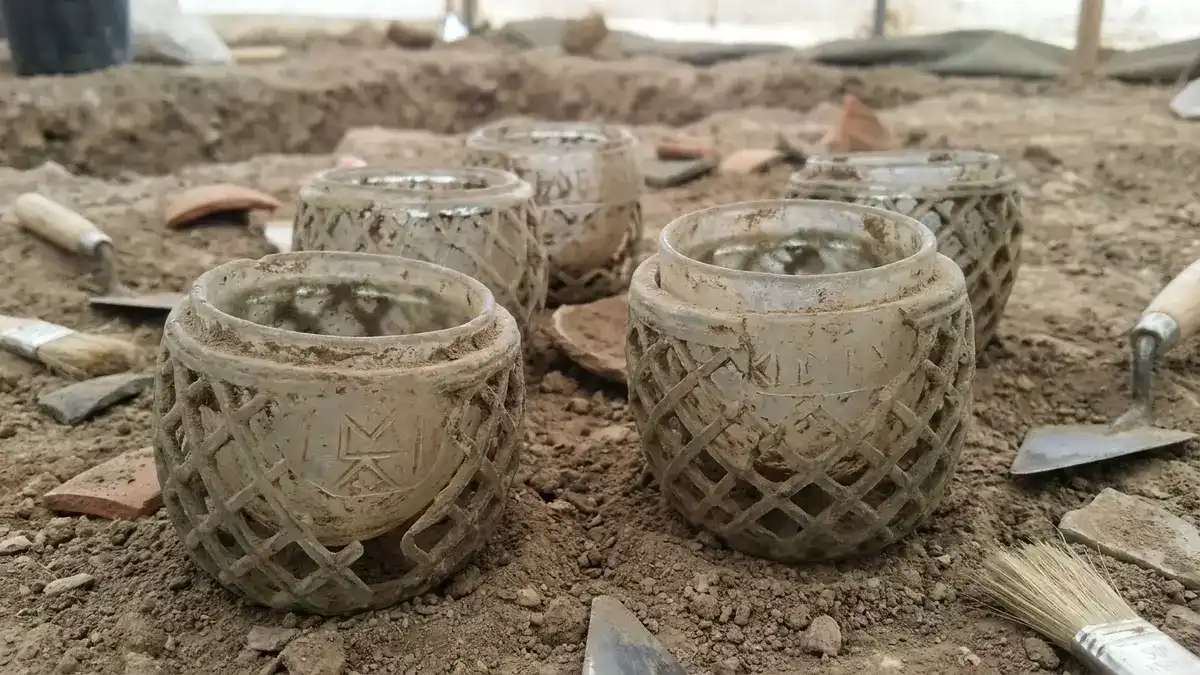
To understand the magnitude of this discovery, one must first appreciate how astonishingly difficult these vessels were to create. Diatreta are not ordinary cups; they feature an inner glass bowl encased in an outer geometric cage or lattice network. The two layers are connected by incredibly fragile, microscopic glass bridges, all meticulously carved from a single, thick blank of solid glass.
Historically, academic debates have fiercely contested exactly how these objects were made. Theories ranged from complex casting methods to sophisticated glassblowing techniques. Because surviving examples frequently feature celebratory Latin inscriptions—such as BIBE VIVAS (“Drink, may you live!”)—scholars traditionally focused on the text and the sheer physical effort required to carve the glass. The abstract symbols sitting just beneath or beside these inscriptions, however, were largely ignored.
From “Stop-Marks” to Studio Logos
Previously, archaeologists dismissed small carvings of diamonds, leaves, and cross-like shapes as simple “stop-marks”—the ancient equivalent of a punctuation period to fill empty space. But Meredith’s research, published in World Archaeology and the Journal of Glass Studies, challenges this passive assumption.

By comparing multiple surviving cage cups across different global collections, she identified identical and near-identical geometric motifs repeating across separate vessels. This was not random decoration. Instead, these symbols functioned exactly like modern studio logos or trademarks, acting as a deliberate visual language that established brand identity for specific Roman workshops.
Debunking the Myth of the Solitary Artisan
The discovery of these makers’ marks completely upends the traditional romanticized view of the lone ancient craftsman. The sheer amount of time, risk, and specialized skill required to cut, engrave, and polish a single cage cup means that a lone worker would struggle to produce these at scale.
Instead, the evidence points to a highly organized, assembly-line style of production. The creation of a single cup likely involved an interconnected ecosystem of craftworkers:
Master Glassblowers: Crafting the initial thick-walled blanks.
Specialized Engravers: Mapping out the geometric lattice and carving away the excess material.
Master Polishers: Smoothing down the impossibly tight spaces between the inner bowl and the outer cage.
The repeating symbols indicate that these teams were not working in isolation. They shared techniques, passed unfinished pieces between specialists, and used a unified coding system to communicate within and between different regional workshops. This level of synchronized labor reveals a corporate sophistication in the late Roman Empire that rivals modern manufacturing.
A Glassblower’s Perspective on Ancient Labor
What makes this breakthrough possible is Meredith’s unique dual background as both a Washington State University academic and an active glassblower. Physical familiarity with molten glass, specialized cutting wheels, and the unforgiving nature of brittle materials provides a practical perspective that traditional text-based historians often lack.
By analyzing tool marks, unfinished artifacts, and recycled glass fragments, researchers can reconstruct the daily “lived experiences” of these ancient laborers. The work was grueling, requiring intense physical stamina, immense patience, and an understanding of structural physics. When an artisan carved a diatreta, one single slip of the tool would shatter weeks of labor. The presence of workshop logos suggests that the artisans took immense collective pride in surviving this high-stakes process, using their marks to guarantee quality to elite Roman buyers.
Mapping a Multilingual Craft Network
The implications of this discovery stretch far beyond luxury glassware. The late Roman Empire was a massive, melting pot of cultures, languages, and traditions. To delve deeper into how these ancient workers communicated, researchers are building an innovative digital database in collaboration with computer science teams.
This database is designed to track irregular spellings, mixed Greek and Latin alphabets, and unconventional symbols across thousands of ancient artifacts. Many artisans in the late empire were illiterate or spoke regional dialects, yet they successfully navigated complex, multilingual commercial environments. By cataloging these micro-details, the project aims to illuminate the hidden social networks of the working-class scribes, metalworkers, and glassmakers who kept the Roman economy moving.
The Legacy of Ancient Branding
Ultimately, the hidden signatures on these Roman cage cups prove that branding and corporate identity are not modern inventions born out of the Industrial Revolution. Thousands of years ago, Roman glass workshops understood the value of a trademark. These subtle symbols assured wealthy patrons that their extraordinarily expensive vessels came from an elite studio capable of flawless execution.
Thanks to a mix of modern physical craft experience and rigorous archaeological analysis, the anonymous workers of the ancient world are finally getting the credit they deserve. They were not just manual laborers; they were part of a sophisticated, highly connected global industry that pushed the boundaries of what humanity thought possible with glass.
Frequently Asked Questions
What are Roman cage cups (diatreta)?
Cage cups, or diatreta, are luxury glass vessels from the late Roman Empire, created between the fourth and sixth centuries CE. They consist of an inner drinking bowl surrounded by a delicate, freestanding outer lattice or decorative cage, connected only by tiny, carved glass bridges.
How were these ancient glass vessels made?
While scholars have debated the exact methods for centuries, the prevailing consensus supported by recent research is that they were carved from a single, thick, blank piece of glass. Artisans used specialized rotary tools and polishers to meticulously cut away the negative space to form the outer cage.
What do the hidden symbols on the glass mean?
Previously thought to be meaningless decorative fillers or “stop-marks,” these abstract symbols (like diamonds and leaves) are now recognized as makers’ marks. They functioned as studio logos, representing the collective brand of the workshop that manufactured the vessel.
Why does this discovery change our understanding of Roman history?
It disproves the theory that these cups were made by lone, isolated artisans. Instead, the repeating marks prove that Roman glass production relied on highly organized, collaborative teams of specialized workers who shared standardized communication systems and techniques across workshops.
How did researchers uncover these hidden signatures?
The breakthrough came when an art historian with practical glassblowing experience noticed recurring, identical geometric patterns on the backs of cups in a private collection. By combining physical knowledge of the glassmaking process with a comparative study of surviving artifacts, the intentional nature of these marks was finally decoded.