
Table of Contents
- 1. The Dmanisi Enigma: Extreme Anatomical Diversity
- 2. Decoding Evolutionary Secrets Through Ancient Enamel
- 2.1. The Clear Dental Divide
- 3. Redefining the Human Family Tree: Two Species in the Caucasus
- 3.1. 1. Homo georgicus
- 3.2. 2. Homo caucasi
- 4. A Far More Complex Ancient World
- 5. Frequently Asked Questions
- 5.1. Why is the Dmanisi archaeological site so famous?
- 5.2. What did the new study discover about the Dmanisi fossils?
- 5.3. What are the names of the two proposed species found at the site?
- 5.4. Why did scientists use teeth instead of skulls to identify the species?
- 5.5. How does this discovery change our understanding of human migration?
1.8M-Year-Old Georgian Fossils Upend Single Human Migration Theory
A groundbreaking dental analysis of 1.8-million-year-old fossils unearthed at the Dmanisi archaeological site in the Republic of Georgia is completely shattering the classic textbook narrative of human evolution. For decades, mainstream anthropology has held that a single, pioneering human species—Homo erectus—was the sole hominin to successfully migrate out of Africa during the early Pleistocene era.
However, a new study published in the journal PLOS ONE delivers compelling evidence to the contrary. By peering deep into the fossilized enamel of ancient teeth, an international team of scientists has revealed that this pivotal prehistoric exodus likely involved at least two entirely distinct human species coexisting on the rugged landscape of the Caucasus.
1.8M-Year-Old Georgian Fossils Upend Single Human Migration Theory
The Dmanisi Enigma: Extreme Anatomical Diversity
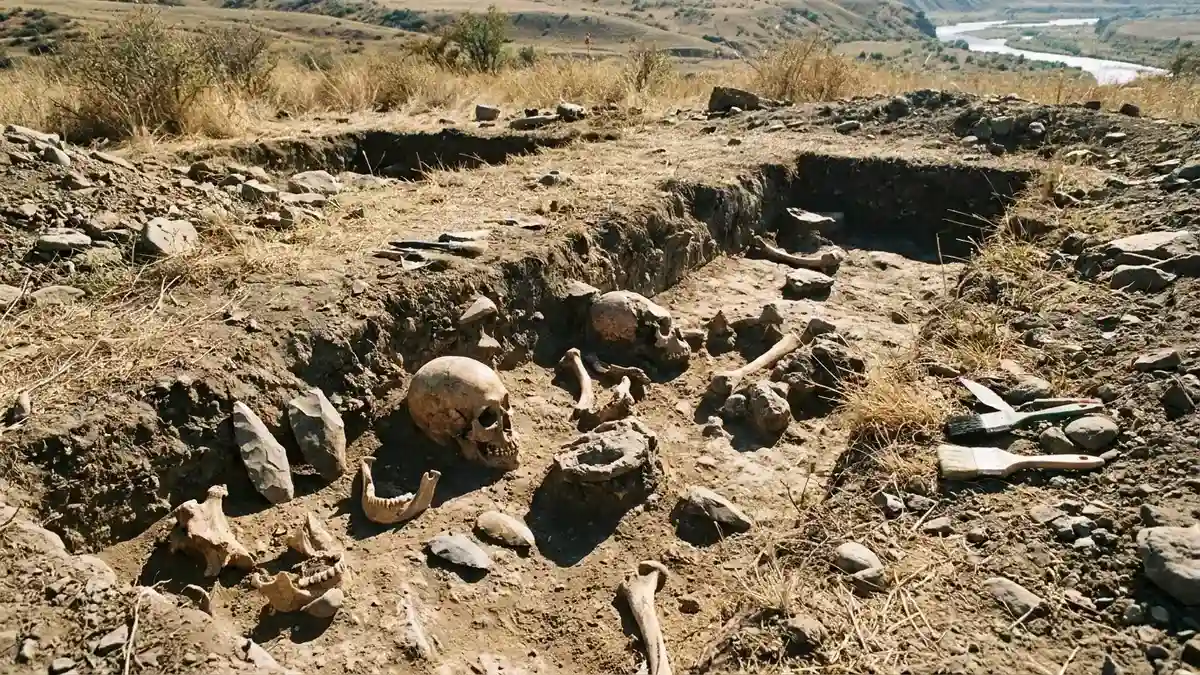
Located southwest of the Georgian capital of Tbilisi, the Dmanisi site is globally revered as the home of the oldest known hominin remains ever discovered outside the African continent. Since excavations began in the late 1990s, the locality has yielded an extraordinary treasure trove of primitive stone tools, extinct animal bones, and five remarkably well-preserved human skulls.
From the moment they were pulled from the earth, these skulls sparked fierce scientific debates due to their bewildering physical diversity:
The Gracile Specimens: Several skulls appear relatively delicate, modern, and distinctly human-like in their structural proportions.
The Primitive Specimens: Most notably “Skull 5″—the world’s first completely intact Early Pleistocene adult hominin skull—features a tiny, ape-like braincase coupled with a massive, projecting face.

For years, scientists were split into two warring camps. One side argued that the extreme anatomical variations were simply natural differences between males and females of a single, highly diverse species (sexual dimorphism). The other side suspected they were looking at a mixture of completely different species that happened to die in the same geographic pocket.
Decoding Evolutionary Secrets Through Ancient Enamel
To settle the debate once and for all, the research team shifted their focus away from highly malleable cranial shapes, which can warp and distort under the immense pressure of geological forces over millions of years. Instead, they turned to the most resilient substance in the human body: tooth enamel.
The researchers meticulously analyzed the crown surface areas of the premolars and molars belonging to three Dmanisi individuals who possessed sufficient dental material. To contextualize their findings, they processed the data through a massive statistical comparative framework containing 583 fossil teeth spanning various Australopithecus ancestors and multiple early Homo lineages.

The Clear Dental Divide
The statistical classification yielded an unmistakable taxonomic split among the Georgian fossils, proving that the structural differences were far too severe to be blamed on gender variations alone:
| Fossil Specimen | Primary Dental Alignment | Evolutionary Characteristics |
| Dmanisi Individual 1 | Closely aligned with Australopiths | Highly primitive, ape-like dental proportions reminiscent of earlier African ancestors. |
| Dmanisi Individuals 2 & 3 | Closely aligned with early Genus Homo | More advanced, reduced crown surface areas tracking closely with early human lineages. |
The scale of dental divergence between these individuals drastically exceeds the variations seen even in highly dimorphic modern great apes, such as gorillas. The data strongly suggests that the Dmanisi site was a shared landscape for multiple hominin groups.
Redefining the Human Family Tree: Two Species in the Caucasus
Based on these definitive dental profiles, the study’s authors strongly advocate for a multi-species model at Dmanisi around 1.8 million years ago. Rather than labeling every find as Homo erectus, the researchers point toward the coexistence of two distinct regional classifications:
1. Homo georgicus
This lineage represents the more primitive, small-brained, and large-faced hominins found at the site (epitomized by Skull 5). Their dental signatures anchor them closer to the evolutionary transition point between late ape-like ancestors and early humans.
2. Homo caucasi
This lineage represents the more advanced, gracile, and larger-brained individuals. Their physical traits and teeth show a much closer affinity to the core branch of early genus Homo that would eventually give rise to later human forms.
A Far More Complex Ancient World
If these findings continue to be validated by ongoing research, the implications for human evolutionary history will be monumental. The old, comforting narrative of a neat, linear progression—where a single dominant species walked out of Africa and steadily conquered the globe—is effectively dead.
Instead, the dawn of global human expansion is revealing itself to be a messy, complex, and richly diverse chapter of prehistory. The initial migrations out of Africa were likely a mosaic of multiple human species, each possessing different physical adaptations, behavioral traits, and survival strategies as they stepped out together into the sweeping, unpredictable environments of Eurasia.
Frequently Asked Questions
Why is the Dmanisi archaeological site so famous?
Dmanisi, located in the Republic of Georgia, holds the oldest securely dated hominin fossils ever discovered outside of Africa, securely anchoring human presence in Eurasia to 1.8 million years ago.
What did the new study discover about the Dmanisi fossils?
By analyzing and comparing 583 fossil teeth, the study discovered that the dental differences among the Dmanisi individuals are too vast to belong to a single species. The data indicates that at least two separate human species coexisted at the site simultaneously.
What are the names of the two proposed species found at the site?
The more primitive, small-brained form characterized by robust facial features is often classified as Homo georgicus, while the more gracile, human-like form with more advanced dental proportions is referred to as Homo caucasi.
Why did scientists use teeth instead of skulls to identify the species?
While skull bones can easily warp, crack, or become distorted by the weight of the earth over millions of years, tooth enamel is the hardest substance in the body and highly resistant to changes. This makes dental crown dimensions an incredibly reliable metric for mapping evolutionary relationships.
How does this discovery change our understanding of human migration?
It completely upends the traditional theory that Homo erectus was the only species to leave Africa 1.8 million years ago. It suggests that the first major migration into Eurasia was a highly complex event involving multiple distinct human species adapting to new environments at the same time.