
Table of Contents
- 1. Inside the Delta’s Ancient Factory: Mass Production Explored
- 1.1. The Fish Processing Hub
- 1.2. Diversified Class Workshops
- 2. The Roman Necropolis: Shifting Social and Burial Rites
- 2.1. Bioarchaeological Insights: A Portrait of Daily Health
- 3. Golden Treasures En Route to Cairo
- 4. Frequently Asked Questions
- 4.1. Where exactly were these ancient Egyptian discoveries made?
- 4.2. How old are the industrial workshops and the cemetery?
- 4.3. What did the ancient factory produce on a large scale?
- 4.4. Why did Romans bury children inside large clay jars?
- 4.5. What do the human remains tell us about life in the western Delta?
2,000-Year-Old Roman Necropolis and Industrial Complex Found in Egypt
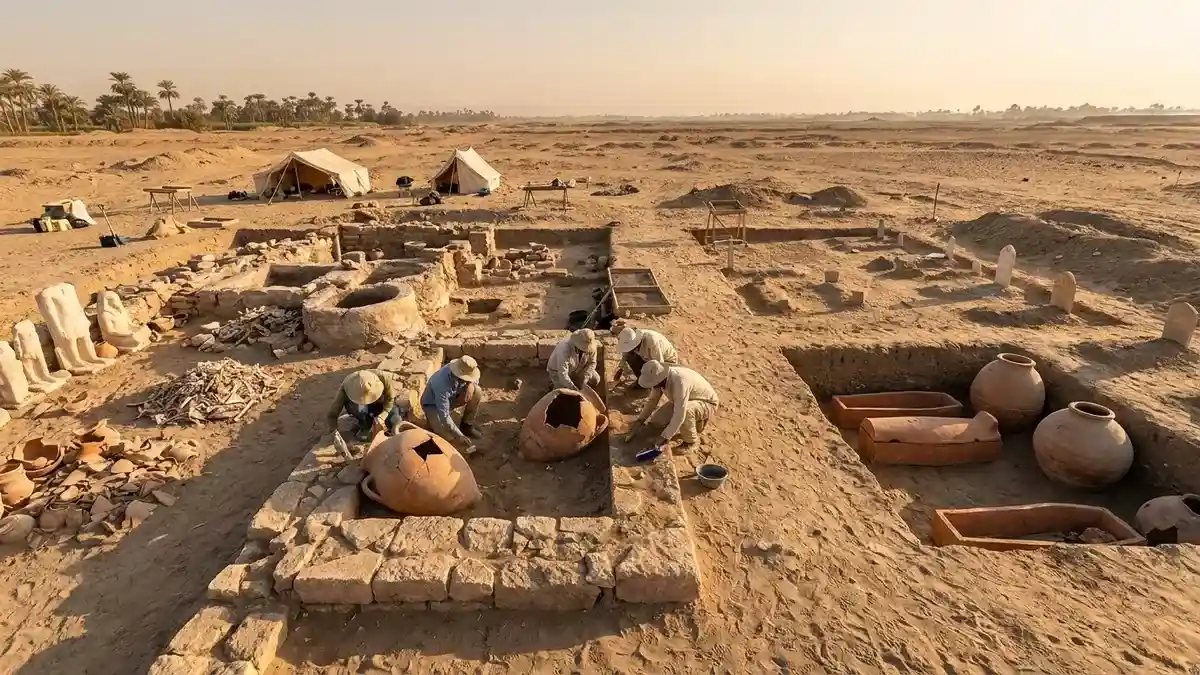
A massive archaeological breakthrough in Egypt’s western Nile Delta has exposed a bustling 2,000-year-old manufacturing hub alongside a diverse Roman-era cemetery. Excavating the ancient settlements of Kom el-Ahmar and Kom Wasit in the Beheira Governorate, a joint Egyptian-Italian team has pulled back the curtain on ancient Mediterranean trade, factory-scale food production, and intimate burial traditions spanning multiple historical eras.
The joint mission—spearheaded by Egypt’s Supreme Council of Antiquities and the University of Padua—highlights the western Delta’s forgotten role as a critical economic engine. Strategically positioned, this regional powerhouse linked the rich agricultural hinterlands of Egypt directly to the global trade networks of ancient Alexandria and the broader Mediterranean world.
2,000-Year-Old Roman Necropolis and Industrial Complex Found in Egypt
Inside the Delta’s Ancient Factory: Mass Production Explored
The crowning achievement of the industrial excavation is a large, meticulously organized manufacturing building dating from the Late Period into the early Ptolemaic Period. Comprising at least six distinct rooms, the structural layout reveals a highly sophisticated division of labor designed for high-volume commercial output.
The Fish Processing Hub
Two of the workshop’s largest rooms were entirely dedicated to large-scale fish processing. Archaeologists painstakingly recovered a staggering 9,700 fish bones from the floor layers, proving that this facility specialized in the mass production of salted and cured fish. In antiquity, salted fish was a crucial, non-perishable protein source that drove highly lucrative, long-distance maritime trade.
Diversified Class Workshops
Rather than relying on a single trade, this ancient industrial park supported a highly diversified local economy. The remaining four rooms functioned as specialized artisan workshops dedicated to:
Metallurgy & Stoneworking: Forging essential metal components and carving utilitarian stone tools.
Faience Manufacturing: Firing glazed ceramic amulets and religious charms highly sought after by everyday ancient citizens.
Sculpture Studios: The team unearthed numerous unfinished limestone figurines captured in various intermediate stages of carving, providing a rare look at ancient manufacturing techniques.

Discarded fragments of imported Greek pottery and distinct Mediterranean amphorae (large storage jars) indicate that this industrial complex was fully operational by the 5th century BCE. The data provides definitive proof that robust commercial and cultural alliances linked Egypt to the Greek world centuries before the arrival of Alexander the Great.

The Roman Necropolis: Shifting Social and Burial Rites
Directly adjacent to the sprawling factory grounds, the archaeological team exposed a multi-layered Roman-era cemetery. The varied burial styles found within this single necropolis offer a vivid reflection of the fluid social classes and shifting cultural influences defining the Delta under Roman rule.
The team documented three distinct burial methods:
Simple Earth Burials: Modest, unadorned graves dug directly into the soil, likely serving the everyday working-class populace.
Ceramic Coffins: More structured, terracotta sarcophagi indicating a modest level of personal wealth or social standing.
Amphora Burials: A poignant regional custom where deceased infants and young children were gently placed inside large, repurposed clay storage jars before internment.
Bioarchaeological Insights: A Portrait of Daily Health
Specialists are currently conducting extensive bioarchaeological analyses on the skeletal remains of 23 individuals recovered from the cemetery, a group encompassing men, women, adolescents, and children.
Initial skeletal inspections reveal a surprisingly optimistic narrative: the local population appears to have lived under relatively stable, prosperous conditions. The bones show no indicators of widespread chronic disease, systemic malnutrition, or physical trauma resulting from interpersonal violence. Ongoing genetic, isotopic, and physical studies will continue to map out exact dietary habits, lifespan data, and biological sex ratios to build an unprecedentedly detailed demographic profile of the ancient region.
Golden Treasures En Route to Cairo
Among the sea of utilitarian tools and industrial debris, researchers uncovered several pristine luxury artifacts. Chief among them are dozens of flawlessly preserved, intact amphorae and a striking pair of delicate gold earrings, believed to have belonged to an elite young Roman woman.
Recognizing their immense artistic and cultural value, authorities have securely transferred these premier pieces to the prestigious Egyptian Museum in Cairo for permanent curation, preservation, and eventual public display.
Frequently Asked Questions
Where exactly were these ancient Egyptian discoveries made?
The excavations took place at the twin archaeological sites of Kom el-Ahmar and Kom Wasit, situated in the Beheira Governorate within Egypt’s western Nile Delta.
How old are the industrial workshops and the cemetery?
The industrial complex dates back to the Late Period and the early Ptolemaic Period (with roots stretching back to the 5th century BCE), while the neighboring necropolis belongs to the later Roman Period, creating a historical timeline spanning over 2,000 years.
What did the ancient factory produce on a large scale?
The facility was a multi-functional industrial park. Two rooms were used for the mass production of salted fish (confirmed by 9,700 excavated fish bones), while other rooms produced stone and metal tools, limestone statues, and glazed faience amulets.
Why did Romans bury children inside large clay jars?
Burying infants and young children inside repurposed amphorae (storage jars) was a common, deeply symbolic funerary practice across various parts of the ancient Mediterranean. It is often interpreted by anthropologists as a protective, womb-like vessel for the child in the afterlife, or a practical, respectful burial method for grieving families of modest means.
What do the human remains tell us about life in the western Delta?
An analysis of 23 excavated skeletons reveals that the inhabitants lived relatively comfortable lives. Their bones lack any signature markers of devastating plagues, severe malnutrition, or violent trauma, indicating a stable and healthy local environment.