
Table of Contents
- 1. Unlocking the Secrets of the Xerxes I Alabastron
- 2. From Royal Palaces to Everyday Burials
- 2.1. Calcite as the Universal Packaging of Late Antiquity
- 3. Re-evaluating the Treasures of King Tutankhamun
- 4. Mapping the Ancient Global Drug Trade
- 5. Frequently Asked Questions
- 5.1. What did the Yale study discover inside the ancient vessel?
- 5.2. Who was Xerxes I and why is his name on the jar?
- 5.3. Why did ancient people use calcite to store opium?
- 5.4. How does this connect to King Tutankhamun’s tomb?
- 5.5. Was opium use restricted only to royalty in the ancient world?
New Research Links Ancient Egyptian Alabaster to Imperial Opium Trade
A groundbreaking chemical analysis of an inscribed Egyptian alabaster vessel has provided the most definitive scientific proof to date that opium use was deeply woven into the fabric of the ancient Mediterranean world. Executed by the Yale Ancient Pharmacology Program (YAPP), the study extracted organic residue from a 2,500-year-old jar housed in the Yale Babylonian Collection.
The testing successfully identified a complex cocktail of specialized opiate markers trapped inside the pores of the stone. This marks the very first time scientists have definitively verified the exact chemical contents of a historically inscribed Egyptian alabastron (a small, narrow-necked vessel used for precious liquids). The discovery challenges centuries of academic assumptions regarding ancient trade, pharmacology, and elite lifestyle habits, suggesting these iconic stone containers were manufactured with a far more potent purpose than previously imagined.
New Research Links Ancient Egyptian Alabaster to Imperial Opium Trade
Unlocking the Secrets of the Xerxes I Alabastron
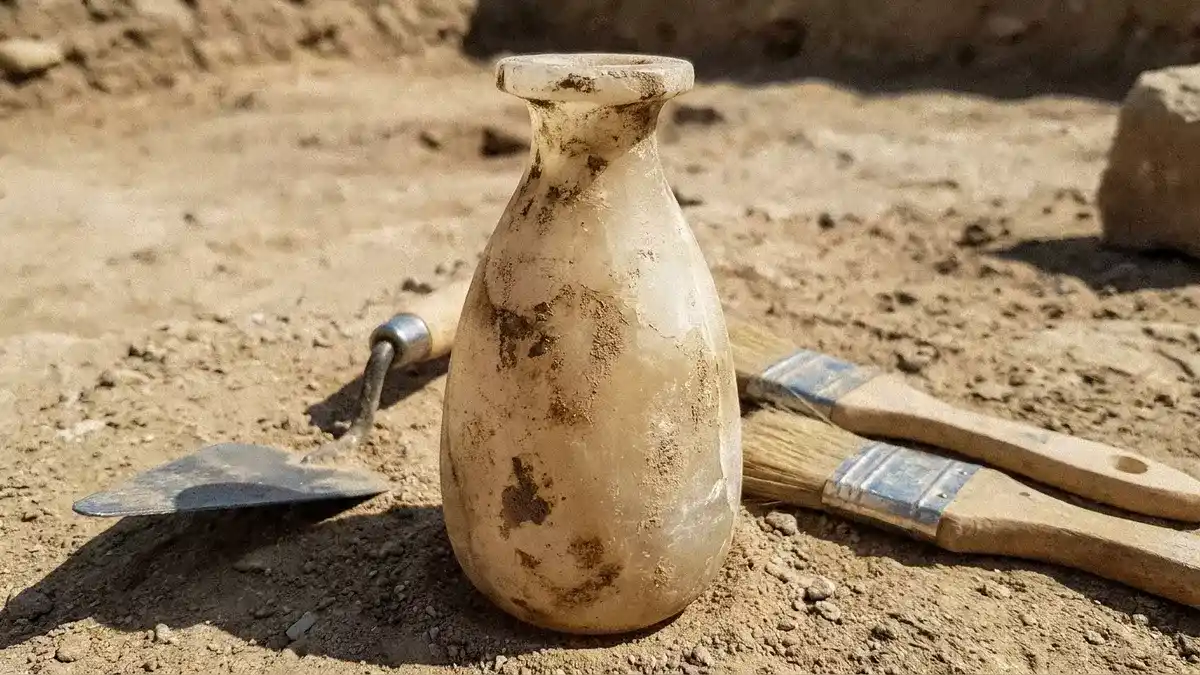
The primary focal point of this historic investigation is an beautifully preserved, intact vase carved entirely from rich calcite stone. What makes this specific artifact an international treasure is its dedication to Xerxes I, the famous Achaemenid Emperor who ruled over the sprawling Persian Empire from 486 to 465 BCE.
During this era, the Persian Empire had expanded its borders drastically, conquering Egypt and transforming it into a vital imperial province. To solidify political alliances and project supreme authority across this massive territory, luxury items were frequently commissioned and inscribed with royal propaganda. The Yale vase features an official dedication to Xerxes I rendered simultaneously in four distinct ancient languages, highlighting the multicultural reality of Near Eastern imperial rule.
       [THE CHEMICAL SIGNATURE OF ANCIENT OPIUM]
                          │
  ┌───────────────┬───────┴───────┬───────────────┐
  ▼               ▼               ▼               ▼
Morphine      Thebaine       Papaverine       Noscapine
Despite being thoroughly cleaned over its multi-millennial journey through antiquities collections, the vessel’s interior walls still retained micro-traces of dark, highly aromatic organic residue. Utilizing advanced, non-destructive extraction methods perfected over years of evaluating fragile museum artifacts, the Yale research team successfully pulled a clear chemical profile from the residue. The results were undeniable, revealing high concentrations of key alkaloids that occur exclusively in the opium poppy (Papaver somniferum), including morphine, thebaine, papaverine, and noscapine.
 Seizure of Carthaginian Bronze Coins Highlights Ancient Economy and Illicit Antiquities Trade
From Royal Palaces to Everyday Burials
For generations, art historians and archeologists assumed that smooth, heavy translucent calcite jars were used strictly to hold high-end cosmetics, thick moisturizing salves, or floral-based perfumes. The Yale study completely shatters this assumption by revealing a direct, functional connection between the material properties of calcite and the storage of powerful narcotics.
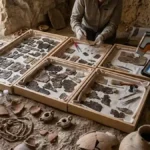
This discovery seamlessly aligns with earlier, highly debated archaeological finds excavated by pioneering British archaeologist Flinders Petrie at the historic site of Sedment, Egypt. Petrie’s team recovered plain, uninscribed alabaster vessels and imported Cypriot ceramic juglets from standard, non-elite graves that also displayed clear chemical markers of opiate storage.
| Discovery Site | Vessel Context | Social Stratification | Historical Significance |
| Yale Babylonian Collection | Inscribed Royal Calcite Jar | Imperial Elite (Xerxes I) | Links narcotic trade to top-tier imperial diplomacy |
| Sedment Excavations | Plain Alabaster & Cypriot Juglets | Common/Provincial Citizens | Proves widespread access to opium among ordinary people |
By comparing these two distinct sets of data, historians now have a clear picture of an interconnected ancient market. Opium was not an ultra-rare, protected substance reserved strictly for kings, nor was it a crude folk remedy limited to provincial villages. Instead, the distribution network spanned across all levels of society—influencing both the grand palaces of Achaemenid-era Mesopotamia and the everyday provincial graves of common Egyptian citizens.
Calcite as the Universal Packaging of Late Antiquity
Archaeologists believe that ancient societies deliberately selected calcite for opium storage due to its unique structural and physical attributes. The dense, cool stone provided excellent insulation against temperature spikes, preventing volatile liquid solutions from evaporating or degrading rapidly under the intense Mediterranean sun.
Furthermore, the distinct elongated shape and high-sheen polished surface of these vessels served an important sociological purpose. Much like how specific packaging styles or smoking paraphernalia instantly denote tobacco or cannabis products to modern consumers, the unmistakable appearance of an Egyptian alabaster jar acted as a universal visual brand across the ancient world. When a merchant or consumer spotted a stylized alabastron, they knew exactly what potent substance was contained inside.
Re-evaluating the Treasures of King Tutankhamun
The broader implications of the Yale study reach even further back into Egyptian history, shedding exciting new light on the most famous archaeological discovery of all time: the tomb of King Tutankhamun (who ruled roughly 800 years before Xerxes I).
+-------------------------------------------------------------+
|               THE 1,000-YEAR OPIUM TIMELINE                 |
|                                                             |
|   1330s BCE                                    470s BCE     |
|   [ KING TUT ] <────────────────────────────> [ XERXES I ]  |
|   • Alabaster Jars                             • Inscribed Vase |
|   • Scraped Residues                           • Verified Opium |
|   • Mystery Solved?                            • Yale Analysis  |
+-------------------------------------------------------------+
When Howard Carter first unsealed Tutankhamun’s pristine burial chamber in the 1920s, he discovered dozens of beautifully carved alabaster oil jars and storage containers. A significant number of these vessels were coated in thick, dark, gelatinous residues that primitive chemical testing of the early 20th century could never properly identify.
Interestingly, many of these jars had been systematically scraped clean along their interior rims by ancient tomb looters who broke into the burial site shortly after the pharaoh’s funeral. These thieves completely ignored large, heavy gold objects, focusing their efforts entirely on draining the liquid contents of the stone jars.
With chemical evidence now proving that alabaster was the standard vessel type for high-grade opiates across a millennium of Near Eastern history, it is increasingly probable that King Tutankhamun’s personal collection was packed with identical narcotic formulations. The immense black-market value of refined medicinal opium perfectly explains why ancient tomb raiders would risk execution just to steal a jar of dark sludge.
Mapping the Ancient Global Drug Trade
The team at Yale is far from finished with their investigation. Moving forward, the researchers plan to deploy an array of cutting-edge analytical equipment, including portable X-ray Fluorescence (pXRF) and portable Fourier-Transform Infrared Spectroscopy (pFTIR), to study similar legacy artifacts across global collections.
By analyzing the specific mineral compositions of these vessels and comparing them directly to raw calcite reference samples gathered from the famous ancient quarries of Hatnub in Egypt, scientists hope to completely map the ancient pharmaceutical trade routes. This ongoing research promises to illuminate exactly how opium crops were managed, how narcotics were prepared and standardized across empires, and how a unique stone vessel type became globally synonymous with comfort, pain relief, and luxury for over a thousand years.
Frequently Asked Questions
What did the Yale study discover inside the ancient vessel?
The Yale Ancient Pharmacology Program detected distinct chemical markers of opium—including morphine, thebaine, papaverine, and noscapine—inside a 2,500-year-old inscribed Egyptian alabaster vase.
Who was Xerxes I and why is his name on the jar?
Xerxes I was a powerful emperor who ruled the Persian (Achaemenid) Empire from 486 to 465 BCE. His name is inscribed on the vessel in four separate languages because Egypt was an important conquered province of his empire during that period.
Why did ancient people use calcite to store opium?
Calcite stone offered excellent physical insulation, protecting the liquid opium mixtures from heat degradation. Additionally, its distinct shape and high-gloss sheen served as a recognizable visual marker for consumers, functioning much like modern product branding.
How does this connect to King Tutankhamun’s tomb?
Many of the alabaster vessels found in Tutankhamun’s tomb contained mysterious dark residues that early 20th-century scientists could not identify. The verified presence of opium in identical vessels across a 1,000-year timeline suggests that King Tut’s jars likely held similar opiate compounds.
Was opium use restricted only to royalty in the ancient world?
No. While the Xerxes vase represents an elite imperial context, identical opium residues have been recovered from plain alabaster vessels in common, ordinary graves at other Egyptian archaeological sites, proving that all social classes had access to the drug.