
Table of Contents
- 1. The Science of Ancient Rubber: Castilla Elastica
- 2. The Race Against Decay: Engineering Anoxic Environments
- 3. Birth of the Mesoamerican Ballgame
- 4. Future Museum Exhibition
- 5. Frequently Asked Questions
- 5.1. What makes the El Manatí rubber balls historically significant?
- 5.2. Why did they begin to degrade after being excavated?
- 5.3. What is anoxia technology and how does it save the artifacts?
- 5.4. Did the Olmec mix other plants into the rubber to make it bouncy?
- 5.5. How was the Mesoamerican ballgame played?
High-Tech Anoxia Oxygen Chambers to Preserve 3,000-Year-Old Olmec Rubber Balls
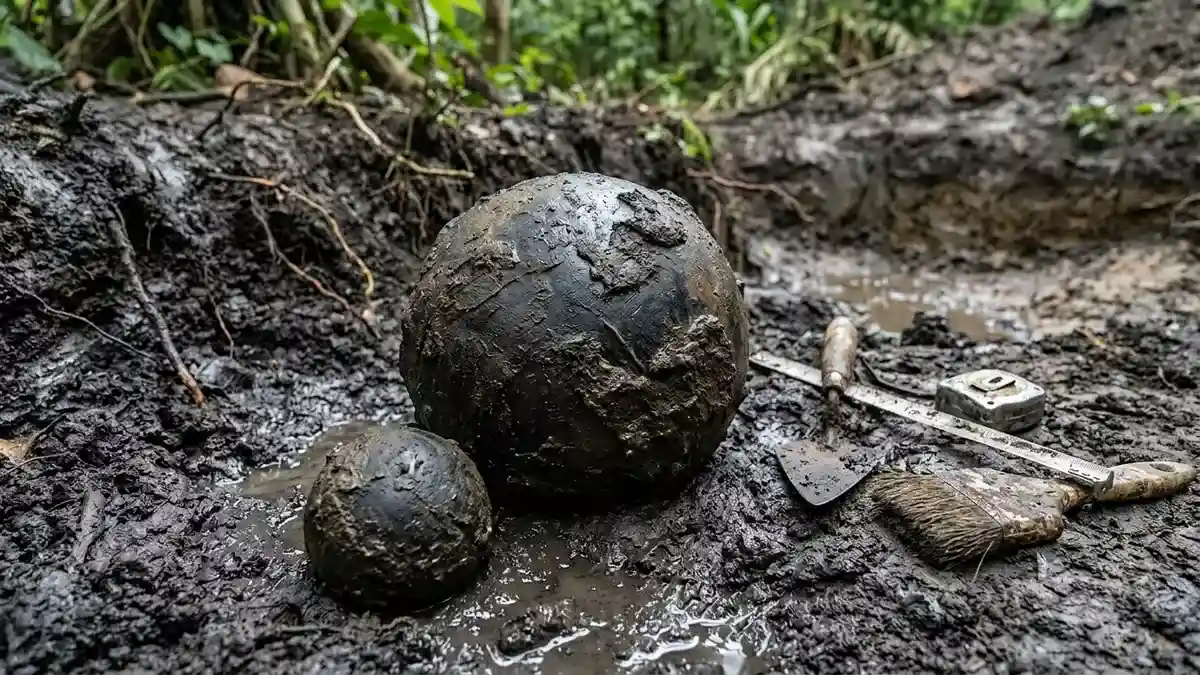
The Olmec civilization—frequently recognized as the “mother culture” of Mesoamerica—flourished in the tropical lowlands of modern-day Veracruz and Tabasco around 1800 BCE. While they are globally renowned for carving colossal stone heads, their technical ingenuity with organic chemistry was equally revolutionary. For millennia, a waterlogged ritual bog at the base of Cerro Manatí naturally protected a priceless collection of ancient artifacts, including the absolute earliest archaeological evidence of rubber manufacturing in human history.
Discovered in 1988 at the El Manatí site in southern Veracruz, a set of 14 solid rubber balls dating back between 3,200 and 3,600 years old has spent decades puzzling conservationists. Exposed to the open air after centuries in mud, these ancient artifacts began to rapidly degrade.
Now, an international collaboration of scientists from Mexico’s National Institute of Anthropology and History (INAH), the National Autonomous University of Mexico (UNAM), and the Universidad Veracruzana has deployed a cutting-edge aerospace storage strategy: custom-engineered anoxia (oxygen-free) chambers designed to halt molecular decay in its tracks.
High-Tech Anoxia Oxygen Chambers to Preserve 3,000-Year-Old Olmec Rubber Balls
The Science of Ancient Rubber: Castilla Elastica
Long before Goodyear patented vulcanization in the 19th century, Olmec artisans had already mastered the processing of raw polymers. Chemical profiling has confirmed that the 14 El Manatí balls were manufactured using the latex sap of Castilla elastica, a tropical rubber tree indigenous to the Mexican lowlands.
The physical diversity of the recovered balls points to highly varied production techniques and potentially distinct ritual uses:
Size Variance: The artifacts range from tiny spheres under 5 centimeters (2 inches) in diameter to massive specimens exceeding 30 centimeters (12 inches).
Weight Variance: The weight of individual balls spans from a light 180 grams (6 ounces) to a crushing 5 kilograms (11 pounds).
[Harvest Castilla Elastica Sap] ──► Solidification Processing ──► [Layered Wrapping / Molding]
For years, a popular archaeological theory suggested that the Olmec mixed the juice of the Ipomoea alba (moonflower) vine into the raw latex to introduce elasticity and prevent brittleness. However, recent rigorous replication experiments conducted by the research team have officially ruled out this hypothesis. The Olmec successfully achieved the structural density of these massive spheres purely through precise processing, drying, and layered molding of raw Castilla elastica polymers.
The Race Against Decay: Engineering Anoxic Environments
The waterlogged, anaerobic (oxygen-depleted) environment of the El Manatí bog acted as a perfect preservation capsule for over three millennia. It kept the organic rubber damp, shielded from ultraviolet light, and away from oxygen. Once excavated, however, atmospheric oxygen began reacting with the historic rubber, triggering irreversible oxidation that threatened to turn the invaluable spheres into dust.

To counter this, UNAM’s cultural heritage laboratory is spearheading a highly structured, multi-decade conservation program divided into precise developmental phases:
Phase 1 (2007–2013): Conservators tested primitive anoxia packaging materials, tracked local microclimates, and studied the raw degradation rates of modern Castilla elastica sap.
Phase 2 (2014–2019): Scientists deployed advanced infrared spectroscopy, X-ray fluorescence, and accelerated aging chambers to map out the exact chemical vulnerabilities of the ancient rubber.
Phase 3 (2020–Present): Focus shifted to optimizing long-term display and storage strategies. The project is currently engineering bespoke, airtight anoxic storage cases custom-tailored to the unique dimensions and weight of each individual ball. These cases completely purge oxygen, replacing it with an inert gas like nitrogen to permanently halt molecular breakdown.
Simultaneously, researchers are utilizing high-resolution photogrammetry to generate millimeter-accurate 3D digital models. This ensures that even if the physical rubber continues its microscopic decay, the exact geometric shapes and surface textures of the balls are preserved in the digital space forever.
Birth of the Mesoamerican Ballgame
These 14 fragile artifacts represent the physical genesis of the Mesoamerican ballgame—a deeply symbolic athletic ritual that endured for over 2,500 years across the Maya, Zapotec, Mixtec, and Aztec empires.
                       [Cosmic Cycles & Solar Movements]
                                       │
                                       ▼
  [Olmec Rubber Ball] ──► Played on Stone Courts ──► No Hands / Forearms Allowed
                                       ▲
                                       │
                    [Mythological War: Life vs. Death]
Far more than a simple leisure sport, the ballgame was a cosmic reenactment. Played on grand stone courts, athletes used their hips, thighs, and elbows—strictly avoiding the use of hands or feet—to propel the heavy rubber spheres through stone hoops. The movement of the ball symbolized the travel of the sun and stars across the sky, and matches were heavily intertwined with agricultural fertility, rain rituals, and mythological warfare between the forces of life and the dark lords of the underworld.
The architectural legacy of this sport continues uninterrupted into the modern era. In southeastern Mexico, communities still practice traditional variants like Pok-ta-Pok, while in northern states, players compete in Ulama—a game where solid rubber balls are still harvested and manufactured from the exact same Castilla elastica trees utilized by the Olmec 3,600 years ago.
Future Museum Exhibition
Currently maintained under strict climate control at the INAH Veracruz Center, these balls are being prepared for public viewing. Once the custom anoxic cases are fully certified, the teams plan to display the artifacts at premier institutions, such as the National Museum of Anthropology in Mexico City or the Museum of Anthropology in Xalapa, allowing the public to witness the physical origin of the world’s oldest organized team sport.
Frequently Asked Questions
What makes the El Manatí rubber balls historically significant?
Dating back 3,200 to 3,600 years, the 14 rubber balls found at El Manatí are the absolute oldest known rubber artifacts ever discovered on Earth, pre-dating modern industrial rubber processing by millennia.
Why did they begin to degrade after being excavated?
For thousands of years, the balls were safely sealed inside a wet, oxygen-free bog. Once dug up, exposure to atmospheric oxygen caused rapid chemical oxidation, making the ancient rubber brittle and prone to turning to dust.
What is anoxia technology and how does it save the artifacts?
Anoxia technology involves creating completely oxygen-free environments. Scientists are building custom, airtight display cases for each rubber ball, replacing harmful oxygen with stable, inert gases like nitrogen to permanently freeze the chemical decay process.
Did the Olmec mix other plants into the rubber to make it bouncy?
While previous archaeological literature hypothesized that moonflower juice (Ipomoea alba) was added to create elasticity, recent scientific replication experiments have debunked this, proving the Olmec achieved their results purely through processing the latex of the Castilla elastica tree.
How was the Mesoamerican ballgame played?
The game was played on large stone courts where athletes used their hips, elbows, and knees to drive heavy rubber balls across the field without using their hands or feet. It functioned as a deeply religious ritual mimicking the movement of cosmic bodies and ancestral battles.