
Table of Contents
- 1. The Shipping Container of the Pre-Industrial World
- 2. Tracking the Timber: A Changing European Landscape
- 3. Tailored for Cargo: How Goods Dictated Barrel Design
- 3.1. The Bureaucratic Herring Cask
- 3.2. The Versatile Beer Barrel
- 4. Heavy Lifting: How Wine Reshaped European Port Architecture
- 5. The Second Life of a Barrel: Pre-Industrial Recycling
- 6. Solving Cold Cases: The Secret Language of Cooper Marks
- 6.1. Identifying a Forgotten Shipwreck
- 7. Frequently Asked Questions
- 7.1. Why were wooden casks so important to early European trade?
- 7.2. Where did the wood for these barrels come from?
- 7.3. Why are so many historical barrels found in old wells and toilets?
- 7.4. How did the weight of these barrels change medieval cities?
- 7.5. What information do the carvings on the barrels provide?
How Simple Wooden Casks Quietly Built the Global Economy
When we picture the meteoric rise of European global commerce between the Late Middle Ages and the early modern era, we often imagine soaring galeons, bustling port cities, and exotic luxury spices. Yet, the true unsung hero of this economic transformation was far more mundane: the humble wooden cask.
A comprehensive new historical study has revealed that these basic wooden barrels did far more than simply hold liquids; they acted as the literal building blocks of Europe’s early trade networks. By standardizing logistics, extending the shelf-life of perishable food, and shaping urban architecture, the cask revolutionized global trade long before the invention of the steel shipping container. Today, the waterlogged soil of the Netherlands is yielding these hidden artifacts, offering historians a pristine look into the daily mechanics of early European capitalism.
How Simple Wooden Casks Quietly Built the Global Economy

The Shipping Container of the Pre-Industrial World
For his doctoral research at Leiden University, archaeologist Jeroen Oosterbaan conducted an exhaustive investigation into the entire lifecycle of historical casks. By cross-referencing excavated shipwrecks, municipal trade records, museum collections, historical artwork, and tree-ring data (dendrochronology), Oosterbaan constructed one of the most comprehensive analyses of pre-industrial logistics ever attempted.
While the Romans used barrels, their economic importance expanded dramatically between 1300 and 1800. As European populations boomed and cities grew, the demand for bulk goods skyrocketed. The wooden cask solved a massive logistical hurdle. It allowed merchants to transport vast quantities of heavy merchandise across thousands of miles over rough seas and unpaved roads, all while driving down transport costs and expanding market access.
Oosterbaan notes that the historical impact of the wooden cask directly mirrors the 20th-century introduction of the standardized steel shipping container. Both inventions completely revolutionized global economics by standardizing storage dimensions, protecting cargo from damage, and drastically accelerating loading and unloading times at international ports.

Tracking the Timber: A Changing European Landscape
The study focused primarily on casks unearthed at Dutch archaeological sites from the 14th through 18th centuries—a period during which the Netherlands evolved into the undisputed commercial hub of Europe. This massive industrial output required an immense amount of high-quality wood, which in turn altered the forestry industries of neighboring territories.
By utilizing tree-ring dating on recovered staves, researchers traced a massive shift in resource procurement:
Early Era (1300–1500): Initial timber supplies were harvested locally or imported from nearby forests in western Germany and northern France.
Boom Era (1500–1800): As trade networks scaled up and Western European forests faced deforestation, Dutch merchants established deep trade pipelines with Eastern Europe. Timber was systematically clear-cut in Poland and the wider Baltic region, then floated down rivers to be shipped to Dutch ports.
Once the raw timber arrived, highly organized guilds of skilled barrel makers, known as coopers, took over. Operating under strict local regulations and standardized manufacturing guidelines, these cooperage guilds ensured that every barrel produced met exact structural and volume requirements.
Tailored for Cargo: How Goods Dictated Barrel Design
The study uncovered a fascinating level of specialization among historical coopers. Barrels were not one-size-fits-all; instead, their construction, dimensions, and administrative oversight varied radically depending on the specific commodity they were built to hold.
The Bureaucratic Herring Cask
During this era, salted herring was a vital food source that fueled Europe’s working classes and navies. Because the fish had to remain completely submerged in brine to prevent deadly spoilage, herring casks were subjected to intense bureaucratic scrutiny. Official municipal inspectors examined these barrels to verify they were packed perfectly airtight and filled to exact legal volumes before they could be cleared for export.
The Versatile Beer Barrel
In contrast, beer barrels exhibited an incredible diversity of shapes and capacities. Because beer was largely a regional commodity brewed for localized distribution, coopers built beer casks to match the specific storage rooms, wagon sizes, and unique brewing traditions of individual towns, resulting in a chaotic variety of measurements across the continent.
Heavy Lifting: How Wine Reshaped European Port Architecture
The sheer volume of international trade eventually forced European port cities to alter their physical infrastructure. Wine, an incredibly lucrative luxury import, was moved in massive casks that frequently exceeded 660 pounds (approx. 300 kg) when fully loaded.
Because these immense containers were far too heavy to be maneuvered by human muscle power alone, major trading hubs had to invent mechanical solutions. Port cities across the Low Countries and Germany constructed massive, human-powered wooden cranes—frequently referred to as “wine cranes”—along their waterfronts. Powered by workers walking inside massive internal treadwheels, these monumental mechanical structures lifted the heavy wine casks directly out of incoming cargo ships and lowered them onto the docks, forever altering the architectural skylines of medieval harbors.
The Second Life of a Barrel: Pre-Industrial Recycling
One of the most remarkable findings of Oosterbaan’s research is what happened to these wooden casks after they were retired from maritime trade. Instead of being thrown away or burned for firewood, old barrels became prime structural materials for urban development.
Because the tightly bound oak staves were incredibly durable and naturally water-resistant, urban builders repurposed old casks to line the interiors of domestic water wells and deep cesspits (underground waste pits). The waterlogged, oxygen-depleted soil conditions across the Netherlands acted as a natural preservative, shielding the buried wood from decay for hundreds of years. This accidental preservation has provided modern archaeologists with an incredibly rich, intact archive of historical woodwork.
Solving Cold Cases: The Secret Language of Cooper Marks
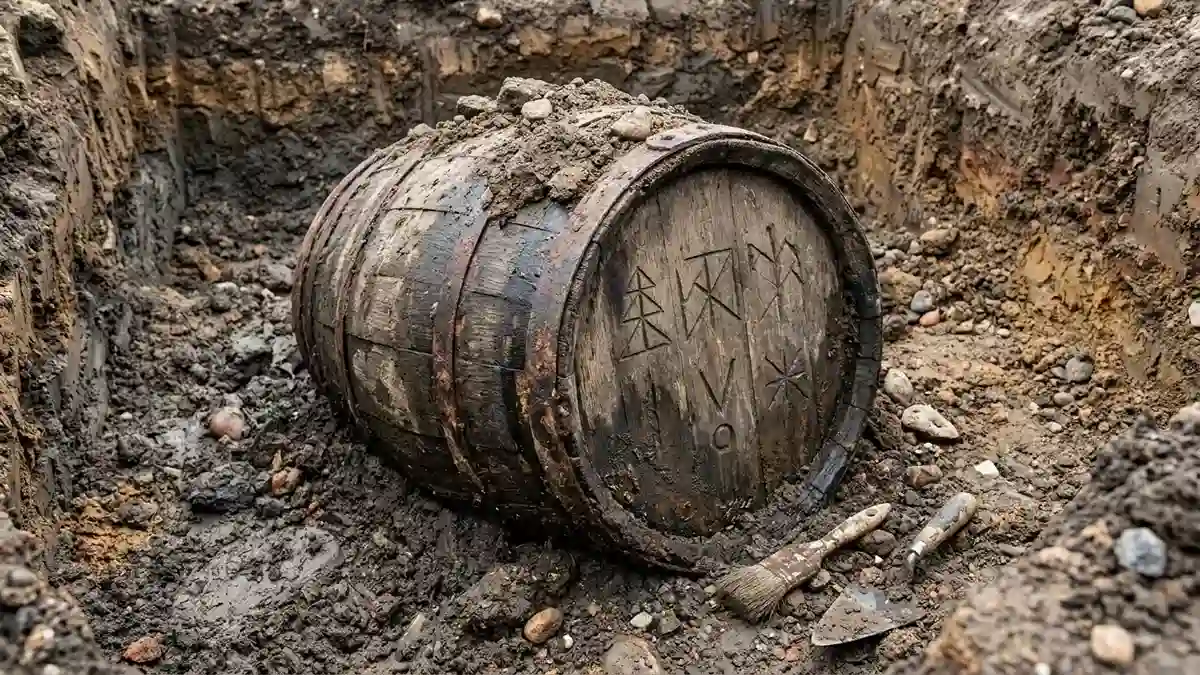
Beyond the wood itself, the study analyzed thousands of distinct, enigmatic symbols carved directly into the exterior faces of the recovered barrel lids. Oosterbaan successfully compiled these markings into a brand-new comprehensive classification system, unlocking an administrative language that had been lost for centuries.
These carved markings served multiple corporate and legal purposes:
Maker Marks: Identified the specific cooper or guild workshop that manufactured the container.
Ownership Brands: Identified the merchant house or trading company that owned the cargo inside.
Quality Controls: Verified that the contents had passed official inspections at regional border checkpoints.
Accounting Codes: Recorded specific quantities, weights, and taxation metrics for port officials.
Identifying a Forgotten Shipwreck
This new understanding of barrel markings recently yielded a major archaeological breakthrough. By analyzing a distinct three-letter monogram carved into several casks recovered from an anonymous wreckage site off the coast of Texel, researchers matched the physical artifacts with historical colonial shipping registries.
This simple administrative mark allowed historians to definitively identify the mysterious “Burgzand Noord 4” shipwreck as ‘t Hart, a famous 18th-century Dutch frigate that sank in the North Sea. It stands as a powerful testament to how a humble storage container can solve centuries-old maritime mysteries.
Frequently Asked Questions
Why were wooden casks so important to early European trade?
Before the advent of industrial plastics or steel, wooden casks were the ultimate heavy-duty storage solution. Their rounded shape allowed a single dockworker to roll incredibly heavy loads that would otherwise be impossible to lift, while their durable, airtight construction kept vital food supplies like beer, wine, and salted fish fresh during month-long sea voyages.
Where did the wood for these barrels come from?
As European trade rapidly expanded between 1300 and 1800, local forests in France and Germany faced heavy depletion. To meet the immense demand for shipping containers, Dutch merchants established massive timber trade routes with Poland and the wider Baltic region to import high-quality oak.
Why are so many historical barrels found in old wells and toilets?
Once a cask became too worn or leaky to safely transport expensive liquids across the ocean, it was recycled. Urban citizens used old barrels to line the walls of backyard water wells and cesspits because the sturdy, circular wooden frames kept the surrounding dirt from collapsing inward.
How did the weight of these barrels change medieval cities?
Massive wine and oil casks could easily weigh over 660 pounds, making manual labor highly inefficient. To handle this bulk cargo, major European trading ports had to invent and construct large, treadwheel-powered wooden harbor cranes to safely load and unload shipping vessels.
What information do the carvings on the barrels provide?
The carved symbols functioned as an early corporate tracking system. They provided a clear paper trail showing who made the barrel, who owned the cargo, whether the contents passed official health and quality inspections, and how much tax had been paid at international borders.