
Table of Contents
- 1. Unlocking the Secrets of the Pergamon Unguentarium
- 1.1. Advanced Molecular Fingerprinting
- 2. Thyme Oil: The Ancient Art of Odor Management
- 3. Validating Galen and the Healers of Antiquity
- 4. Overlapping Boundaries: Medicine, Hygiene, and Cosmetics
- 5. Overcoming Cultural Discomfort in Archaeology
- 6. Frequently Asked Questions
- 6.1. What did scientists discover inside the 1,900-year-old Roman vial?
- 6.2. Where was this ancient medical vial found?
- 6.3. How did researchers prove the residue contained human waste?
- 6.4. Why did the Romans mix thyme with human feces for treatments?
- 6.5. Did famous ancient doctors actually recommend using feces?
1,900-Year-Old Roman Vial Confirms Use of Human Feces in Ancient Medicine
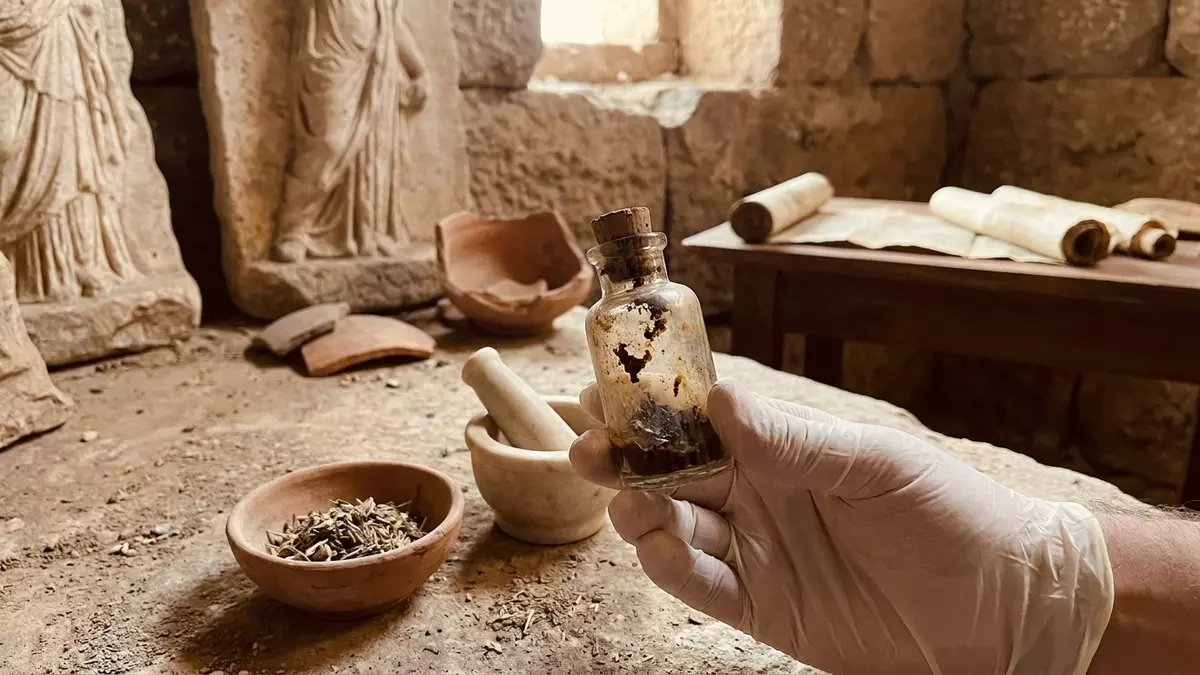
An extraordinary chemical analysis of residue trapped inside a small Roman glass bottle has provided the first direct physical evidence of a shocking ancient medical practice: the use of human feces as a therapeutic treatment.
The artifact, known as an unguentarium, was recovered from a tomb in Pergamon, an ancient metropolis located in modern-day Turkey that served as one of the most prominent medical hubs of the Roman world during the second and third centuries. The discovery bridges the gap between historical texts and tangible reality, proving that ancient healers actually mixed human waste with fragrant herbs to treat their patients.
1,900-Year-Old Roman Vial Confirms Use of Human Feces in Ancient Medicine
Unlocking the Secrets of the Pergamon Unguentarium
The breakthrough began when an international team of researchers examined a sealed glass vessel currently housed in the Bergama Archaeology Museum in Turkey. Inside the container, archaeologists noticed mysterious, dark brown flakes clinging firmly to the interior glass walls.
While multiple stored glass containers from the site showed faint traces of organic matter, this specific vial preserved a substantial amount of material, making full scientific testing possible.
Advanced Molecular Fingerprinting
To determine the exact composition of the ancient residue, the research team extracted a microscopic sample and subjected it to highly advanced laboratory techniques:

Gas Chromatography: A method used to separate the individual volatile components of a complex chemical mixture.
Mass Spectrometry: A technique that measures the mass-to-charge ratio of molecules to identify unknown compounds with absolute precision.
The molecular results were undeniable. The testing detected high concentrations of coprostanol and 24-ethylcoprostanol. These specific organic compounds are biochemical biomarkers that form exclusively in the digestive systems of organisms that process cholesterol. By measuring the precise relative proportions of these substances, scientists definitively matched the biological fingerprint to a human source.
Thyme Oil: The Ancient Art of Odor Management
The fecal matter was not the only substance preserved inside the 1,900-year-old vial. Alongside the biological waste, researchers identified a distinct profile of highly aromatic molecules, most notably carvacrol.
Carvacrol is the primary chemical compound responsible for the pungent, herbaceous scent of thyme oil. The deliberate pairing of human excrement with an intensely fragrant herb provides profound insight into the clinical sensibilities of Roman medical practitioners.
Ancient medical literature frequently instructed physicians to mix strong-smelling herbs with repulsive ingredients to mask the foul odors, making the treatments more tolerable for patients. The presence of thyme inside the Pergamon container confirms that Roman healers consciously managed the sensory experience of their medicine, carefully balancing therapeutic efficacy with odor control.
Validating Galen and the Healers of Antiquity
For centuries, modern historians have debated whether the bizarre medical recipes found in ancient texts were ever actually prepared, or if they were merely theoretical or symbolic writings. This chemical discovery firmly settles the debate.
Pergamon was the birthplace and home clinic of Galen, arguably the most influential physician of the Roman Empire. In his extensive medical treatises, Galen explicitly recorded remedies utilizing animal and human dung to treat a variety of ailments, including:
Deep-seated tissue inflammation
Severe skin and wound infections
Complex reproductive health conditions
Galen was not alone in these prescriptions. The famous Greek pharmacologist Dioscorides and the Roman naturalist Pliny the Elder both documented similar dung-based therapies in their encyclopedic works. The residue inside this single bottle proves that Roman healers actively mixed, bottled, and distributed these exact recipes.
Overlapping Boundaries: Medicine, Hygiene, and Cosmetics
Small glass unguentaria are among the most common artifacts excavated from graves and ancient settlements across the vast territory of the Roman Empire. For generations, traditional archaeology has uniformly labeled these vessels as simple containers for perfumes, scented body oils, or basic cosmetics.
However, this study demonstrates that some of these everyday bottles actually held highly complex, therapeutic pharmacological compounds. In the ancient Roman world, the boundaries separating cosmetics, daily hygiene, and medical therapy were incredibly fluid.
A scented, oil-based preparation could easily pull double duty, serving a social role as a masking fragrance while simultaneously acting as a clinical ointment.
Overcoming Cultural Discomfort in Archaeology
Direct physical evidence for dung-based medicine has remained remarkably rare in the archaeological record for two primary reasons. First, organic matter breaks down rapidly over thousands of years, meaning conditions must be absolutely perfect for such residues to survive. Second, a modern cultural aversion to dealing with human excrement has historically limited research interest in analyzing these types of residues.
By pairing modern laboratory chemistry with a meticulous re-reading of classical texts, the research team has broken through these barriers. The findings offer a far more accurate, unvarnished look at the realities of ancient Roman healthcare. Far from being a modern contamination anomaly, the calculated integration of thyme proves that ancient medicine was a highly sophisticated, deliberate, and deeply sensory practice.
Frequently Asked Questions
What did scientists discover inside the 1,900-year-old Roman vial?
Scientists conducted a chemical analysis of the residue inside a small Roman glass bottle and discovered the first direct physical evidence of human feces used as medicine, mixed with thyme oil to mask the offensive smell.
Where was this ancient medical vial found?
The artifact was recovered from a tomb in Pergamon, an ancient Roman city located in modern-day Bergama, Turkey. Pergamon was a major center for medicine and healing in the second and third centuries.
How did researchers prove the residue contained human waste?
Using gas chromatography and mass spectrometry, scientists identified the molecular compounds coprostanol and 24-ethylcoprostanol. These specific substances are biological markers produced during digestion, and their exact proportions pointed directly to a human origin.
Why did the Romans mix thyme with human feces for treatments?
Ancient medical texts reveal that physicians frequently blended potent aromatic herbs, like thyme, with foul-smelling ingredients to make treatments more acceptable to patients. The discovery of carvacrol (the main component of thyme oil) proves they actively managed the sensory odor of their remedies.
Did famous ancient doctors actually recommend using feces?
Yes. Prominent ancient medical authorities, including the imperial physician Galen, the pharmacologist Dioscorides, and the writer Pliny the Elder, all wrote recipes utilizing dung to treat various physical conditions, such as inflammation and infections.