
Table of Contents
- 1. The Decades-Old Enigma of the Eastern Facade
- 2. The Tri-Tech Arsenal: Peering Through Solid Stone
- 2.1. 1. Electrical Resistivity Tomography (ERT)
- 2.2. 2. Ground Penetrating Radar (GPR)
- 2.3. 3. Ultrasonic Testing (UST)
- 3. Dissecting Anomalies A1 and A2
- 4. Next Horizons: Muons, Endoscopy, and Cosmic Rays
- 5. A Global Revolution in Digital Egyptology
- 6. Frequently Asked Questions
- 6.1. What did scientists discover inside the Menkaure Pyramid?
- 6.2. Why do these anomalies suggest a second entrance?
- 6.3. What specific scanning technologies were used?
- 6.4. What is “Image Fusion” and why was it necessary?
- 6.5. What are the next steps for the research team?
New Anomalies in Menkaure Pyramid Hint at Hidden Second Entrance
A groundbreaking collaborative project between Cairo University and the Technical University of Munich (TUM) has revealed two previously unknown, air-filled cavities inside the Menkaure Pyramid at Giza. The monument, famed as the smallest of the three iconic Great Pyramids, is now at the center of an international scientific effort to locate a long-hypothesized second entrance on its eastern facade.
Operating under the umbrella of the famed ScanPyramids project, the research team published their findings in the journal NDT & E International. By deploying a suite of cutting-edge, non-invasive imaging technologies, the scientists have successfully peered through millennia of solid stone, mapping structural anomalies that could rewrite our understanding of Old Kingdom engineering and royal burial architecture.
New Anomalies in Menkaure Pyramid Hint at Hidden Second Entrance

The Decades-Old Enigma of the Eastern Facade
For over a century, mainstream Egyptologists have focused their attention almost exclusively on the northern face of the Menkaure Pyramid, where the only known, official entrance corridor penetrates the structure. However, a peculiar architectural anomaly on the eastern facade has quietly puzzled researchers for decades.
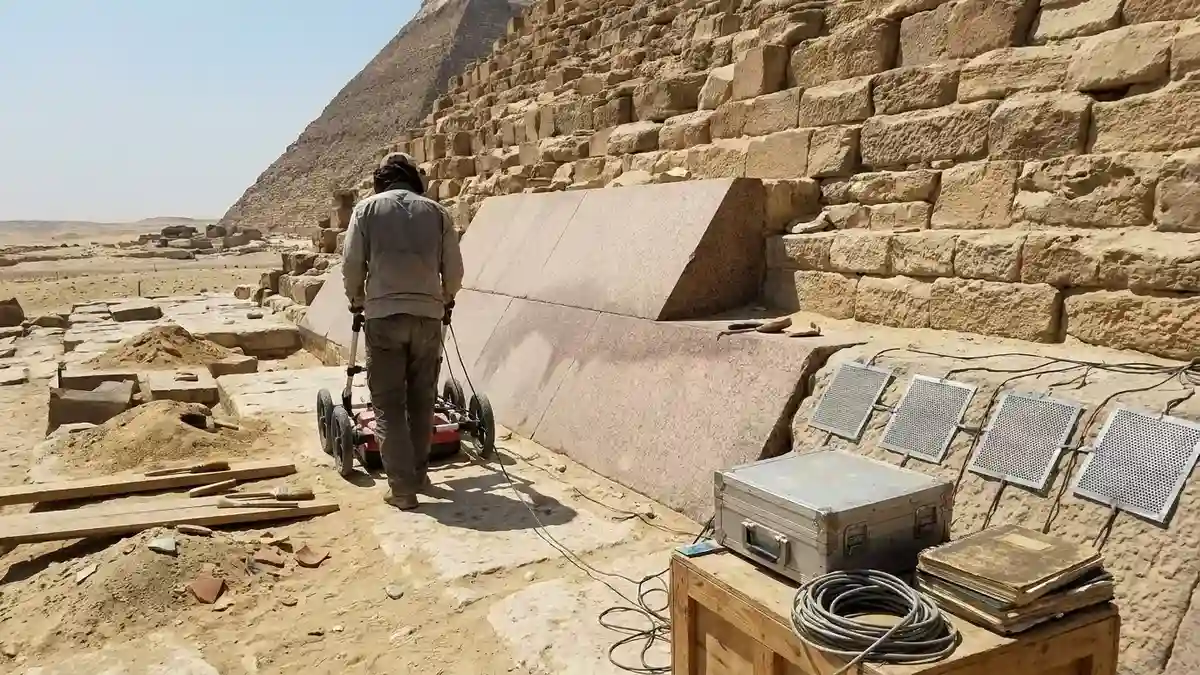
On this eastern side sits a highly localized, polished section of massive granite casing blocks measuring roughly four meters high by six meters wide. What makes this specific section bizarre is its finish: the granite blocks are worked to an incredibly smooth, flush surface—perfectly mimicking the exact style of elite stone framing used to outline the monument’s northern entrance.
In 2019, independent researcher Stijn van den Hoven formally proposed that this distinct, high-status finish was an architectural marker signaling a hidden, secondary access point. Until now, confirming this provocative theory was impossible without physically dismantling or damaging the ancient, protected masonry.

       [VISUALIZING THE MONUMENT'S FACADES]

          [NORTH FACE]                  [EAST FACE]
               │                             │
               ▼                             ▼
       Known Main Entrance           Polished Granite Zone
     (Smooth Casing Stones)        (Smooth Frame Design)
                                             │
                                             ▼
                                    *NEW CAVITIES FOUND*
The Tri-Tech Arsenal: Peering Through Solid Stone
To investigate the mystery safely, the ScanPyramids team assembled a formidable trio of advanced Non-Destructive Testing (NDT) technologies. Rather than relying on a single data stream, the team cross-referenced three distinct physical phenomena to build an ironclad map of the interior.
1. Electrical Resistivity Tomography (ERT)
This technique passes precise electrical currents through the pyramid’s outer stone layers using specialized stainless-steel mesh electrodes. By measuring electrical resistance, ERT identifies changes in material density, instantly flagging low-density areas like open voids or high-density features like hidden granite blocks.
2. Ground Penetrating Radar (GPR)
GPR fires high-frequency electromagnetic radar pulses deep into the limestone. As these waves travel through the monument, they bounce back when they hit a boundary between different materials—such as transitioning from solid stone to an open air pocket—allowing scientists to calculate the exact depth of subsurface objects.
3. Ultrasonic Testing (UST)
UST transmits high-frequency sound waves through the blocks. Because acoustic waves travel at different speeds through solid limestone, hollow gaps, or fractured masonry, mapping variations in wave travel time allows researchers to construct a highly accurate internal geometric blueprint.
+-------------------------------------------------------------+
|               THE IMAGE FUSION (IF) PIPELINE                |
|                                                             |
|    [ERT DATA]  ───────┐                                     |
|    [GPR DATA]  ───────┼─> [IMAGE FUSION] ─> High-Precision   |
|    [UST DATA]  ───────┘     (IF PROCESS)    Interior Blueprint|
+-------------------------------------------------------------+
To eliminate experimental error and maximize accuracy, the raw datasets from all three methods were combined using a sophisticated processing matrix known as Image Fusion (IF). This computing method perfectly aligned, stacked, and cross-verified the separate electrical, electromagnetic, and acoustic readouts, giving researchers the highest resolution look inside a pyramid’s walls to date.
Dissecting Anomalies A1 and A2
The unified Image Fusion data confirmed the existence of two distinct structural voids resting directly behind the beautifully smooth eastern granite blocks. Numerical simulations and structural modeling quickly ruled out the possibility that these anomalies were caused by natural settling, geological shifting, or accidental cracks in the structural limestone.
Anomaly A1: Located roughly 1.35 meters beneath the outer granite facade, this chamber measures approximately 1.5 meters wide by 1.0 meter high.
Anomaly A2: Sitting slightly closer to the surface at a depth of 1.13 meters, this adjacent pocket measures roughly 0.9 meters wide by 0.7 meters high.
| Anomaly Designation | Subsurface Depth | Width Dimensions | Height Dimensions | Physical Interpretation |
| A1 | 1.35 Meters | 1.5 Meters | 1.0 Meter | Intentional, air-filled internal void |
| A2 | 1.13 Meters | 0.9 Meters | 0.7 Meters | Intentional, air-filled internal void |
Professor Christian Grosse of the Technical University of Munich emphasized that these findings represent a massive technological and historical milestone. He noted that utilizing NDT methods allows science to systematically scan the interiors of humanity’s oldest treasures without leaving a single scratch, bringing modern scholarship “a big step closer” to confirming the existence of a grand secondary entranceway.
+-------------------------------------------------------------+
|             CROSS-SECTION VIEW OF THE DISCOVERY             |
|                                                             |
|   [Outer Facade] ──> [Granite Blocks]                       |
|                             │                               |
|                             ├───> Depth 1.13m: [ANOMALY A2] |
|                             │                               |
|                             └───> Depth 1.35m: [ANOMALY A1] |
+-------------------------------------------------------------+
Next Horizons: Muons, Endoscopy, and Cosmic Rays
Despite the definitive confirmation of these air pockets, the ScanPyramids team remains appropriately objective regarding their exact scale and true historical purpose. Because the current generation of surface-applied NDT equipment has a limited penetration depth, scientists cannot yet determine how far into the pyramid’s core these chambers extend or if they connect to a larger, sprawling network of secret corridors.
To solve this next piece of the puzzle, the team is officially inviting international researchers to deploy deeper-penetrating diagnostic tools. The next phases of the exploration will likely involve muon tomography—a process that tracks cosmic ray subatomic particles as they pass through the monument to map massive, deep-interior voids—along with ultra-thin fiber-optic endoscopy drills if non-destructive access paths can be established.
A Global Revolution in Digital Egyptology
This breakthrough follows the historic 2023 discovery of a completely hidden, nine-meter-long corridor located right above the main entrance of the Great Pyramid of Khufu (Cheops), which was also brought to light by the ScanPyramids initiative.
Together, these back-to-back discoveries demonstrate how advanced imaging is fundamentally altering the fields of archaeology and architectural history. The long-neglected eastern side of the Menkaure Pyramid is finally stepping out of the shadow of the northern face, proving that even after 4,000 years, the sands of Giza still hold incredible engineering secrets waiting to be decoded.
Frequently Asked Questions
What did scientists discover inside the Menkaure Pyramid?
Using a combination of advanced non-destructive scanning technologies, an international research team detected two previously unknown, air-filled structural anomalies (designated A1 and A2) hidden directly behind the eastern face of the pyramid.
Why do these anomalies suggest a second entrance?
The two air-filled voids sit directly behind a highly localized section of beautifully polished, smooth granite blocks on the eastern facade. This sophisticated stonework perfectly mirrors the architectural framing used to denote the pyramid’s known northern entrance.
What specific scanning technologies were used?
The ScanPyramids team utilized three distinct non-invasive technologies: Electrical Resistivity Tomography (ERT) to measure density, Ground Penetrating Radar (GPR) to track electromagnetic reflections, and Ultrasonic Testing (UST) to evaluate acoustic wave travel times.
What is “Image Fusion” and why was it necessary?
Image Fusion is an advanced computing process that aligns and blends multiple distinct datasets into a single, high-resolution graphic model. This allowed researchers to cross-verify the readouts from all three scanning tools, guaranteeing the anomalies were real and accurately mapped.
What are the next steps for the research team?
Because current tools cannot see deep past the outer layers of the pyramid, researchers plan to utilize deeper-penetrating methods, such as muon imaging (cosmic-ray tracking) and micro-endoscopic cameras, to determine how far the cavities extend into the monument.