
Table of Contents
- 1. Unlocking the Casablanca Fossil Assemblage
- 2. Magnetic Reversals and High-Precision Dating
- 2.1. Life and Death in an Ancient Carnivore Den
- 3. Shifting the Cradle of Humanity Northwest
- 4. Frequently Asked Questions
- 4.1. Why are the Casablanca fossils linked to Neanderthals if they were found in Africa?
- 4.2. What was the Matuyama–Brunhes transition, and how did it date the fossils?
- 4.3. How do these hominins differ from Homo antecessor found in Spain?
- 4.4. What does the presence of hyena bite marks mean?
- 4.5. Why does this discovery change our view of East Africa as the “Cradle of Humanity”?
Morocco Fossils Dated to 773,000 Years Ago Rewrite Human and Neanderthal Origins
A revolutionary study has placed a critical ancestral population of both modern humans (Homo sapiens) and Neanderthals in Northwest Africa roughly 773,000 years ago. The discovery, centered on a collection of ancient human bones unearthed near Casablanca, Morocco, provides crucial physical evidence that directly matches long-standing genetic predictions about the deep roots of humanity.
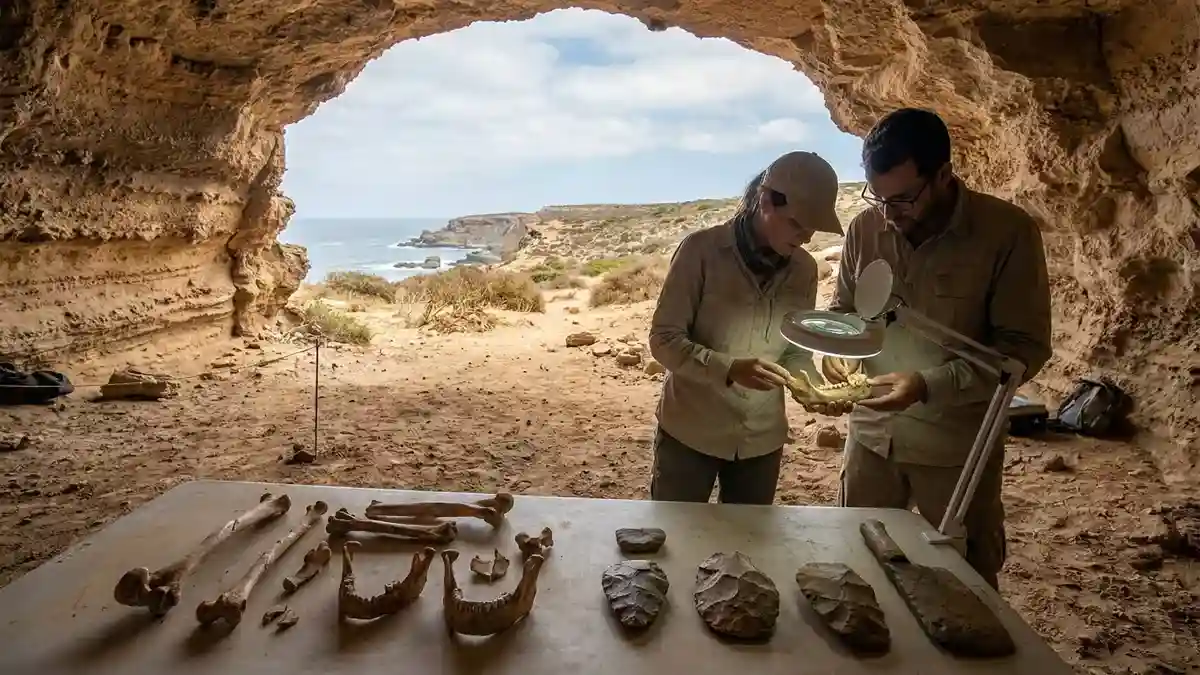
Published in the journal Nature, the research focuses on an extraordinary assemblage of fossils, primitive stone tools, and meticulous geological data recovered from a cave known as the Grotte à Hominidés (Hominid Cave) at Thomas Quarry I. The findings drastically shift the focus of paleoanthropology, demonstrating that Northwest Africa played a fundamental role in the evolution of our lineage long before Homo sapiens ever walked the earth.
Morocco Fossils Dated to 773,000 Years Ago Rewrite Human and Neanderthal Origins
Unlocking the Casablanca Fossil Assemblage
For decades, an exasperating “fossil gap” between one million and 600,000 years ago hindered scientists trying to map human evolution. While DNA sequencing of modern humans and Neanderthals consistently calculated that our lineages split from a common ancestor during this precise window, actual physical skeletons from this era remained exceptionally rare.

The Casablanca discoveries bridge this evolutionary chasm. The international research team conducted an exhaustive anatomical analysis of multiple hominin individuals found within the cave:
Partial lower jaws (mandibles) belonging to two adults and one child
A series of well-preserved vertebrae
A large collection of isolated teeth

     [Homo erectus] (Primitive ancestral traits)
           │
           ▼
┌───────────────────────────────────────┐
│  Casablanca Hominins (773,000 YA)     │ ◄── Mixed Mosaic Anatomy
└───────────────────────────────────────┘
           │
           ├──► Homo sapiens (Modern Humans)
           └──► Homo neanderthalensis (Neanderthals)
High-resolution micro-CT imaging revealed a fascinating mosaic of physical traits. The jaw structure and internal dental anatomy display a transitionary mix of primitive characteristics inherited from Homo erectus alongside advanced, emerging traits that point directly toward later human lineages.
Crucially, the scans proved that these individuals represent a distinct population basal to the shared origin of modern humans, Neanderthals, and Denisovans. They match neither the classic Homo erectus nor the contemporary Homo antecessor lineages found in Spain, demonstrating an unexpected degree of early human diversity.
Magnetic Reversals and High-Precision Dating
Securing a precise age for African fossils from the middle of the Pleistocene epoch is notoriously difficult. To overcome this, geologists tracked a catastrophic planetary event frozen directly inside the cave’s layers: the Matuyama–Brunhes transition.
Approximately 773,000 years ago, Earth’s magnetic field completely flipped, causing compass needles to point south instead of north. The research team collected and tested 180 individual sediment samples throughout the Grotte à Hominidés.
Cave Stratigraphy & Chronology:
├── Upper Layers: Normal Magnetic Polarity (Brunhes Epoch)
├── FOSSIL HORIZON: Matuyama-Brunhes Transition (Exactly 773,000 Years Ago)
└── Lower Layers: Reversed Magnetic Polarity (Matuyama Epoch)
The human fossils were embedded directly within the thin layer of sediment deposited during the exact geological moment this magnetic reversal occurred. This provided the team with an incredibly rare, definitive chronological anchor, making these bones some of the most precisely dated early human remains ever recovered on the African continent.
Life and Death in an Ancient Carnivore Den
The environmental context of the cave tells a dark story of survival on the prehistoric Atlantic coast. Long before humans utilized the cave, the Grotte à Hominidés operated as a highly active carnivore den.
Clear, microscopic bite marks scarring an excavated human leg bone suggest that giant prehistoric hyenas routinely scavenged or preyed upon these early human populations.
However, humans were actively modifying the surrounding landscape. Scattered just outside the den were numerous stone tools belonging to the early Acheulean technological tradition. These heavy stone handaxes and cleavers link the Casablanca hominins to a widespread stone-tool culture that had been adapting across Africa for over a million years.
Shifting the Cradle of Humanity Northwest
For generations, the hunt for human origins centered almost exclusively on the fossil-rich rifts of East Africa and the deep caves of South Africa. The Thomas Quarry I discoveries definitively disrupt this narrative.
The geographical implications are profound when paired with prior discoveries in the region. Notably, the oldest confirmed Homo sapiens fossils on Earth were discovered at Jebel Irhoud, Morocco, dating to roughly 300,000 years ago. The newly analyzed Casablanca hominins lived in the exact same region nearly half a million years earlier, displaying the structural evolutionary precursor traits required to give rise to those later populations.
Moroccan Evolutionary Continuum:
[Thomas Quarry I Hominins] ─── (~473,000 Year Evolution) ───> [Jebel Irhoud Homo sapiens]
   (773,000 Years Ago)                                           (300,000 Years Ago)
Rather than being an isolated evolutionary evolutionary dead-end, Northwest Africa is emerging as a dynamic theater for human development. Modern climate models suggest that during cyclical “Green Sahara” phases, increased rainfall transformed the desert into lush grasslands. These fertile corridors allowed early human groups to migrate seamlessly between sub-Saharan regions and the Mediterranean coast, preventing isolation and fueling genetic diversity across the continent.
Frequently Asked Questions
Why are the Casablanca fossils linked to Neanderthals if they were found in Africa?
While Neanderthals evolved and lived in Europe and Asia, they share a common ancestor with modern humans (Homo sapiens), who evolved in Africa. These 773,000-year-old Moroccan fossils exhibit the foundational, transitionary anatomical traits expected of the parent population before the two lineages split and went their separate geographic ways.
What was the Matuyama–Brunhes transition, and how did it date the fossils?
The Matuyama–Brunhes transition was a natural reversal of Earth’s magnetic poles that occurred exactly 773,000 years ago. By detecting the unique magnetic signature of this flip inside the specific cave sediment layers where the bones were resting, scientists obtained a highly accurate timeline for the fossils.
How do these hominins differ from Homo antecessor found in Spain?
Though they lived around the same time, micro-CT scans of internal tooth and jaw structures showed distinct differences between the populations. This confirms that early human evolution was not a single straight line, but rather a diverse network of different regional populations existing simultaneously across Africa and southern Europe.
What does the presence of hyena bite marks mean?
The bite marks indicate that the cave was shared or contested space. During the Early Pleistocene, large carnivores like hyenas regularly used these caves to consume carcasses, meaning early humans were frequently scavenged by, or fell victim to, large predators.
Why does this discovery change our view of East Africa as the “Cradle of Humanity”?
It proves that critical, highly advanced stages of human evolution were happening simultaneously across the entire African continent. Northwest Africa was not an evolutionary sideline; its dynamic coastlines and alternating green corridors made it a major hub for ancestral human populations.