
Table of Contents
**3,000 Years of Genetic Stability in Ancient Low Countries**
Ancient DNA research is rewriting the story of prehistoric Europe, and a major new study from the Low Countries reveals an unexpected chapter of remarkable continuity. While much of the continent experienced waves of migration and rapid genetic turnover, communities in what is now the Netherlands, Belgium, and northwestern Germany maintained strong local roots for roughly 3,000 years. This stability persisted right up until the transformative Bell Beaker expansion reshaped northwestern Europe.
The findings, published in *Nature*, challenge long-held views of prehistory as a constant sequence of population replacements. Instead, they highlight how geography, lifestyle, and social choices allowed certain regions to preserve hunter-gatherer ancestry far longer than elsewhere.
3,000 Years of Genetic Stability in Ancient Low Countries
### A Unique Path in the Rhine-Meuse Region
Researchers analyzed genome-wide data from 112 ancient individuals who lived between approximately 8500 and 1700 BCE in the Rhine-Meuse river delta and surrounding areas. This comprehensive dataset provides an unprecedented look at genetic changes across the Mesolithic, Neolithic, and early Bronze Age in a key part of Europe.
Across most of the continent, the arrival of farming between 6500 and 4000 BCE triggered massive ancestry shifts. Descendants of early farmers from western Anatolia mixed with local hunter-gatherers, often leading to farmer-related DNA dominating the genetic landscape within a few centuries. In many places, local forager ancestry dropped dramatically.
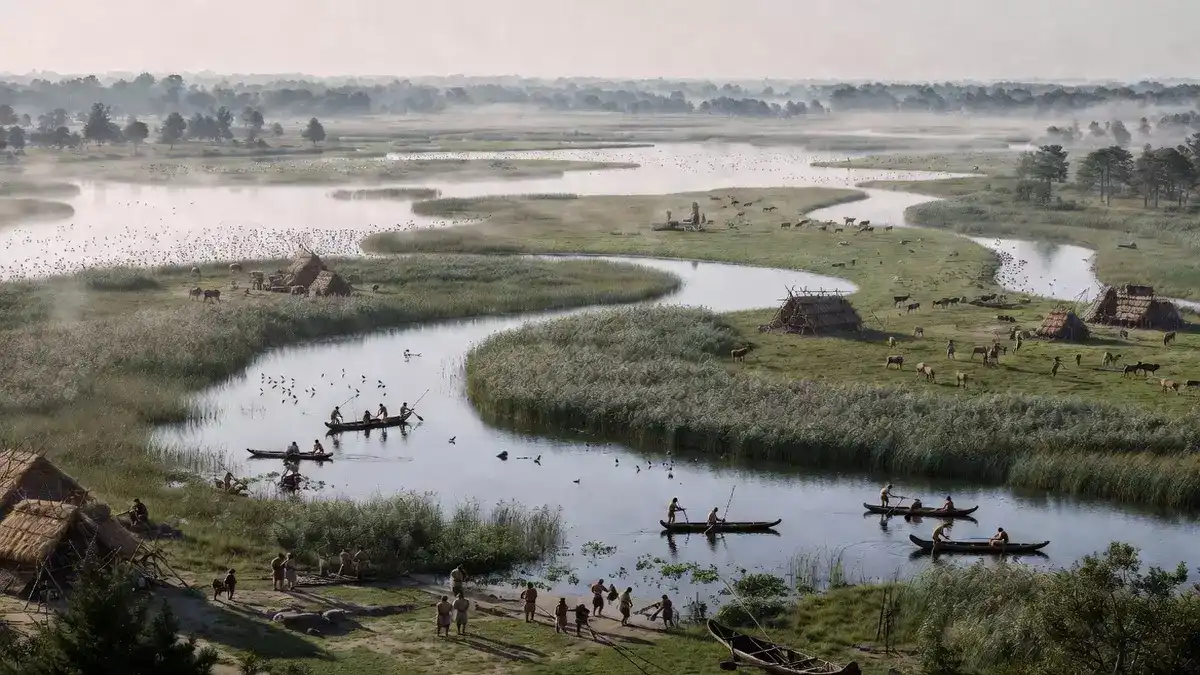
The Low Countries followed a different trajectory. The wetland-rich Rhine-Meuse region offered abundant natural resources that supported a mixed economy longer than in other areas. Hunter-gatherer ancestry remained significant until around 3000 BCE, with some individuals still carrying about 50% local forager genetic heritage.
### Slow Adoption of Farming Life
Archaeological evidence had already suggested delayed large-scale agriculture in this delta region, and the genetic data now confirms it. Small groups of farmers first appeared in areas like Zuid Limburg around 5500 BCE. These early agriculturalists traced their roots back to Anatolian farming communities that had gradually moved through Central Europe.

However, contact between these southern farming settlements and northern hunter-gatherer groups stayed relatively limited. Most communities in the river plains and coastal lowlands continued traditional ways of life—hunting, fishing, gathering wild plants, and exploiting rich local ecosystems—for centuries.
The landscape itself played a crucial role. The Rhine-Meuse delta provided diverse resources in a compact area: fish, waterfowl, large game, fruits, nuts, and seeds. Rivers and coastal routes facilitated the exchange of ideas, tools, and pottery styles without requiring large-scale population movement or replacement. The Linearbandkeramik (LBK) farming culture that spread widely elsewhere never fully supplanted older lifeways in these lowlands.
### Insights from Maternal and Paternal Lines
One fascinating detail emerges from patterns of maternal ancestry. Early farmer DNA appears to have entered northern delta communities primarily through women. Female individuals with Early European Farmer (EEF) ancestry integrated into local groups, while male hunter-gatherer lineages remained dominant for a long time. This suggests social connections formed through partnerships and alliances rather than wholesale population replacement.
Such patterns add nuance to our understanding of how Neolithic societies interacted. Cultural and genetic exchanges could happen gradually, shaped by local conditions and individual choices.
### Cultural Change Without Major Genetic Turnover
Around 3000 BCE, the Corded Ware complex spread across large parts of Europe, often linked to groups carrying steppe ancestry moving westward. In many regions, this brought sharp increases in steppe-related DNA.
The western Rhine-Meuse area once again shows a distinctive pattern. Communities here adopted Corded Ware pottery styles and single-burial customs, but genetic evidence reveals only limited steppe ancestry overall. Some male individuals carried Y-chromosome lineages typical of early Corded Ware groups, yet the majority of their genome remained rooted in local populations. This indicates that cultural innovations traveled faster than genes in this region.
### The Bell Beaker Turning Point
A more significant genetic shift occurred after 2500 BCE with the rise of the Bell Beaker phenomenon. In the Lower Rhine-Meuse region, new communities emerged from mixing between local populations—who contributed roughly 13 to 18% of the ancestry—and incoming groups connected to Corded Ware traditions.
This blended population became highly mobile and influential. It expanded across northwestern Europe and played a central role in one of the most dramatic genetic changes in British prehistory. In Great Britain, Bell Beaker-related groups from the Rhine-Meuse network largely replaced earlier Neolithic ancestry, with estimates of 90 to 100% turnover in some areas.
A region known for long-term genetic continuity thus became a launching point for widespread demographic change across the North Sea.
### Why This Research Matters for Understanding European Prehistory
This study from the Low Countries provides critical context for the broader narrative of European prehistory. For decades, archaeologists and geneticists emphasized large-scale migrations and rapid cultural replacements. While those events certainly occurred, the new data shows that outcomes varied significantly by region. Wetlands, river systems, and rich foraging opportunities allowed certain communities to maintain older traditions longer.
The research also demonstrates the power of combining ancient DNA with detailed archaeological evidence. By studying a large number of individuals across several millennia in one coherent region, scientists can distinguish between local continuity and external influences with greater confidence.
**Key implications include:**
– **Geographic determinism**: Landscape and resource availability influenced how societies adopted or resisted new ways of life.
– **Sex-biased admixture**: Patterns of male and female contributions to gene pools reveal social dynamics in prehistoric communities.
– **Cultural diffusion**: Ideas, technologies, and burial practices could spread independently of major population movements.
– **Regional variation**: Even neighboring areas could follow very different paths during the same broad historical periods.
### The Bell Beaker Culture in Broader Perspective
The Bell Beaker phenomenon remains one of the most intriguing developments in European prehistory. Characterized by distinctive bell-shaped pottery, archery equipment, and new burial rites, it spread across western and central Europe. The genetic evidence now clarifies that in the Rhine-Meuse heartland, this culture arose from a specific mixture of local forager-farmer descendants and steppe-related migrants.
This blended group’s subsequent expansions had lasting impacts on the genetic makeup of modern northwestern Europeans, including populations in Britain and Ireland.
### Limitations and Future Directions
While the sample of 112 individuals is impressive, ancient DNA research always benefits from larger datasets and improved analytical methods. Future studies may incorporate more samples from surrounding regions, finer-scale dating, and additional analyses such as isotopic data for diet and mobility.
Researchers from Leiden University and an international team, including lead author Iñigo Olalde and senior author David Reich, contributed to this work. The full paper is titled “Lasting Lower Rhine-Meuse forager ancestry shaped Bell Beaker expansion,” published in *Nature* in 2026.
### Connecting Past and Present
Discoveries like this remind us that human history is rarely simple or uniform. The Low Countries’ long period of genetic stability shows how resilient local identities could be, even during times of widespread change. At the same time, the eventual role of these communities in the Bell Beaker expansions illustrates how regions of continuity can later drive transformation elsewhere.
As ancient DNA continues to illuminate the human story, we gain deeper appreciation for the complex interplay of migration, adaptation, and cultural exchange that shaped modern Europe.
**Conclusion**
The new DNA study reveals 3,000 years of surprising genetic stability in Europe’s Low Countries before the Bell Beaker expansion. From the Mesolithic through much of the Neolithic, communities in the Rhine-Meuse region preserved strong hunter-gatherer ancestry while selectively adopting elements of farming and later cultural complexes. This nuanced history enriches our understanding of prehistoric Europe and highlights the importance of regional perspectives in archaeology and genetics.
By bridging local continuity with broader continental changes, the research offers valuable insights into how ancient societies navigated innovation, identity, and interaction—lessons that still resonate today.
**FAQ**
**Q: What are the Low Countries in prehistoric context?**
A: This refers to the Rhine-Meuse river delta region covering modern Netherlands, Belgium, and parts of northwestern Germany, known for its wetlands and strategic location.
**Q: How long did hunter-gatherer ancestry persist in this area?**
A: Significant local forager genetic heritage remained prominent until around 3000 BCE, much later than in many other parts of Europe.
**Q: What role did women play in early genetic exchanges?**
A: Early farmer ancestry primarily entered through female individuals who joined local hunter-gatherer communities, while male lineages stayed largely local for centuries.
**Q: Did the Corded Ware culture cause major genetic change here?**
A: No. Cultural elements like pottery and burial styles were adopted, but steppe ancestry remained limited, showing cultural diffusion without large-scale population replacement.
**Q: How did the Low Countries influence Britain’s prehistory?**
A: Bell Beaker groups with roots in the Rhine-Meuse region contributed to a nearly complete replacement of earlier Neolithic ancestry in Britain after 2500 BCE.
**Q: Why is this study significant for ancient DNA research?**
A: It provides a detailed, long-term regional perspective that contrasts with continent-wide patterns, demonstrating both continuity and eventual impact on neighboring areas.
This groundbreaking research continues to transform how we view the deep roots of European populations and the dynamic nature of prehistoric societies.