
Table of Contents
- 1. Unlocking the Toxins of Umhlatuzana
- 2. The Strategy of the Slow Poison
- 3. Proof of Astonishing Cultural Continuity
- 4. Cognitive Milestones of Early Homo sapiens
- 5. Frequently Asked Questions
- 5.1. How did scientists detect poison on a 60,000-year-old rock?
- 5.2. What plant did the ancient poison come from?
- 5.3. Why didn’t early humans just use sharper, deeper arrows instead?
- 5.4. Does anyone still use this specific poison today?
- 5.5. What does this find tell us about early human intelligence?
60,000-Year-Old Poison Arrows Found in South Africa Mark Earliest Known Chemical Warfare
In a staggering discovery that completely shifts our timeline of human technological innovation, scientists have uncovered the world’s oldest direct evidence of poisoned weapons. Microscopic chemical analysis of 60,000-year-old quartz arrowheads excavated from South Africa has revealed traces of deadly plant-based toxins.
Published in the journal Science Advances, the study pushes back the confirmed use of chemical hunting assistance by more than 50,000 years. The findings prove that Middle Stone Age Homo sapiens possessed an incredibly sophisticated understanding of botany, chemistry, and delayed cause-and-effect relationships long before humans migrated out of Africa.
60,000-Year-Old Poison Arrows Found in South Africa Mark Earliest Known Chemical Warfare
Unlocking the Toxins of Umhlatuzana
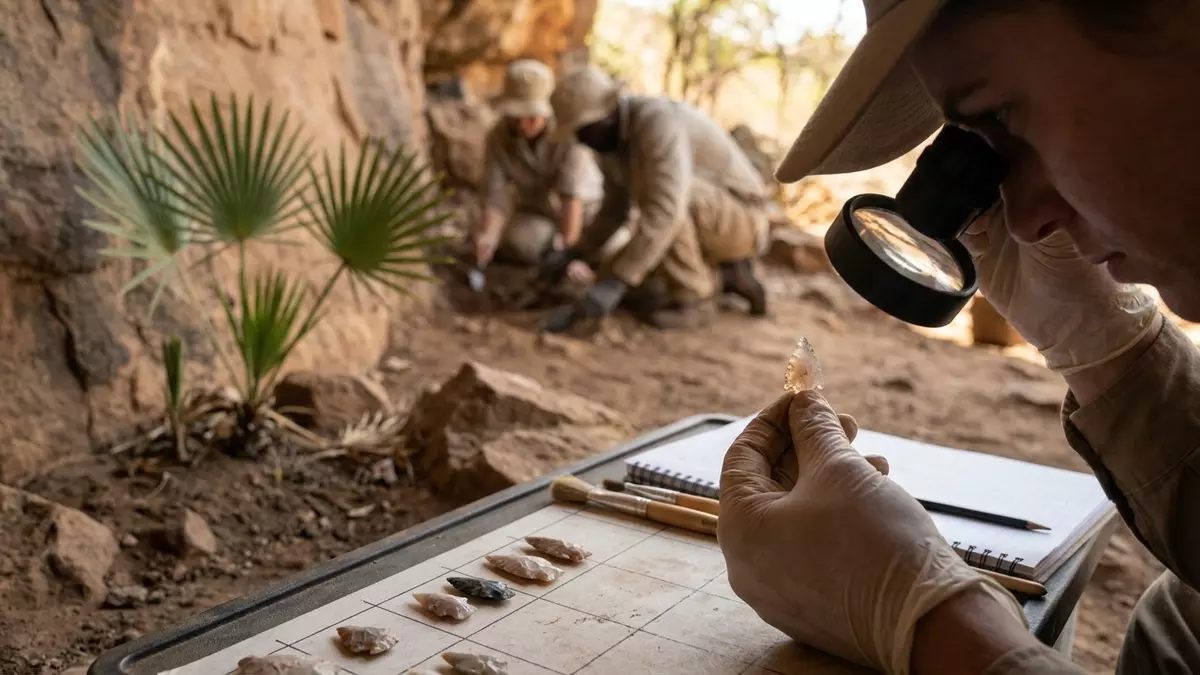
The breakthrough centered on a collection of small quartz arrowheads, known as microliths, recovered from the Umhlatuzana Rock Shelter in KwaZulu-Natal, South Africa. These stone tips belong to the Howiesons Poort techno-culture—a prehistoric period celebrated for sudden leaps in human creativity, arts, and tool design.

An international research team subjected ten of these ancient arrowheads to advanced microchemical and biomolecular analyses. What they found stuck to the stone was an archaeological holy grail: five out of the ten arrowheads retained clear, unmistakable organic residues of lethal plant toxins.
Quartz Arrowhead Residue Analysis:
├── 10 Total Micro-Arrowheads Tested
├── 5 Tips Confirmed Positive for Plant Alkaloids
└── Chemical Compounds Isolated: Buphandrine & Epibuphanisine
The specific biomolecules identified were buphandrine and epibuphanisine. These highly toxic alkaloids belong exclusively to the Amaryllidaceae lily family. More specifically, the chemical signature matches the toxic bulb of Boophone disticha (commonly known as the century plant or tumbleweed), a lethal flora species that indigenous hunting communities in southern Africa still utilize for arrow poison today.
The Strategy of the Slow Poison
The discovery offers profound insights into how prehistoric humans hunted megafauna. The neurotoxins derived from Boophone disticha bulbs do not kill an animal instantly upon impact. Instead, they enter the bloodstream and slowly weaken, disorient, and paralyze the prey over several hours.
This slow-acting mechanic reveals that early humans were executing highly advanced hunting strategies:
Persistence Hunting Facilitation: Once an animal was nicked by a tiny poison tip, hunters did not have to risk close-quarters combat with a thrashing, wounded beast. They could track the animal from a safe distance while the chemical compound did the heavy lifting.
Overcoming Kinetic Limitations: The bows of the Middle Stone Age were relatively small and lacked the mechanical power to drive a stone deep enough to kill a large animal through physical trauma alone. Poison transformed a minor flesh wound into a guaranteed kill.
Energy Conservation: By reducing the physical demand of chasing down completely healthy prey, poisoned weapons drastically increased the energy efficiency and success rates of hunting parties.

Prehistoric Weapon Evolution:
[Traditional Stone Tip] ── Requires deep muscle penetration ──> High risk, high energy output
[Poisoned Microlith]     ── Requires only a minor skin scratch ──> Low risk, guaranteed kill over time
Proof of Astonishing Cultural Continuity
Before this study, the use of poison in deep history was largely a guessing game. Archaeologists occasionally inferred poison use based on the presence of bone applicators or small grooved arrows, but direct, undeniable chemical proof had never been extracted from weapons older than a few thousand years.
To ensure the accuracy of their findings, the research team compared the 60,000-year-old quartz residues against two control samples:
Historical poisoned arrows recovered from southern Africa during the 18th century.
Fresh chemical extracts pulled directly from modern-day Boophone disticha bulbs.
The profiles matched seamlessly. This reveals a mind-boggling 60,000-year thread of ecological and toxicological knowledge passed down through hundreds of generations of hunting communities in southern Africa.
Cognitive Milestones of Early Homo sapiens
From a cognitive perspective, manufacturing a poisoned arrow is an incredibly complex mental task. It requires an abstract understanding of nature that goes far beyond opportunistic survival.
To create these weapons, an ancient hunter had to successfully navigate a multi-step chain of logic:
Cognitive Chain of Chemical Weapon Production:
[Botany: Identify rare, underground bulbs] ──► [Chemistry: Safely extract and process toxins] ──► [Engineering: Mount quartz to shaft using adhesives] ──► [Abstract Logic: Anticipate death hours after hit]
This required advanced planning, an understanding of hidden plant mechanics, and the cognitive capacity to connect an action performed on a rock shelter floor to an effect that wouldn’t manifest until hours later out on the savanna. It proves beyond doubt that late Pleistocene humans in South Africa operated with the same intellectual architecture and complex strategic reasoning that defines modern humanity today.
The fact that these delicate organic molecules survived for 60,000 years inside a dirt floor opens thrilling new doors for archaeology, proving that with the right technology, scientists can hunt for ancient medicines, poisons, and organic innovations across the globe.
Frequently Asked Questions
How did scientists detect poison on a 60,000-year-old rock?
Scientists utilized advanced biomolecular and microchemical analysis techniques capable of identifying ancient residues at the molecular level. They successfully isolated specific plant alkaloids called buphandrine and epibuphanisine still clinging to the microscopic cracks of the quartz stone.
What plant did the ancient poison come from?
The poison was extracted from the toxic bulb of Boophone disticha, a member of the Amaryllidaceae family. It is a highly toxic, fan-leafed plant native to southern Africa that is notorious for its potent neurotoxic properties.
Why didn’t early humans just use sharper, deeper arrows instead?
The bows available 60,000 years ago were lightweight and could not fire a heavy arrow with enough velocity to instantly kill a large animal. By tipping lightweight quartz fragments with poison, the hunter only needed to scratch the animal’s skin to deliver a lethal dose, turning a weak weapon into a deadly one.
Does anyone still use this specific poison today?
Yes. The chemical analysis revealed an incredible line of cultural continuity. The exact same plant and processing methodologies detected on the 60,000-year-old artifacts were documented on historical arrows from the 1700s and are still used by indigenous San hunters in southern Africa today.
What does this find tell us about early human intelligence?
It proves that humans living 60,000 years ago possessed complex cognitive skills, including advanced abstract reasoning, long-term planning, and an understanding of chemistry and delayed cause-and-effect relationships. They were not primitive foragers, but highly analytical survival strategists.