
Table of Contents
- 1. The Discovery Beneath the Western Wall Plaza
- 2. Sealed by the Fires of the Roman Conquest
- 3. Stone Vessels and the Strict Laws of Ritual Purity
- 4. A Bustling Hub for Local Residents and Ancient Pilgrims
- 5. How Religion Architecturally Shaped Ancient Urban Spaces
- 6. A Missing Piece of the Temple-Centered City Puzzle
- 7. Frequently Asked Questions
- 7.1. What is a mikveh and what was its purpose?
- 7.2. Why is the discovery under the Western Wall Plaza significant?
- 7.3. Why did ancient Jews use stone vessels instead of pottery?
- 7.4. Who would have used this specific ritual bath?
- 7.5. What do the four steps leading into the bath signify?
2,000-Year-Old Ritual Bath Found Under Jerusalem’s Western Wall
An extraordinary archaeological discovery beneath the Western Wall Plaza in Jerusalem is offering a rare, firsthand glimpse into ancient Jewish life moments before a defining historical catastrophe. Archaeologists have uncovered a remarkably well-preserved ritual purification bath, known as a mikveh, dating back to the final years of the Second Temple period.
Buried beneath a thick blanket of ash and debris left by the Roman army, this ancient installation provides undeniable physical evidence of daily religious devotion in Jerusalem leading up to the city’s dramatic fall in 70 CE. The find acts as a poignant time capsule, capturing the intersection of daily routine, religious law, and political upheaval in ancient Judea.
2,000-Year-Old Ritual Bath Found Under Jerusalem’s Western Wall
The Discovery Beneath the Western Wall Plaza
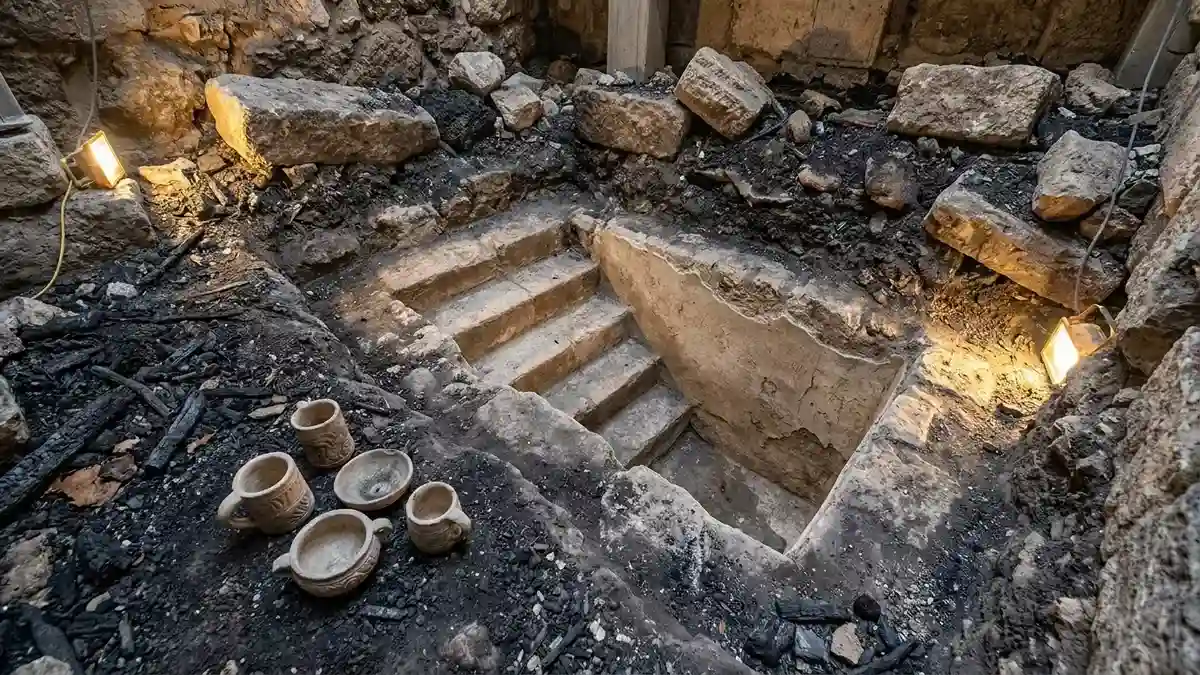
The excavation, conducted by the Israel Antiquities Authority under the Western Wall Plaza, targeted a highly sensitive and historically rich sector of Jerusalem’s ancient urban landscape. As teams cleared layers of accumulated earth, they exposed a subterranean installation carved directly into the bedrock.
This structure was identified as a mikveh, a specialized bath designed for ritual immersion and purification under Jewish law. The physical dimensions of the bath reflect careful planning and adherence to specific religious standards, measuring approximately 3.05 meters (10 feet) in length, 1.35 meters (4.4 feet) in width, and 1.85 meters (6 feet) in height.
To ensure the water-tight integrity necessary for a functional ritual pool, the ancient builders coated the interior stone walls with a durable layer of plaster. Access into the pool was facilitated by four precisely carved stone steps descending from the southern side. The meticulous craftsmanship of these stairs highlights the strict attention paid to the ritual requirements governing immersion practices during the Second Temple era.

Sealed by the Fires of the Roman Conquest
What makes this specific mikveh uniquely significant to historians is the context of its burial. The ritual bath was found entirely sealed beneath a heavy, undisturbed destruction layer. This layer is a direct physical record of the Roman siege and subsequent leveling of Jerusalem nearly two millennia ago.
Inside this debris, researchers documented a grim scene of sudden devastation:
Burned Ash: Thick pockets of carbonized material indicating widespread, intense fires.
Collapsed Architectural Elements: Heavy stones and structural debris that violently caved in on the installation.
Domestic Artifacts: Everyday household items trapped mid-use beneath the falling structures.

The composition of this layer points to an incredibly sudden, violent termination of life and activity at the site. Rather than a gradual abandonment, the individuals utilizing this space were forced out or overwhelmed rapidly as Roman legions breached the city’s defenses. The sealing layer essentially froze the installation in time, preserving a snapshot of its final day of operation.
Stone Vessels and the Strict Laws of Ritual Purity
As archaeologists meticulously sifted through the ash and collapsed material filling the area, they recovered a variety of artifacts that shed light on the lifestyle of Jerusalem’s inhabitants. Among the pottery fragments were numerous pieces of ancient stone vessels.
During the late Second Temple period, stone vessels became a defining hallmark of Jewish domestic and religious life in Jerusalem. According to Jewish halakha (religious law), clay pottery and metalware were susceptible to contracting ritual impurity; if contaminated, clay vessels had to be broken and discarded. Stone, however, was uniquely classified as immune to ritual impurity.
The widespread adoption of stone tables, bowls, and mugs allowed families to maintain the highest standards of purity in their daily lives without the constant financial burden of replacing contaminated clay goods. Finding these specialized stone vessels immediately alongside the newly excavated mikveh confirms that the entire complex was deeply integrated into rigorous purity practices.
A Bustling Hub for Local Residents and Ancient Pilgrims
The physical location of the newly discovered mikveh provides critical clues regarding who was using it. The excavation site sits in immediate proximity to the Temple Mount, the spiritual and political heart of ancient Judaism.
Specifically, the site is situated near primary ancient access routes that led directly into the holy Temple complex. These include the Great Bridge to the north and the monumental Robinson’s Arch to the south. Because of this strategic positioning, the area experienced immense foot traffic.
Previous archaeological campaigns in this immediate zone have revealed a high concentration of other mikva’ot and supporting ritual infrastructure. This dense network of purification facilities suggests the neighborhood served a dual purpose:
Residential Quarter: Accommodating local residents who lived near the Temple and integrated strict purity laws into their everyday household routines.
Pilgrim Infrastructure: Serving the massive influx of thousands of Jewish pilgrims who traveled to Jerusalem from across the ancient world, particularly during the major pilgrimage festivals of Passover, Shavuot, and Sukkot. Before ascending the holy mount, these visitors were required to undergo ritual purification, making public or semi-public mikva’ot near the gates absolutely essential.
How Religion Architecturally Shaped Ancient Urban Spaces
For researchers, the discovery of this mikveh serves as a powerful case study in how deeply held religious beliefs can fundamentally alter urban architecture and spatial design. In Second Temple-period Jerusalem, religious purity laws were not confined to abstract texts or isolated sanctuaries; they directly dictated how buildings were constructed, how homes were arranged, and how public spaces were managed.
The presence of a carefully engineered ritual bath in a bustling, semi-public area near major thoroughfares demonstrates that purification was seamlessly woven into the fabric of daily life. From the choice of stone kitchenware to the subterranean modifications of the bedrock, the physical environment of Jerusalem was deliberately sculpted to support a community striving for constant ritual readiness.
A Missing Piece of the Temple-Centered City Puzzle
The unearthing of this 2,000-year-old mikveh provides historians with an invaluable anchor to the past. The ash trapped inside the sealing layer binds the structure directly to the documented historical narrative of the First Jewish-Roman War, offering an authentic, unedited look at a functional installation caught in the crosshairs of history.
Ultimately, archaeologists view this discovery as a vital piece of a much larger puzzle. It reinforces the understanding of ancient Jerusalem as a thoroughly Temple-centered metropolis. In this vibrant urban center, the boundaries between secular daily survival and sacred religious obligation did not exist; instead, they were beautifully and tightly intertwined.
Frequently Asked Questions
What is a mikveh and what was its purpose?
A mikveh is a specialized ritual purification bath used in Judaism. Its primary purpose is not physical cleanliness, but rather spiritual purification. Individuals would immerse themselves completely in the water to transition from a state of ritual impurity to purity, a practice required before entering sacred spaces like the Temple or participating in certain religious rituals.
Why is the discovery under the Western Wall Plaza significant?
The discovery is highly significant because it was found sealed underneath an intact layer of destruction from the Roman conquest of 70 CE. This provides an undisturbed time capsule showing exactly how the bath was used and what daily life looked like immediately before the city and the Second Temple were destroyed.
Why did ancient Jews use stone vessels instead of pottery?
According to ancient Jewish dietary and purity laws, stone was considered immune to becoming ritually impure. Clay pottery, if exposed to something impure, had to be broken and thrown away. Using stone vessels was a practical way for the people of Jerusalem to maintain strict purity standards without constantly destroying their household items.
Who would have used this specific ritual bath?
Due to its location near the Temple Mount and major access routes like Robinson’s Arch, this mikveh was likely used by both the local residents living near the Temple complex and the vast crowds of pilgrims who traveled to Jerusalem for major religious festivals.
What do the four steps leading into the bath signify?
The four steps were precisely carved into the bedrock to allow individuals to safely descend into the pool for full immersion. The exact design and craftsmanship demonstrate a careful adherence to the specific religious and architectural regulations required to make a ritual bath valid under Jewish law.