
Table of Contents
- 1. The Cougar Mountain Capsule: Surviving the Millennium
- 2. Decoding the Stitching: Prehistoric Tailoring Technology
- 3. The Architecture of Cordage: Nets, Bags, and Weaving
- 4. The Great Rabbit Drives: Mass Harvesting the High Desert
- 5. Climate Adaptation and Technological Shifts
- 6. Frequently Asked Questions
- 6.1. What makes the Cougar Mountain Cave discovery so historic?
- 6.2. How did these delicate materials survive for nearly 12,000 years?
- 6.3. What climate event forced humans to develop this tailored clothing?
- 6.4. How did ancient people hunt enough animals to make these fur robes?
- 6.5. What tools did early Americans use to sew these hides together?
Paleolithic Tailors: 12,000-Year-Old Sewn Hide Found in Oregon Cave
Deep within the arid high desert of the Great Basin, a revolutionary archaeological discovery has rewritten the history of fashion, technology, and human survival in ancient North America. By analyzing remarkably well-preserved organic materials from a system of dry volcanic caves in Oregon, scientists have identified the oldest known physical evidence of sewn animal hide on the continent.
Dating back nearly 12,000 years to the twilight of the last Ice Age, this prehistoric textile masterpiece provides an unprecedented look at how early Americans engineered tailored clothing to withstand a sudden, punishing climate shift.
Paleolithic Tailors 12,000-Year-Old Sewn Hide Found in Oregon Cave
The Cougar Mountain Capsule: Surviving the Millennium
Organic materials like plant fibers, wood, and animal skins are highly volatile and almost never survive the ravages of time. However, the unique environmental conditions inside Oregon’s Cougar Mountain Cave and the neighboring Paisley Caves acted as a natural freezer. Because these deep chambers remained bone-dry and sheltered from water infiltration for thousands of years, delicate materials that would normally rot within decades were perfectly mummified.

A comprehensive multi-institutional study published in the journal Science Advances focused on a treasure trove of 55 highly perishable artifacts recovered from these caves. By running 66 independent radiocarbon dates, researchers anchored the collection between 12,900 and 11,700 years ago.
This tight timeline places the artifacts directly within the Younger Dryas—a famous, centuries-long global cold snap that plunged North America back into severe glacial conditions just as the Ice Age was ending.
Decoding the Stitching: Prehistoric Tailoring Technology
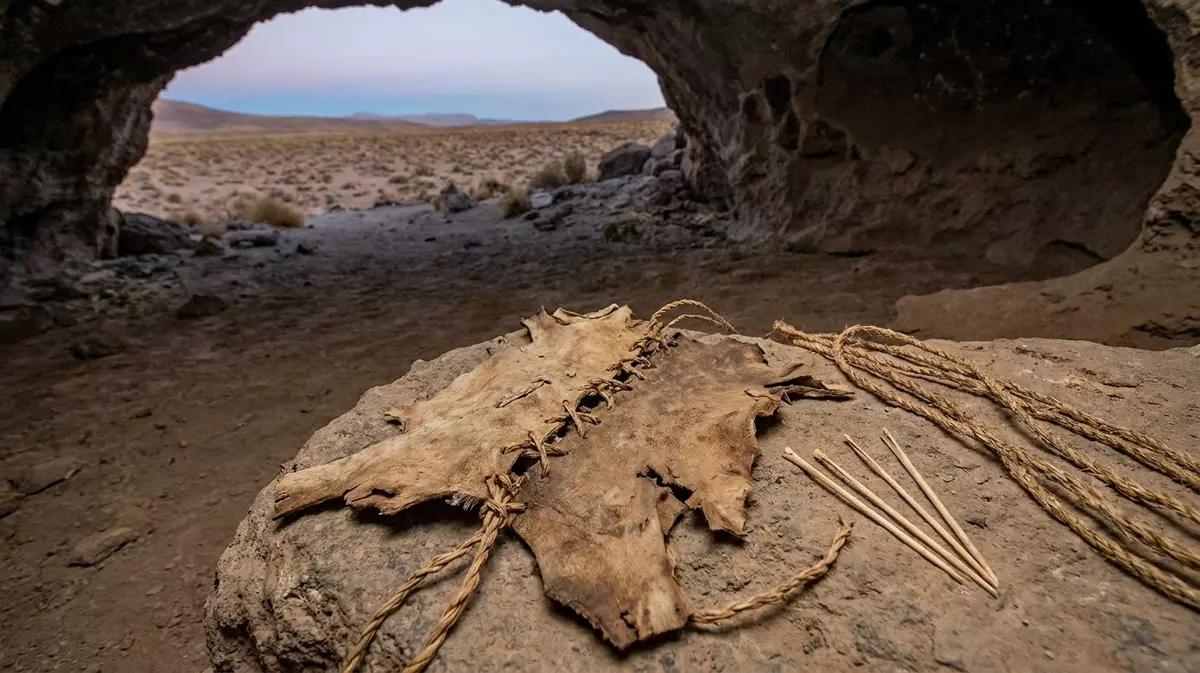
The crown jewel of the collection consists of two small fragments of soft animal skin firmly joined together by a durable, hand-spun strip of plant-fiber cordage. This artifact displays unmistakable, deliberate stitching patterns, making it the earliest physical example of sewn hide garments in North America.

          [Fragment A: Pre-punched Animal Hide]
                         │
                         ├─► [Over-Under Stitching Vector]
                         │   (Executed with ultra-fine eyed bone needles)
                         ▼
          [Fragment B: Matching Animal Hide Layer]
                         ▲
                         │
                         └─► [Two-Ply Plant Fiber Cordage]
                             (Tightly twisted to resist friction & snapping)
Archaeologists believe these stitched fragments represent the remains of fitted, tailored clothing, protective winter footwear, or insulated shelter covers. This interpretation is backed up by another extraordinary regional find: four neighboring archaeological sites yielded ultra-fine, polished bone needles complete with drilled eyes.
These needles rank among the most sophisticated, high-precision tools recovered from the Late Pleistocene world. Their presence proves that early Americans weren’t just wrapping loose skins around their shoulders; they possessed a highly developed, specialized tradition of sewing and textile engineering.
The Architecture of Cordage: Nets, Bags, and Weaving
Beyond the sewn hide, the dry caves yielded an abundance of plant-fiber innovations, showing that ancient communities had thoroughly mastered the mechanical properties of regional flora.

Archaeologists documented complex cords displaying an array of distinct thicknesses, plies, and directional twists ($S$-twist and $Z$-twist). This structural variety indicates that rope making was highly specialized:
Heavy Coarse Cords: Engineered to handle high tensile stress, making them ideal for heavy-duty binding or construction.
Fine Thread-Like Strings: Spun with high flexibility to weave intricate containers, utility bags, and clothing seams.
Twined open-Mesh Fragments: Woven using advanced geometric spacing techniques perfectly suited for fabricating mass-harvesting fishing and hunting nets.
The Great Rabbit Drives: Mass Harvesting the High Desert
The strategic purpose behind this advanced fiber and textile technology becomes clear when looking at neighboring sites located within a 100-kilometer radius of the caves. Archaeologists excavating massive, ancient fire pits discovered a staggering assemblage of over 14,000 rabbit bones—and virtually no remains of any other animal species.
+-------------------------------------------------------------------------+
|                    PALEO-INDIAN HARVESTING STRATEGIES                   |
+------------------------------------+------------------------------------+
| Technological Component            | Socio-Economic Function            |
+------------------------------------+------------------------------------+
| Woven Open-Mesh Fiber Nets         | Strung across valleys for mass     |
|                                    | communal rabbit drives             |
| Tailored Rabbit-Fur Pelts          | Strips of fur woven with plant     |
|                                    | fibers to create thick winter robes|
| Whittled Wooden Stakes & Triggers  | Set as passive, year-round         |
|                                    | deadfall traps for small game      |
+------------------------------------+------------------------------------+
This lopsided wildlife record matches the ethnographic footprint of communal rabbit drives. Entire tribal bands would cooperate to string hundreds of meters of woven fiber netting across desert valleys, forming an expansive funnel.
Hunters would then flush thousands of jackrabbits out of the brush, driving them into the nets for mass capture. These highly organized events provided communities with a massive surplus of lean meat and, crucially, an abundance of warm winter fur.
Inside Paisley Caves, researchers recovered a priceless piece of this history: a strip of soft rabbit skin with the thick winter hair still attached. The artifact perfectly mirrors the historic winter robes crafted by the Northern Paiute communities in recent centuries, who meticulously sliced rabbit pelts into strips and laced them together with plant fiber to create heavily insulated, windproof cloaks.
Climate Adaptation and Technological Shifts
The rise and fall of this complex sewing culture tracks tightly with ancient climate data. During the brutal cold of the Younger Dryas, fitted, wind-resistant fur garments were a basic biological necessity for human survival in the damp, marshy plains of the ancient Great Basin.
However, the archaeological record shows that after 11,000 years ago, as the regional climate rapidly warmed and dried out into a desert environment, the demand for heavy hide outfits plummeted. Bone needles and thick hide scraps fade from the cave strata, replaced by an explosion of lightweight, highly breathable plant-based textiles, sandals, and woven grass baskets.
This technological transition showcases the incredible intellectual flexibility of early Americans, proving they were scientists of their environment who completely transformed their industrial toolkits to thrive on a fast-changing planet.
Frequently Asked Questions
What makes the Cougar Mountain Cave discovery so historic?
It contains the oldest physically preserved evidence of sewn animal hide ever found in North America, dating back between 12,900 and 11,700 years ago.
How did these delicate materials survive for nearly 12,000 years?
The artifacts were protected inside unique volcanic caves in Oregon that remained completely dry and isolated from moisture for millennia, preventing the natural bacteria and rot that typically destroys skin, fur, and wood.
What climate event forced humans to develop this tailored clothing?
The sewing technology matches the Younger Dryas, a sudden, severe global cooling phase at the end of the last Ice Age that brought freezing temperatures and high moisture to the Great Basin region.
How did ancient people hunt enough animals to make these fur robes?
Communities used complex plant-fiber cords to weave massive hunting nets. They staged highly coordinated, communal rabbit drives, funneling thousands of animals into the nets at once to harvest meat and pelts.
What tools did early Americans use to sew these hides together?
Archaeologists have uncovered incredibly fine, highly polished needles crafted from animal bones, featuring precisely drilled eyes designed to carry thin, two-ply threads spun from local plant fibers.