
Table of Contents
- 1. The Mystery of the Grotta del Romito Burial
- 2. Decoding a Rare Genetic Condition
- 3. Insights into Stone Age Social Care
- 4. Integrating Medicine and History
- 5. Frequently Asked Questions (FAQ)
- 5.1. 1. What is the significance of the 12,000-year-old burial discovery?
- 5.2. 2. How did researchers confirm the girl’s diagnosis?
- 5.3. 3. Does this discovery prove that prehistoric societies cared for the disabled?
- 5.4. 4. Who were the individuals found in the double burial?
- 5.5. 5. Why is this study important for modern medicine?
12,000-Year-Old DNA Reveals Earliest Genetic Diagnosis
In a groundbreaking synthesis of modern clinical genetics and archaeology, researchers have identified the oldest known genetic diagnosis in an anatomically modern human. By analyzing the DNA of a teenage girl who lived 12,000 years ago, scientists have confirmed she suffered from a rare form of skeletal dysplasia, offering a profound window into the health and social structures of Stone Age communities.
12,000-Year-Old DNA Reveals Earliest Genetic Diagnosis
The Mystery of the Grotta del Romito Burial
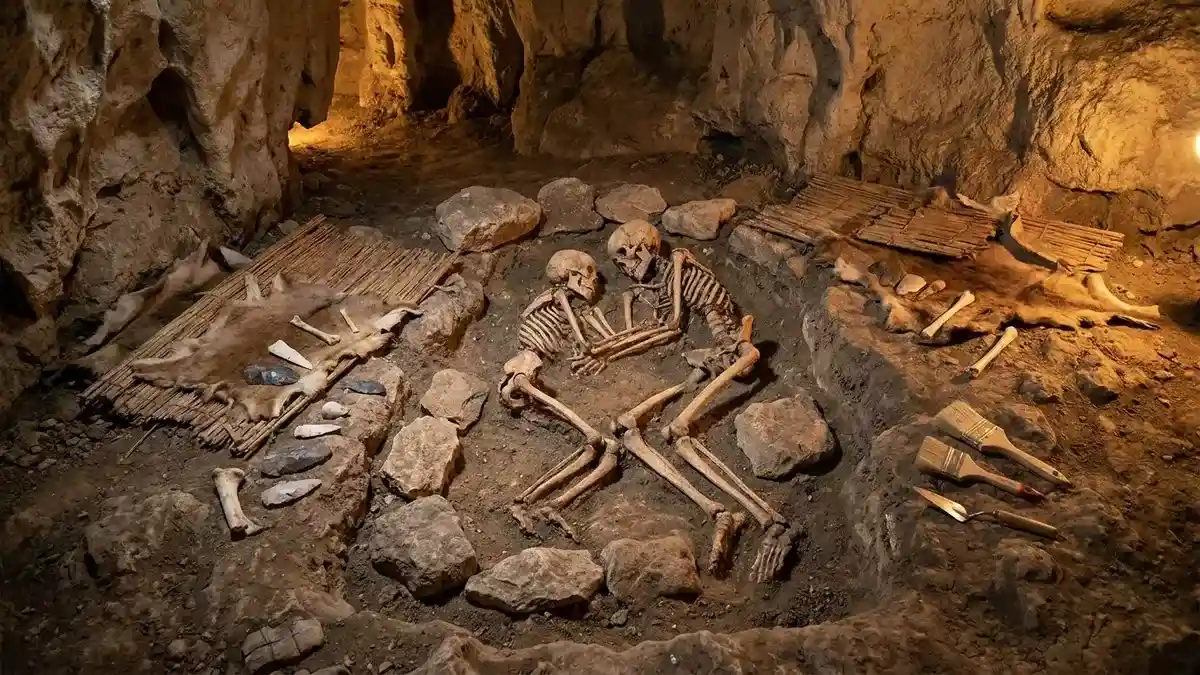
The investigation centers on a double burial unearthed in 1963 within the Grotta del Romito, a limestone cave in southern Italy. For decades, the discovery—two individuals laid to rest in a poignant embrace—captured the attention of the scientific community. One individual, referred to as “Romito 2,” was a teenager who exhibited severe physical challenges, including extreme limb shortening and a stature of only 110 centimeters (about 3 feet 7 inches). The second individual, “Romito 1,” was an adult measuring 145 centimeters (4 feet 9 inches), both notably smaller than the averages recorded for their era.
Recent advances in paleogenomics allowed an international research team to extract high-quality DNA from the inner ear bones of these remains. The results were revelatory: both individuals were female, and genetically, they were first-degree relatives—most likely mother and daughter.
Decoding a Rare Genetic Condition
The DNA analysis provided a definitive diagnosis for Romito 2: a homozygous mutation in the NPR2 gene. This confirmed she suffered from acromesomelic dysplasia, Maroteaux type, a rare inherited disorder that causes the severe limb and stature abnormalities observed in her skeleton.
Furthermore, the genetic testing revealed that the mother (Romito 1) carried a single copy of this mutated gene. This inherited trait explains her own reduced stature, which, while less severe than her daughter’s, remained significantly below the norm for that period. This study demonstrates that these rare genetic conditions are not modern medical anomalies; rather, they have been a part of the human experience for millennia.
Insights into Stone Age Social Care
Beyond the medical diagnosis, the study offers compelling evidence regarding the social dynamics of prehistoric hunter-gatherers. Romito 2 survived into adolescence despite her severe physical limitations—a feat that would have been exceptionally difficult without consistent assistance from her group.

Researchers emphasize that her survival is a testament to the compassion and social cooperation present in her community. Her family clearly adapted to her needs, likely providing her with food, assistance with mobility, and support that allowed her to live as a recognized member of her society. This challenges the stereotype that prehistoric groups were purely survival-oriented, showing instead that they possessed deep-rooted mechanisms for care and inclusivity.
Integrating Medicine and History
This research is the result of a massive interdisciplinary effort, involving teams from the University of Vienna, Sapienza University of Rome, and Liège University Hospital Centre. By applying tools traditionally reserved for modern medical diagnostics, scientists were able to classify the individuals within the “Villabruna” genetic cluster—a group of hunter-gatherers who expanded across Europe approximately 14,000 years ago.
As Dr. Adrian Daly of Liège University Hospital Centre notes, these findings are just the beginning. The application of ancient DNA genome analysis provides a gateway to identifying many other genetic diseases that have remained hidden in the archaeological record for thousands of years. As medical science continues to advance, our ability to look back and understand the lives of our ancestors—and the challenges they faced—continues to grow, revealing a shared history that is as human as it is ancient.
Frequently Asked Questions (FAQ)
1. What is the significance of the 12,000-year-old burial discovery?
This discovery provides the earliest known genetic diagnosis in an anatomically modern human. It proves that rare genetic disorders like acromesomelic dysplasia have existed throughout human history and were not unique to modern populations.
2. How did researchers confirm the girl’s diagnosis?
By extracting DNA from the inner ear bones, scientists identified a specific mutation in the NPR2 gene. This gene is known today to cause the rare condition called acromesomelic dysplasia, which leads to shortened limbs and short stature.
3. Does this discovery prove that prehistoric societies cared for the disabled?
Yes. The fact that the teenager lived into her teens despite her severe physical challenges suggests that her community provided the necessary care, food, and mobility support. This serves as clear evidence of social cooperation and empathy in Stone Age family groups.
4. Who were the individuals found in the double burial?
The DNA analysis confirmed both individuals were female and closely related—most likely a mother and her daughter. Both carried genetic markers related to the Villabruna hunter-gatherer cluster of southern Europe.
5. Why is this study important for modern medicine?
The study demonstrates that tools used to identify genetic causes of abnormal growth today can be successfully applied to ancient remains. This opens the door for researchers to map the historical prevalence and evolution of various rare genetic diseases, potentially providing context for modern medical conditions.