
Table of Contents
- 1. The Cross-Coastal Discoveries: Kent and Dorset
- 2. Decoding the Genetic Footprint: A Paternal Legacy
- 2.1. 1. The Maternal Lineage (Mitochondrial DNA)
- 2.2. 2. The Ancestral Mixture (Autosomal DNA)
- 3. The Grave of the Updown Girl: A Tale of Wealth and Inclusion
- 4. The Worth Matravers Mystery: The Sailor’s Anchor
- 5. Mapping the Ancient Highway: From the Sahel to Britain
- 6. Conclusion: The Cosmopolitan Dark Ages
- 7. Frequently Asked Questions
- 7.1. What did the DNA study reveal about 7th-century England?
- 7.2. Where exactly were these skeletons discovered?
- 7.3. How much West African ancestry did these individuals possess?
- 7.4. Were these individuals treated as outsiders by the Anglo-Saxons?
- 7.5. How did people travel from West Africa to England in the 600s CE?
Ancient DNA Overturns Traditional Beliefs About Early Medieval England
For centuries, popular history textbooks have painted 7th-century Anglo-Saxon England as an isolated, culturally uniform world. According to conventional narratives, the collapse of Roman administration severed Britain’s Mediterranean lifelines, plunging the island into a localized, insular dark age. However, a revolutionary ancient DNA study has shattered this assumptions, revealing that early medieval England was far more cosmopolitan and globally connected than anyone ever imagined.
By sequencing the genomes of individuals buried in early medieval cemeteries, scientists have uncovered undeniable genetic proof of recent sub-Saharan West African ancestry in two individuals buried at opposite ends of the southern English coast. These findings do not just rewrite individual family trees—they rewrite the entire history of global migration, proving that the human networks of the Early Middle Ages stretched smoothly from the English Channel all the way to the African Sahel.
Ancient DNA Overturns Traditional Beliefs About Early Medieval England
The Cross-Coastal Discoveries: Kent and Dorset
The groundbreaking research, published in the journal Antiquity, draws its data from two geographically separate Anglo-Saxon cemetery excavations:
Updown in Kent: Situated in the extreme southeast of England, an area deeply exposed to continental European trade.
Worth Matravers in Dorset: Located in the rugged southwest, a region traditionally considered outside the core Anglo-Saxon cultural zone.

In both cemeteries, the vast majority of the excavated skeletons exhibited genetic profiles typical for the era—primarily northern European, West British, or Irish ancestries. However, one individual in each cemetery stood out as a profound genetic anomaly.
Decoding the Genetic Footprint: A Paternal Legacy
To map out the heritage of these individuals, geneticists deployed a dual-testing protocol that examined different sections of their cellular blueprints.

1. The Maternal Lineage (Mitochondrial DNA)
First, the team analyzed mitochondrial DNA (mtDNA), which is passed down entirely unaltered from mother to child. In both cases, the maternal markers pointed directly to deep northern European roots. This indicates that both individuals were born to mothers who were fully local to the European or British landscape.
2. The Ancestral Mixture (Autosomal DNA)
The massive surprise came when researchers analyzed autosomal DNA, which inherits a mixed blend of traits from both parents. The autosomal profiles revealed a striking 20% to 40% genetic affinity to modern-day West African populations, specifically mirroring the genetic signatures of the Yoruba, Mende, Mandenka, and Esan ethnic groups.
By running these ancestral proportions through complex statistical inheritance models, scientists constructed a precise family timeline. The calculations reveal that both the young girl from Kent and the young man from Dorset likely shared a paternal grandparent—most likely a grandfather—who originated in the southern Sahel region of West Africa. This African ancestor traveled thousands of miles north into Europe sometime between the mid-500s and early 600s CE, marrying into a local northern European lineage.
The Grave of the Updown Girl: A Tale of Wealth and Inclusion
Beyond the genetics, the physical objects buried alongside the deceased provide crucial context about how these individuals were perceived by their communities. At the Updown site in Kent, researchers examined the skeleton of a young girl who was between 11 and 13 years old when she passed away.
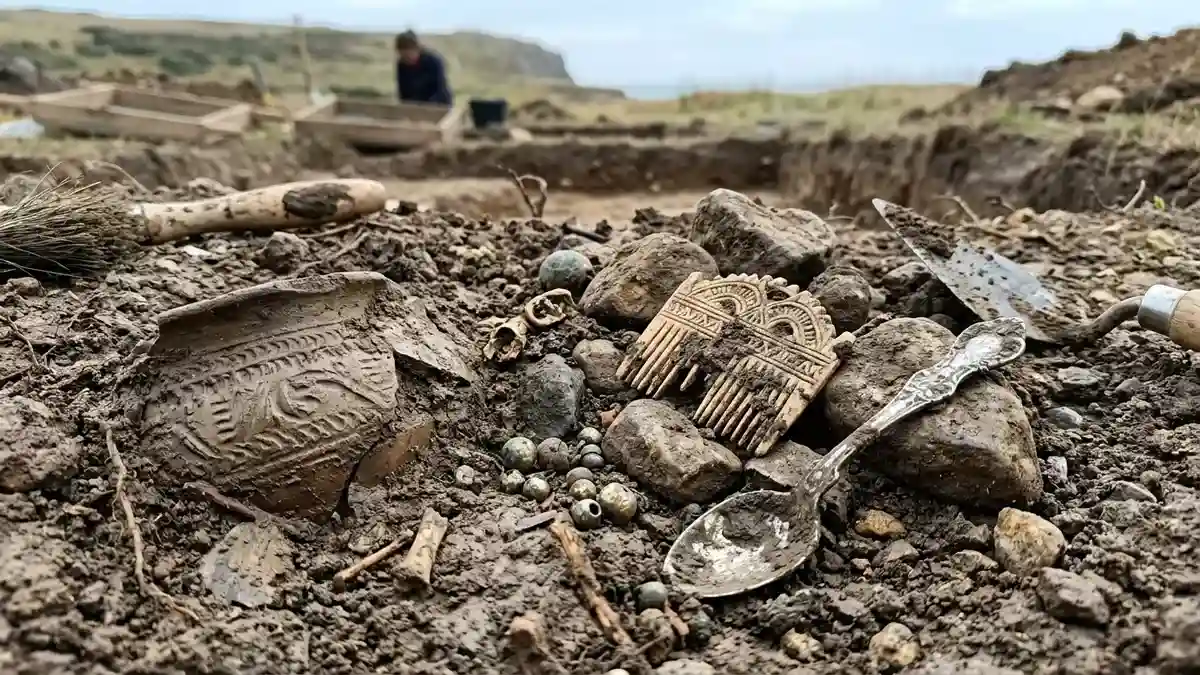
Far from being treated as a marginalized outsider, her grave layout reflects high social standing and meticulous care. She was laid to rest surrounded by an array of elite continental luxuries:
An ornate, decorated ceramic pot imported from Frankish Gaul (modern-day France).
A finely carved bone comb.
A specialized spoon that historians believe may have been used in early Christian liturgical rituals.
Her burial took place during what archaeologists refer to as the “Frankish Phase” of Kentish history—an era characterized by hyper-active royal diplomatic marriages and aggressive trade with continental Europe, centered around major royal networks like Finglesham. The luxurious nature of her grave goods proves that she was a fully integrated, highly valued member of an elite Anglo-Saxon household.
The Worth Matravers Mystery: The Sailor’s Anchor
At the opposite end of the coast, the cemetery of Worth Matravers in Dorset yielded the remains of a young man who shared a similar genetic makeup. He was buried in a shared grave context alongside an older, biologically unrelated male.
Deposited directly next to the bodies within the grave was a massive, functional anchor meticulously carved out of local Dorset limestone. While it is impossible to know his exact profession, the symbolic inclusion of a heavy maritime anchor points strongly to a life tied to seafaring, coastal shipping, or cross-channel logistics.
“What is truly fascinating about these two individuals is that this international connection is not an isolated fluke in a single port town; it is found simultaneously in both the east and the west of Britain,” notes Professor Duncan Sayer of the University of Central Lancashire, the lead author of the Updown study.
Mapping the Ancient Highway: From the Sahel to Britain
How did individuals with deep roots in sub-Saharan West Africa find themselves living and dying in early medieval England? The authors of the studies suggest that their presence is concrete proof of highly functioning, long-distance human migration routes that bypassed the collapsed infrastructure of Western Europe.
Rather than a single, epic migration event, this human movement was likely achieved in stages via active Mediterranean trade pipelines. During the 6th and 7th centuries, the Byzantine (Eastern Roman) Empire still maintained tight administrative and military control over significant portions of North Africa.
Gold, ivory, and spices routinely moved out of sub-Saharan Africa, across the Sahel desert, and into Byzantine trading ports. From there, merchants, diplomatic envoys, and maritime laborers traveled along well-established shipping routes connecting the Mediterranean to Frankish Gaul, ultimately crossing the English Channel into Anglo-Saxon kingdoms.
Conclusion: The Cosmopolitan Dark Ages
The discoveries at Updown and Worth Matravers represent a paradigm shift for early medieval archaeology. While historians have long known that luxury trade goods traveled vast distances across the ancient world, it was easy to assume that the people themselves remained static.
These two 7th-century skeletons provide undeniable physical proof that human beings were moving just as fluidly as the artifacts they carried. As Dr. Ceiridwen J. Edwards of the University of Huddersfield emphasizes, these findings illuminate the profoundly cosmopolitan fabric of early England, revealing a diverse population with far-flung ancestry who were, nonetheless, completely woven into the daily life and sacred rituals of their local communities.
Frequently Asked Questions
What did the DNA study reveal about 7th-century England?
The study revealed that two separate individuals buried in 7th-century England had recent sub-Saharan West African ancestry, proving that early medieval European societies were highly diverse and connected to distant continents through human migration.
Where exactly were these skeletons discovered?
One skeleton belonged to an 11- to 13-year-old girl excavated at an Anglo-Saxon cemetery in Updown, Kent (southeastern England). The second belonged to a young man unearthed in Worth Matravers, Dorset (southwestern England).
How much West African ancestry did these individuals possess?
Autosomal DNA testing revealed that both individuals possessed between 20% and 40% genetic affinity to modern-day West African populations, such as the Yoruba and Mende. This indicates they likely had a paternal grandfather who migrated from the southern Sahel region.
Were these individuals treated as outsiders by the Anglo-Saxons?
No. The archaeological evidence proves they were fully integrated into their local communities. The young girl in Kent was buried with high-status continental luxury goods, including an imported Frankish pot and a ritual spoon, indicating she belonged to an elite, respected household.
How did people travel from West Africa to England in the 600s CE?
Historians believe individuals traveled along long-distance trade and diplomatic networks. Valuables and people moved from sub-Saharan Africa into Byzantine-controlled North Africa, across the Mediterranean to Frankish kingdoms, and finally across the English Channel to Britain.