
Table of Contents
- 1. The Missing Link of the Middle Pleistocene
- 2. Mapping a Unique Evolutionary Mosaic
- 3. Cosmic Chronology: The Matuyama–Brunhes Transition
- 4. Life and Death in an Ancient Carnivore Den
- 4.1. Acheulean Technology
- 4.2. Traces of Predation
- 5. Northwest Africa Steps into the Center of Human Origins
- 6. Frequently Asked Questions
- 6.1. Why are the Casablanca fossils considered the common ancestor of humans and Neanderthals?
- 6.2. How did scientists get such an exact date of 773,000 years?
- 6.3. What kind of tools did these early humans use?
- 6.4. Were these hominins hunted by wild animals?
- 6.5. How does this discovery change the map of human evolution?
773,000-Year-Old Moroccan Fossils Reveal Roots of Human-Neanderthal Lineage
A spectacular collection of ancient hominin bones discovered near Casablanca, Morocco, has rewritten the opening chapters of human evolution. Published in the journal Nature, a groundbreaking study has dated these North African fossils to an astonishing 773,000 years ago.
The results place a highly sophisticated, transitional human population in northwest Africa during a crucial, previously blank canvas of deep time. Biologically, these individuals display a unique mosaic of primitive and advanced traits, establishing them as the closest physical representatives yet discovered to the last common ancestor shared by Homo sapiens, Neanderthals, and Denisovans. This monumental discovery shifts the focus of early human development away from eastern and southern Africa, centering the evolutionary spotlight directly on the Atlantic coast of Morocco.
773,000-Year-Old Moroccan Fossils Reveal Roots of Human-Neanderthal Lineage
The Missing Link of the Middle Pleistocene
For decades, paleoanthropologists have been stymied by an infuriating “fossil gap” spanning the period between 1,000,000 and 600,000 years ago. While sophisticated genetic clock modeling consistently dictated that the evolutionary paths of modern humans and Neanderthals split from a shared ancestral population during this exact window, actual physical remains from this era in Africa were virtually non-existent.

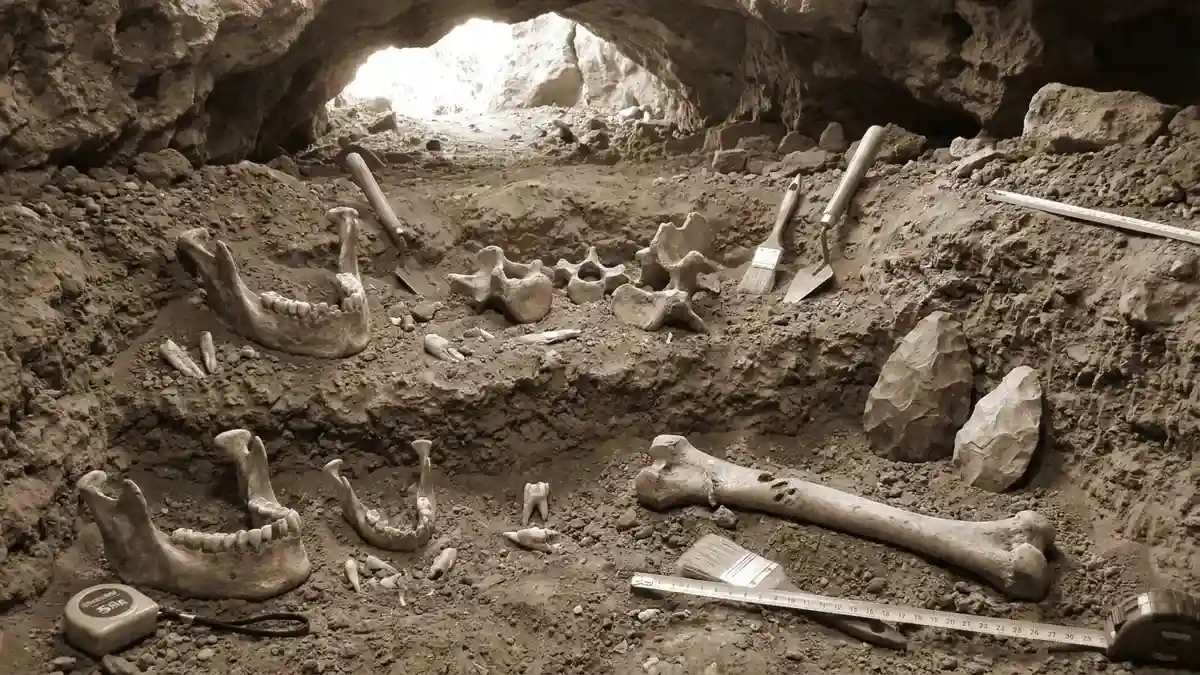
The newly analyzed remains from the Grotte à Hominidés (Hominid Cave) at the Thomas Quarry I site in Casablanca have effectively bridged this divide. The fossil assemblage provides an unprecedented look at a multi-generational community, consisting of:
Partial lower jaws (mandibles) from two distinct adults
A well-preserved lower jaw belonging to a child
Several structural vertebrae from the spinal column
An extensive collection of isolated teeth
Mapping a Unique Evolutionary Mosaic
To pinpoint where these Casablanca hominins belong on our family tree, researchers subjected the dental and jaw remains to high-resolution micro-CT imaging. This non-destructive technology allowed scientists to map the internal structures, enamel thickness, and root configurations hidden deep within the teeth.
 Ancient Shamanic Mask Unveils Hidden Dynamic Between Europe’s First Farmers and Hunter-Gatherers
The structural scans revealed a striking biological blend:
                  [Homo erectus] (Older, robust traits)
                        \
                         \-----> [Thomas Quarry I Hominins] (~773,000 years ago)
                         /       (Anatomical bridge to later species)
                        /
         [Modern Human / Neanderthal / Denisovan Lineages]
The outer jaw and tooth structures retain robust, primitive characteristics reminiscent of Homo erectus. However, the internal dental anatomy presents highly derived, modern features that point directly toward the lineages of Homo sapiens, Neanderthals, and Denisovans.
Crucially, the micro-CT scans confirmed that this population was entirely distinct from Homo antecessor, a contemporary human species found in Atapuerca, Spain, which exhibits early, specialized Neanderthal-specific facial traits. Instead, the Moroccan hominins represent a more generalized, basal ancestral stock that existed prior to those European specializations.
Cosmic Chronology: The Matuyama–Brunhes Transition
Establishing the age of ancient African fossils from this era is notoriously difficult because standard radiocarbon dating becomes useless beyond roughly 50,000 years. To overcome this, the international research team executed a rigorous chronological study by analyzing 180 individual sediment samples extracted from the fossil-bearing layers of the cave.
The breakthrough came via paleomagnetism—the study of changes in Earth’s magnetic field recorded in rocks and fine sediments. The team successfully tracked the Matuyama–Brunhes transition, a monumental geological event during which the Earth’s magnetic north and south poles completely reversed.
Geophysicists have firmly established that this magnetic flip concluded precisely 773,000 years ago. Because the Casablanca human bones were encased directly within the layers of silt and sand deposited during this global magnetic flip, the team achieved an unprecedented level of chronological certainty for African hominin fossils of this antiquity.
Life and Death in an Ancient Carnivore Den
The environmental context surrounding Thomas Quarry I paints a vivid, albeit brutal, picture of life in the Early Pleistocene. The geological architecture of Casablanca’s Atlantic coast—characterized by raised ancient shorelines, shifting dune systems, and marine-carved caves—provided an ideal habitat for both early humans and apex predators.
The Grotte à Hominidés itself was not a permanent human home; evidence indicates it alternated between a temporary shelter for tool-making hominins and a specialized carnivore den.
Acheulean Technology
Excavators recovered an array of stone tools directly alongside the fossil remains. These artifacts belong to the Acheulean technology style, a tool-making tradition characterized by large, symmetrical stone handaxes. This technology had been spreading throughout the African continent for over a million years, and its presence in the cave indicates these hominins possessed the sophisticated cognitive planning required to fashion highly efficient butchering and foraging implements.
Traces of Predation
Living alongside these early humans were massive, prehistoric predators. Forensic examination of a human leg bone recovered from the cave revealed distinct, deep bite marks and gnaw patterns. Taphonomic analysis (the study of how organisms decay and fossilize) proved that large prehistoric hyenas had actively scavenged or preyed upon the human bodies, dragging the remains deep into the cave system where rapid sediment accumulation ultimately sealed and protected them for millennia.
Northwest Africa Steps into the Center of Human Origins
For nearly a century, the mainstream scientific narrative prioritized Eastern and Southern Africa as the exclusive cradles of human evolution. The Thomas Quarry I discovery completely upends this geographic bias.
The geographic landscape of ancient Africa was highly dynamic. During prolonged “Green Sahara” phases—wetter climatic intervals driven by orbital cycles—the modern barriers of the Sahara desert transformed into lush savannas, river networks, and lake systems. These ecological corridors allowed complex human populations to migrate freely, exchanging genetic material across the continent rather than evolving in isolated regional pockets.
The deeper historical timeline of Morocco showcases a remarkably deep and continuous line of human development:
773,000 Years Ago (Thomas Quarry I): Hominins displaying the foundational dental and jaw traits basal to the split of modern humans, Neanderthals, and Denisovans.
300,000 Years Ago (Jebel Irhoud): Located just a few hundred miles away in Morocco, this site holds the world’s oldest confirmed fossils of our own species, Homo sapiens.
By aligning perfectly with the older parameters of genetic split estimates (which range from 765,000 to 550,000 years ago), these 773,000-year-old Casablanca fossils solidify Northwest Africa as a primary engine of early human diversity, pushing the true roots of our shared global lineage deeper into the past than ever before.
Frequently Asked Questions
Why are the Casablanca fossils considered the common ancestor of humans and Neanderthals?
Micro-CT scans of the teeth and jaw structures reveal an anatomical mixture. While they retain some primitive features from Homo erectus, they display internal dental developments that are shared by later Homo sapiens, Neanderthals, and Denisovans, making them the closest physical match to the ancestral population that existed right before these lineages split.
How did scientists get such an exact date of 773,000 years?
Scientists used paleomagnetic dating on 180 sediment samples from the cave. They identified the Matuyama–Brunhes transition—a well-documented global reversal of the Earth’s magnetic poles that occurred exactly 773,000 years ago. The fossils were trapped in sediment layers formed during this reversal.
What kind of tools did these early humans use?
The hominins at Thomas Quarry I utilized early Acheulean stone tool technology. This technology is famous for its large, purposefully flaked stone handaxes and cutting tools, which required significant cognitive planning and manual dexterity to create.
Were these hominins hunted by wild animals?
Evidence strongly suggests a dangerous relationship with carnivores. Forensic analysis of a human leg bone from the site revealed distinct bite marks left by prehistoric hyenas, showing that the cave was used as a carnivore den where human bodies were actively scavenged or brought as prey.
How does this discovery change the map of human evolution?
Previously, human origin stories focused almost exclusively on eastern and southern Africa. This discovery proves that northwest Africa was an equally vital hub of evolutionary activity and population diversity during the Middle Pleistocene, connected to the rest of the continent via ancestral migrations across a historically green, wet Sahara.