
Table of Contents
- 1. The Carmei Gat Salvage Excavations
- 2. Unlocking the Secrets of Canaanite Blade Production
- 2.1. The Crane-Like Pressure Technique
- 3. Industrial Espionage and the Protection of Trade Secrets
- 4. A Window into an Evolving, Complex Society
- 5. Preserving the Blade-Making Legacy
- 6. Frequently Asked Questions
- 6.1. Where exactly was the 5,500-year-old flint workshop found?
- 6.2. What are Canaanite blades, and how were they used?
- 6.3. Why is this specific discovery considered a historical “first”?
- 6.4. How did ancient craftsmen make these tools so uniform?
- 6.5. What does the location of the flint waste reveal about ancient society?
5,500-Year-Old Flint Workshop Discovery Stuns Archaeologists
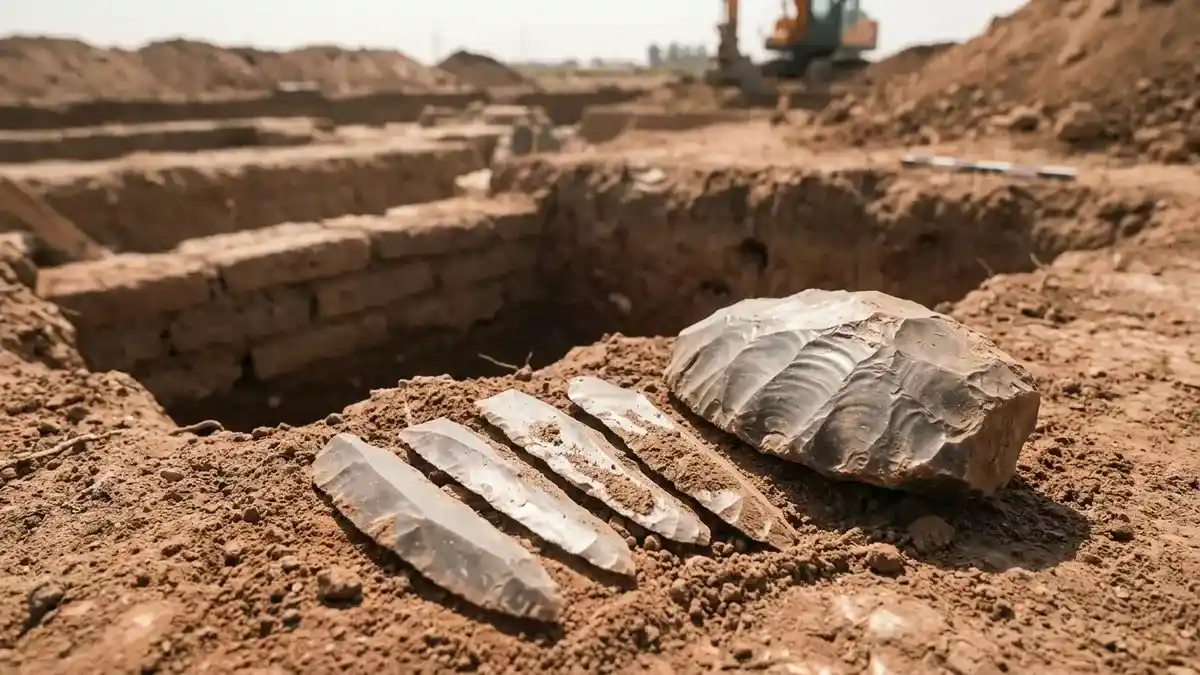
A routine archaeological survey ahead of a massive housing development has completely transformed our understanding of ancient technology and labor in the Middle East. While conducting a salvage excavation near the city of Kiryat Gat, researchers in Israel uncovered a remarkably sophisticated, 5,500-year-old flint tool production facility. Dating back to the dawn of the Early Bronze Age, this prehistoric factory represents the first specialized, industrial-scale blade workshop ever discovered in the southern region of the country.
The sheer scale of the operation and the exquisite quality of the artifacts left behind indicate that prehistoric humans were far more socially organized, technologically advanced, and economically connected than previously believed. The discovery proves that the area was not merely a cluster of simple farming homesteads, but rather a major manufacturing and distribution hub that supplied essential cutting tools to ancient communities throughout the Levant.
5,500-Year-Old Flint Workshop Discovery Stuns Archaeologists
The Carmei Gat Salvage Excavations
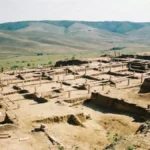
The groundbreaking discovery occurred at a site known locally as Naḥal Qomem (historically referred to as Gat-Govrin or Zeita), located just outside Kiryat Gat. Because modern law requires the preservation of cultural heritage before major construction can begin, the Israel Antiquities Authority (IAA) launched a preventative salvage excavation. The massive field operation was funded by the Israel Lands Authority to clear the way for a brand-new residential neighborhood named Carmei Gat.

Rather than finding a scattering of ordinary domestic refuse, the excavation directors—Dr. Martin David Pasternak, Shira Lifshitz, and Dr. Nathan Ben-Ari—realized they had stumbled upon an exceptionally large, long-settled archaeological complex. Initial mapping revealed that the ancient settlement stretched across more than half a kilometer (roughly a third of a mile), a footprint significantly larger than any historically documented village from that era in southern Israel.
Unlocking the Secrets of Canaanite Blade Production
At the absolute heart of this ancient complex was a highly specialized manufacturing center dedicated to creating what archaeologists call “Canaanite blades.” During the Early Bronze Age, before metallurgy became widespread, these elongated, incredibly sharp stone tools served as the primary cutting instruments for everyday survival.
[ Prehistoric Tool Manufacturing Sequence ]

  Raw Flint Node  -->  1. Core Preparation  -->  2. Pressure Flaking  -->  3. Finished Blade
  Sourced from         Symmetric shaping of       A specialized crane-     Uniform, razor-sharp
  local deposits.      the parent stone.          like device applies      edges ready for daily
                                                  controlled pressure.     utilization.
The excavation yielded hundreds of finely crafted flint blades along with the massive, professionally shaped stone cores from which they were struck. To produce a Canaanite blade, a master artisan had to carefully prepare a large block of high-quality flint, creating parallel ridges along its length. By applying intense, targeted pressure to the top of the core, the knapper could detach long, uniform flakes with razor-sharp edges.
 100,000-year-old Homo sapiens bones from Ethiopia may preserve earliest evidence of human cremation
The Crane-Like Pressure Technique
According to IAA prehistorians Dudu Biton and Dr. Jacob Vardi, the level of uniformity achieved at the Kiryat Gat site required advanced mechanical knowledge. The ancient artisans likely utilized a specialized, crane-like pressure device.
By using a wooden lever system to focus a tremendous amount of body weight onto a precise point on the flint core, they could cleanly press off blades that were perfectly straight and exceptionally long. This method was far more sophisticated than simple hand-held stone percussion, yielding highly predictable tools that functioned as the premium Swiss Army knives of the ancient world.
Industrial Espionage and the Protection of Trade Secrets
One of the most fascinating aspects of the Kiryat Gat workshop is not what the archaeologists found, but how the ancient workers managed their industrial waste. In standard prehistoric manufacturing sites, the flakes, chips, and broken stone fragments produced during knapping—known technically as debitage—are scattered casually around the workspace or tossed into open refuse piles.
At this southern workshop, however, the distribution of waste material was strictly controlled. The debitage was deliberately contained and concealed within specific zones of the facility rather than being left outside the boundaries of the site.
“Intriguingly, the waste fragments, the debitage, were not scattered outside the site, perhaps to better protect and preserve the professional knowledge within the group of experts.” — Dr. Jacob Vardi, IAA Prehistorian
This intentional containment suggests that the knapping techniques were viewed as highly valuable proprietary knowledge. By keeping the manufacturing waste hidden within the guild, these exceptional craftsmen could prevent outsiders from reverse-engineering their specialized flaking methods. This represents an incredibly early form of protecting trade secrets and preserving a commercial monopoly over tool distribution in the region.
A Window into an Evolving, Complex Society
The presence of a dedicated factory provides definitive proof that local human populations had developed a highly organized social hierarchy by the onset of the Bronze Age.
             [ Social Stratification in the Early Bronze Age ]

                          +-----------------------+
                          |   Chieftains/Elite    |
                          |  Managed Distribution |
                          +-----------+-----------+
                                      |
                          +-----------v-----------+
                          |   Master Craftsmen    |
                          | Restricted Guild/Tech |
                          +-----------+-----------+
                                      |
         +----------------------------+----------------------------+
         |                                                         |
+--------v--------+                                       +--------v--------+
|  Local Farmers  |                                       | Regional Trade  |
| Harvest/Cut/Skin|                                       | Levant Networks |
+-----------------+                                       +-----------------+
True professional specialization occurs only when a community is wealthy and stable enough to support individuals who do not produce their own food. Because these master flint-knappers spent their days manufacturing tools, other members of the society had to hunt, farm, and manage infrastructure to sustain them.
Furthermore, structural excavations across the site revealed hundreds of subterranean pits. Many of these underground chambers were neatly lined with durable mud bricks, displaying a high degree of architectural planning. While several pits were utilized for standard grain storage and everyday habitation, others showed distinct signs of being dedicated exclusively to specialized craft workshops, communal social gatherings, and sacred ritual activities.
Evidence indicates that this prime location was continuously occupied for centuries, transitioning smoothly from the late Chalcolithic period (the Copper Age) directly into the Early Bronze Age. Over those generations, the settlement evolved from a self-sufficient village into a highly integrated regional powerhouse. The finished Canaanite blades produced here were not just for local use; they were packaged and traded across vast networks, providing essential agricultural and domestic tools to populations throughout the wider Levant.
Preserving the Blade-Making Legacy
Following their careful retrieval from the Naḥal Qomem soil, the extraordinary flint cores and finished blades have undergone meticulous analysis and stabilization. For the very first time, these rare artifacts are being placed on public display at the Jay and Jeanie Schottenstein National Campus for the Archaeology of Israel in Jerusalem.
By showcasing these pristine 5,500-year-old tools, the exhibit highlights the deep roots of industrial engineering, professional specialization, and economic trade that flourished in the southern desert long before the rise of the region’s historic kingdoms.
Frequently Asked Questions
Where exactly was the 5,500-year-old flint workshop found?
The prehistoric workshop was discovered during a salvage excavation in southern Israel at Naḥal Qomem (also known as Gat-Govrin or Zeita), situated near the modern city of Kiryat Gat. The dig was initiated ahead of the construction of the new Carmei Gat residential neighborhood.
What are Canaanite blades, and how were they used?
Canaanite blades are long, exceptionally sharp, and highly uniform flint tools characteristic of the Early Bronze Age. They were the primary cutting instruments of their era, used daily like modern knives and sickles for harvesting crops, butchering livestock, skinning hides, and precision cutting.
Why is this specific discovery considered a historical “first”?
While individual Canaanite blades have been found in central and northern Israel, this is the first time a specialized, large-scale production workshop has ever been discovered in the southern part of the country. It provides unique proof of localized industrial manufacturing in the south.
How did ancient craftsmen make these tools so uniform?
Artisans utilized an advanced pressure-flaking technique that likely incorporated a wooden, crane-like lever device. By leveraging their body weight through this mechanical tool, they could apply immense, controlled pressure to a prepared flint core, cleanly popping off straight, uniform, razor-sharp blades.
What does the location of the flint waste reveal about ancient society?
The knapping waste (debitage) was deliberately kept inside the workshop area rather than being thrown outside the settlement. Archaeologists believe this was done intentionally to safeguard proprietary technical secrets, indicating the presence of a professional guild protecting its economic monopoly.