
Table of Contents
- 1. The Strategic Importance of the Roman Jura Transversal
- 1.1. Connecting Empires and Frontiers
- 1.2. Protecting the Settlement of Petinesca
- 2. Four Centuries of Engineering and Evolution
- 2.1. The Era of Conquest: 40 BCE
- 2.2. The Final Frontier: CE 369
- 3. Unlocking Secrets with Forty Years of Prehistoric Data
- 4. Rare Artifacts Reveal the Realities of Roman Daily Life
- 4.1. A Masterpiece of Roman Craftsmanship
- 4.2. Offerings to the River Gods and Lost Belongings
- 5. Preservation and the Future of Roman Historiography
- 6. Frequently Asked Questions
- 6.1. How old is the Roman bridge discovered in Switzerland?
- 6.2. Why is the wood from the bridge still preserved after 2,000 years?
- 6.3. What was the purpose of the Roman Jura Transversal?
- 6.4. What kind of artifacts were found at the excavation site?
- 6.5. Why did Romans throw coins and weapons into the river?
2,000-Year-Old Roman Bridge Unearthed by Swiss Archaeologists
Archaeologists in Switzerland have made a breathtaking historical discovery, uncovering the remarkably well-preserved remains of a 2,000-year-old Roman bridge. The ancient structure was found buried deep within the waterlogged sediment of the former Zihl River bed in Aegerten, located within the Canton of Bern. Unearthed during routine construction work, this remarkable find is offering historians an unprecedented glimpse into Roman engineering, military strategy, and daily life north of the Alps.
The excavation revealed more than 300 massive oak foundation piles that had been trapped in oxygen-poor silt for millennia. This unique environment prevented the wood from decaying, leaving the timber tips—some measuring several meters long—in near-perfect condition. Heavy machinery was carefully used to extract the historic samples, which are now providing a treasure trove of data for researchers.
2,000-Year-Old Roman Bridge Unearthed by Swiss Archaeologists
The Strategic Importance of the Roman Jura Transversal
The newly discovered bridge was not an isolated crossing; it served as a vital component of the Roman Jura Transversal. This highway network was one of the most critical transportation corridors on the Swiss Plateau, seamlessly linking busy waterways with overland trade routes.
Connecting Empires and Frontiers
The bridge played a central role in facilitating trade and military movement through the challenging terrain of the Jura Mountains. It connected major regional hubs to Augusta Raurica, which stands as one of the oldest known Roman colonies established along the Rhine River.
Protecting the Settlement of Petinesca
Positioned strategically just outside the ancient Roman station settlement of Petinesca (modern-day Studen), the bridge was heavily guarded. Petinesca functioned as a crucial logistical hub, offering shelter, supplies, and military protection to merchants, couriers, and legions traveling between the major settlements of Aventicum, Vindonissa, and the heavily fortified Rhine frontier.
Four Centuries of Engineering and Evolution
Through the science of dendrochronology (tree-ring dating), experts have been able to map out the extensive lifespan of this river crossing. The timeline reveals that the bridge was maintained and rebuilt for more than 400 years, reflecting its immense value to the Roman Empire.
The Era of Conquest: 40 BCE
The earliest construction phase dates back to approximately 40 BCE. This timeline places the bridge’s origin shortly after Rome successfully conquered the Helvetii, a powerful Celtic confederation that had previously dominated the Swiss Plateau. Building the bridge was a definitive statement of Roman dominance and infrastructural supremacy in the newly acquired territory.
The Final Frontier: CE 369
As the centuries progressed, the bridge underwent continuous maintenance to withstand both the elements and the wear of heavy traffic. The final recorded phase of reconstruction occurred around CE 369 during the reign of Emperor Valentinian I. During this era, the Roman Empire was heavily investing in its northern frontier defenses to repel increasingly frequent Germanic incursions, making the Zihl River crossing a vital military asset until the twilight of Roman rule.

Unlocking Secrets with Forty Years of Prehistoric Data
This major discovery did not happen entirely by chance. Four decades ago, archaeologists identified ancient Roman military fortifications on both banks of the Zihl River. That baseline data proved invaluable for modern researchers.
When contemporary construction projects began in the area, specialists utilized the older data to pinpoint exactly where the bridge structures were likely submerged. By coordinating closely with construction crews and utilizing brief pauses in the building schedule, the archaeological team successfully documented the site, gathered critical laboratory samples, and salvaged precious artifacts without causing costly project delays.
Rare Artifacts Reveal the Realities of Roman Daily Life
Beyond the structural timber, the silt of the ancient riverbed acted as a time capsule, preserving an incredible array of everyday items lost or discarded by those who crossed the bridge over four centuries.
A Masterpiece of Roman Craftsmanship
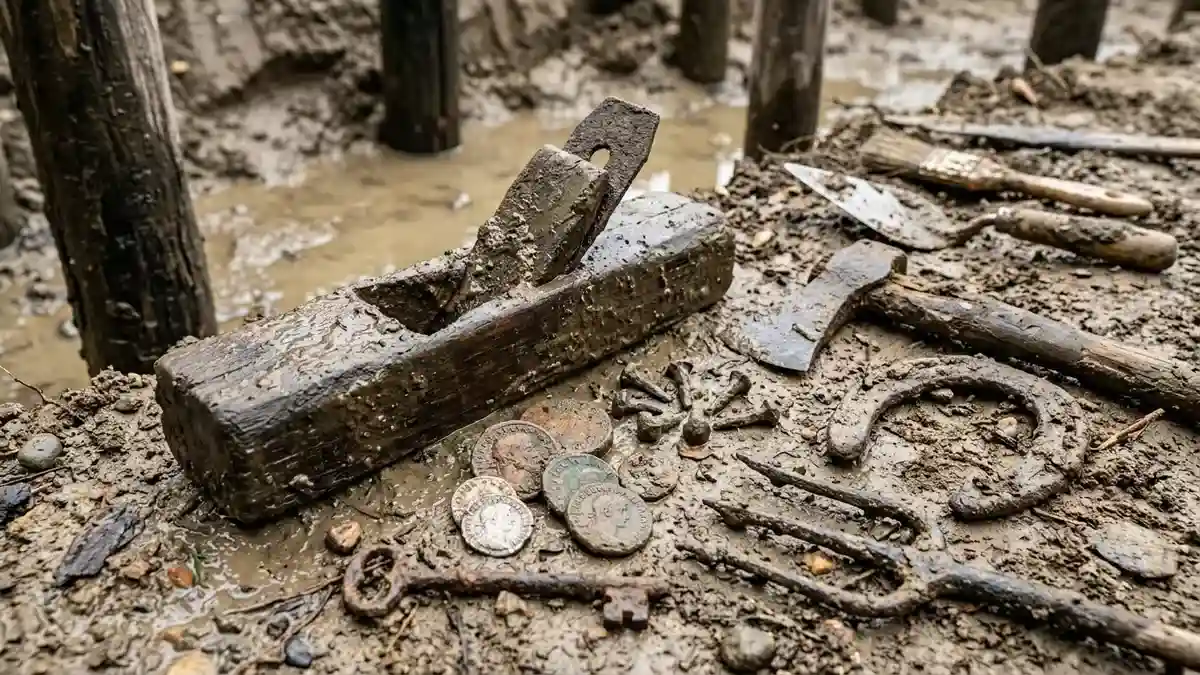
Among the most extraordinary artifacts recovered is a fully intact carpenter’s plane. Carved from a single piece of high-quality wood and featuring its original iron blade, the tool measures 41 centimeters long, 7 centimeters wide, and 5 centimeters high. Because it was sealed away from oxygen in the damp river mud, the wooden body of the tool avoided rot, providing modern woodworkers and historians with a rare look at authentic Roman craftsmanship.
Offerings to the River Gods and Lost Belongings
The excavation also yielded an extensive collection of metallic objects that tell the stories of Roman soldiers, traders, and locals. Among the items pulled from the sediment were:
Military Footwear Hobnails: Heavy-duty iron nails detached from the sandals of marching Roman legionnaires.
Transportation Gear: Well-preserved horseshoes and decorative harness fittings from travel wagons.
Tools and Weapons: Sturdy iron axes and an intact fishing trident used for hunting in the Zihl River.
Domestic Items: Keys, structural hardware, and various Roman coins.
Archaeologists believe that while some of these items were accidentally dropped by distracted travelers, many of the coins and weapons were intentionally thrown into the river as ritual offerings to local deities to ensure safe passage across the water.
Preservation and the Future of Roman Historiography
The vast collection of artifacts and timber samples is currently undergoing rigorous conservation treatment to prevent deterioration now that they have been exposed to the air. Specialized laboratories are analyzing the wood grains and metal compositions to glean deeper insights into ancient manufacturing techniques.
This discovery highlights the sophistication of Roman infrastructure engineering in challenging, waterlogged environments. It emphasizes how imperial planners successfully maintained remote supply lines north of the Alps, ensuring that even the most distant frontiers remained deeply connected to the heart of Rome.
Frequently Asked Questions
How old is the Roman bridge discovered in Switzerland?
The oldest sections of the bridge date back to around 40 BCE, making the site over 2,000 years old. Evidence shows the bridge was continually repaired and used for over 400 years, with the final modifications occurring in CE 369.
Why is the wood from the bridge still preserved after 2,000 years?
The oak piles were buried deep within waterlogged, oxygen-poor river sediment. This anaerobic environment prevented fungi and bacteria from breaking down the organic matter, keeping the wood perfectly preserved for centuries.
What was the purpose of the Roman Jura Transversal?
The Jura Transversal was a vital ancient transport corridor that connected major land and water trade routes across the Swiss Plateau. It allowed the Roman military and traders to travel efficiently through the Jura Mountains to the Rhine frontier.
What kind of artifacts were found at the excavation site?
Archaeologists recovered an incredibly rare, fully intact wooden carpenter’s plane with an iron blade. They also found everyday items including soldiers’ footwear hobnails, horseshoes, keys, coins, axes, and a fishing trident.
Why did Romans throw coins and weapons into the river?
While some items were likely lost by accident, historians believe many artifacts were dropped into the river intentionally. It was a common ancient Roman practice to offer coins, tools, and weapons to water deities in exchange for safety during a journey.