
Table of Contents
**Ancient Močići Site Rewrites Mithras Worship History**
The discovery of a unique Mithras sanctuary in Croatia is prompting scholars to rethink long-held assumptions about one of the Roman Empire’s most enigmatic mystery cults. Far from the dark, enclosed underground temples typically associated with Mithras worship, the site at Močići reveals how ancient devotees adapted their rituals to the natural landscape, blending Persian roots, Roman practices, and local Dalmatian geography in surprising ways.
Mithras, the central figure of this secretive religion, has fascinated historians for centuries. His cult, popular among Roman soldiers, merchants, and officials from the 2nd to 4th centuries CE, emphasized themes of light, truth, cosmic order, and personal initiation. While its origins trace back to the ancient Iranian deity Mithra—venerated in pre-Zoroastrian and Zoroastrian traditions as a guardian of contracts and cosmic balance—the Roman version evolved into a distinct mystery cult with its own rituals, symbols, and sacred spaces.
Ancient Močići Site Rewrites Mithras Worship History

### The Standard Image of Roman Mithraea
For decades, archaeologists have described Mithraic sanctuaries, known as mithraea, with remarkable consistency across the empire. These spaces were typically long, narrow, cave-like rooms designed to mimic the primordial cave where Mithras was said to have been born from rock. Benches lined the side walls for communal meals, while the focal point at the far end featured the iconic tauroctony relief: Mithras slaying a bull, surrounded by symbolic animals including a dog, serpent, scorpion, and torchbearers Cautes and Cautopates. Solar and lunar motifs often framed the scene, underscoring the god’s connection to celestial cycles.
These enclosed temples appeared from military outposts along the Rhine and Danube frontiers to bustling urban centers like Rome and Ostia. The intimate, subterranean design reinforced the cult’s secretive nature, where initiates progressed through graded levels of revelation in dim torchlight. With hundreds of known examples, this architectural template seemed almost universal—until recent findings in the hills above the Adriatic coast challenged that view.
### A Natural Sanctuary in the Croatian Hills
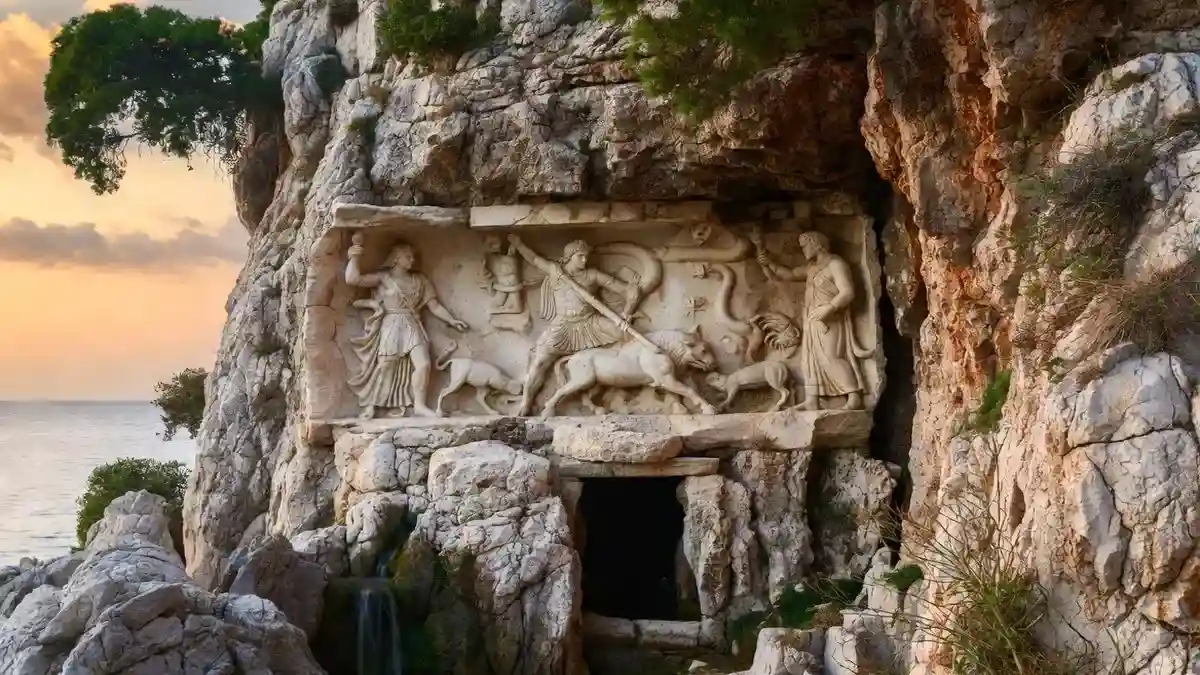
Nestled in the karst landscape near ancient Epidaurum (modern Cavtat, Croatia), the Močići mithraeum offers a strikingly different picture. Rather than a purpose-built structure, the site centers on a natural limestone cave and open-air gathering space. The primary tauroctony relief is carved directly into the rock face above the cave entrance, fully visible from the exterior rather than hidden deep inside.
This relief follows classic Roman Mithraic iconography: Mithras in Persian attire plunges a dagger into the bull, with the usual supporting figures and celestial symbols present. Yet its placement in an open, natural setting transforms how worshippers would have experienced it. Photogrammetry and detailed field surveys show the cave itself is remarkably small—only about 17.7 square meters—too compact for the group dining and initiations common in larger mithraea, which often exceeded 60 square meters.
 Advanced Geochemical Study Reveals Far-Reaching Bronze Age Metallurgy Networks in Sardinia
Instead, ritual activities likely unfolded in the surrounding natural hollow, roughly 14 meters wide, with over 120 square meters of usable open ground. A year-round spring flows through the area, feeding into the cave and providing a constant source of fresh water. Limestone formations and the rugged Adriatic hinterland complete the scene, creating an organic ritual landscape shaped by geology rather than human construction.
### Blending Persian Roots with Local Realities
The Močići site beautifully illustrates the deep continuity between ancient Iranian Mithra and his Roman counterpart. In Persian tradition, Mithra was linked to light, truth, and life-giving waters. Roman Mithras retained echoes of rock birth and cosmic emergence. At Močići, these concepts needed no artificial recreation—the natural cave and spring embodied them perfectly.
Inside the cave, researchers identified a second relief possibly connected to Silvanus, the Roman god of woods, fields, and herding. This fits the local pastoral economy of Dalmatia, where communities relied on seasonal grazing, rocky terrain, and reliable water sources for livestock. The sanctuary thus served not only as a sacred space but as one integrated with everyday rural life.
This adaptation highlights how Roman religion was never monolithic. In frontier regions like Dalmatia, devotees drew on available natural features rather than imposing standardized temple designs. The result was a hybrid practice that honored Mithras while respecting the physical and cultural environment of the Adriatic coast.
### Why This Discovery Matters
The Močići findings, detailed in a 2026 study published in the *Journal of Roman Archaeology* by Ian S. Wilson and Matthew McCarty, push back against overly rigid interpretations of Mithraism. For years, scholars viewed the cult through the lens of its most common surviving examples—urban and military mithraea with uniform layouts. This Croatian sanctuary demonstrates greater flexibility and regional variation than previously assumed.
It also enriches our understanding of how mystery cults spread and evolved. Soldiers and traders carried Mithraic ideas westward, but local conditions influenced their expression. In karst-rich Dalmatia, with its dramatic cliffs, caves, and springs, the landscape itself became part of the theology. Worshippers gathered around existing rock, water, and open sky rather than reconstructing an abstract cosmic model indoors.
This open-air approach may have allowed larger or more inclusive gatherings, bridging the gap between formal ritual and the rhythms of rural existence. It underscores Mithraism’s adaptability—one reason the cult thrived for centuries alongside other religions before Christianity’s rise.
### Connections to Broader Roman Religious Life
Mithraism coexisted with other cults, sometimes in close proximity. The presence of Silvanus imagery at Močići reflects syncretism common in the provinces, where Roman deities merged with local traditions. Similar patterns appear elsewhere in the Balkans, where pastoral gods and nature spirits held strong appeal.
The cult’s emphasis on male initiation, hierarchy, and communal bonding appealed strongly to Roman military personnel. Yet sites like Močići suggest that civilian and rural devotees also participated, adapting practices to their needs. The natural setting may have enhanced the sensory experience—fresh spring water, echoing rock formations, and panoramic views reinforcing themes of cosmic order and renewal.
Archaeological work at Močići builds on earlier observations, including notes by Sir Arthur Evans in the late 19th century. Modern techniques like photogrammetry have revealed details invisible to previous generations, allowing deeper insights into how ancient people interacted with sacred places.
### Implications for Future Research
This discovery encourages archaeologists to look beyond built structures when studying ancient religions. Many sacred sites may have utilized natural features in ways that left subtler traces. In regions with dramatic geology, such as the Dinaric Alps, more open-air sanctuaries could await identification.
It also invites reflection on the interplay between religion, environment, and culture. How did the physical world shape spiritual beliefs, and vice versa? Močići provides a compelling case study in this dynamic relationship, showing how a Persian-rooted god found new life amid Croatian limestone hills.
As researchers continue to analyze the site, including potential artifacts and surrounding features, our picture of Mithraism will likely grow more nuanced. The cult was not a uniform export but a living tradition that responded to local conditions while preserving core symbols and values.
**Conclusion**
The Močići sanctuary stands as a powerful reminder that history rarely fits neat categories. By embracing the natural landscape, its ancient worshippers created a sacred space that was both authentically Mithraic and deeply connected to their world. This Croatian site doesn’t just add to our knowledge of Roman religion—it transforms it, revealing the flexibility, creativity, and environmental sensitivity that helped mystery cults endure across vast distances and diverse cultures.
In an age when we increasingly value connections to nature and place, the ancient devotees at Močići offer timeless lessons about finding the sacred in the world around us.
### FAQ
**What makes the Močići Mithras sanctuary unique?**
Unlike typical enclosed Roman mithraea, Močići features an open-air setting with a natural cave and spring. The tauroctony relief faces outward, and rituals likely occurred in the surrounding landscape rather than inside a built temple.
**Where is Močići located?**
The site lies in the hills above Cavtat (ancient Epidaurum) in southern Croatia, near the Adriatic coast in the Konavle region.
**How does Močići connect to ancient Iranian traditions?**
The natural rock and spring echo Persian associations of Mithra with stone birth, light, and life-giving waters, elements preserved but reinterpreted in the Roman cult.
**When was the Močići sanctuary in use?**
Evidence points to the late 3rd century CE, during the height of Mithraism’s popularity in the Roman provinces.
**Why is this discovery important for understanding Roman religion?**
It demonstrates regional variation and adaptation, showing that Mithraic practice was more diverse and responsive to local geography than previously thought.
**Are there other open-air Mithras sites?**
While rare, Močići highlights the potential for more such discoveries, especially in geologically distinctive provinces. Most known mithraea remain the classic enclosed type.
**Can visitors see the Močići sanctuary today?**
Yes, the site is accessible and managed locally, offering a chance to experience this remarkable blend of history and natural beauty firsthand.
**Ancient Močići Site Rewrites Mithras Worship History**
The discovery of a unique Mithras sanctuary in Croatia is prompting scholars to rethink long-held assumptions about one of the Roman Empire’s most enigmatic mystery cults. Far from the dark, enclosed underground temples typically associated with Mithras worship, the site at Močići reveals how ancient devotees adapted their rituals to the natural landscape, blending Persian roots, Roman practices, and local Dalmatian geography in surprising ways.
Mithras, the central figure of this secretive religion, has fascinated historians for centuries. His cult, popular among Roman soldiers, merchants, and officials from the 2nd to 4th centuries CE, emphasized themes of light, truth, cosmic order, and personal initiation. While its origins trace back to the ancient Iranian deity Mithra—venerated in pre-Zoroastrian and Zoroastrian traditions as a guardian of contracts and cosmic balance—the Roman version evolved into a distinct mystery cult with its own rituals, symbols, and sacred spaces.
### The Standard Image of Roman Mithraea
For decades, archaeologists have described Mithraic sanctuaries, known as mithraea, with remarkable consistency across the empire. These spaces were typically long, narrow, cave-like rooms designed to mimic the primordial cave where Mithras was said to have been born from rock. Benches lined the side walls for communal meals, while the focal point at the far end featured the iconic tauroctony relief: Mithras slaying a bull, surrounded by symbolic animals including a dog, serpent, scorpion, and torchbearers Cautes and Cautopates. Solar and lunar motifs often framed the scene, underscoring the god’s connection to celestial cycles.
These enclosed temples appeared from military outposts along the Rhine and Danube frontiers to bustling urban centers like Rome and Ostia. The intimate, subterranean design reinforced the cult’s secretive nature, where initiates progressed through graded levels of revelation in dim torchlight. With hundreds of known examples, this architectural template seemed almost universal—until recent findings in the hills above the Adriatic coast challenged that view.
### A Natural Sanctuary in the Croatian Hills
Nestled in the karst landscape near ancient Epidaurum (modern Cavtat, Croatia), the Močići mithraeum offers a strikingly different picture. Rather than a purpose-built structure, the site centers on a natural limestone cave and open-air gathering space. The primary tauroctony relief is carved directly into the rock face above the cave entrance, fully visible from the exterior rather than hidden deep inside.
This relief follows classic Roman Mithraic iconography: Mithras in Persian attire plunges a dagger into the bull, with the usual supporting figures and celestial symbols present. Yet its placement in an open, natural setting transforms how worshippers would have experienced it. Photogrammetry and detailed field surveys show the cave itself is remarkably small—only about 17.7 square meters—too compact for the group dining and initiations common in larger mithraea, which often exceeded 60 square meters.
Instead, ritual activities likely unfolded in the surrounding natural hollow, roughly 14 meters wide, with over 120 square meters of usable open ground. A year-round spring flows through the area, feeding into the cave and providing a constant source of fresh water. Limestone formations and the rugged Adriatic hinterland complete the scene, creating an organic ritual landscape shaped by geology rather than human construction.
### Blending Persian Roots with Local Realities
The Močići site beautifully illustrates the deep continuity between ancient Iranian Mithra and his Roman counterpart. In Persian tradition, Mithra was linked to light, truth, and life-giving waters. Roman Mithras retained echoes of rock birth and cosmic emergence. At Močići, these concepts needed no artificial recreation—the natural cave and spring embodied them perfectly.
Inside the cave, researchers identified a second relief possibly connected to Silvanus, the Roman god of woods, fields, and herding. This fits the local pastoral economy of Dalmatia, where communities relied on seasonal grazing, rocky terrain, and reliable water sources for livestock. The sanctuary thus served not only as a sacred space but as one integrated with everyday rural life.
This adaptation highlights how Roman religion was never monolithic. In frontier regions like Dalmatia, devotees drew on available natural features rather than imposing standardized temple designs. The result was a hybrid practice that honored Mithras while respecting the physical and cultural environment of the Adriatic coast.
### Why This Discovery Matters
The Močići findings, detailed in a 2026 study published in the *Journal of Roman Archaeology* by Ian S. Wilson and Matthew McCarty, push back against overly rigid interpretations of Mithraism. For years, scholars viewed the cult through the lens of its most common surviving examples—urban and military mithraea with uniform layouts. This Croatian sanctuary demonstrates greater flexibility and regional variation than previously assumed.
It also enriches our understanding of how mystery cults spread and evolved. Soldiers and traders carried Mithraic ideas westward, but local conditions influenced their expression. In karst-rich Dalmatia, with its dramatic cliffs, caves, and springs, the landscape itself became part of the theology. Worshippers gathered around existing rock, water, and open sky rather than reconstructing an abstract cosmic model indoors.
This open-air approach may have allowed larger or more inclusive gatherings, bridging the gap between formal ritual and the rhythms of rural existence. It underscores Mithraism’s adaptability—one reason the cult thrived for centuries alongside other religions before Christianity’s rise.
### Connections to Broader Roman Religious Life
Mithraism coexisted with other cults, sometimes in close proximity. The presence of Silvanus imagery at Močići reflects syncretism common in the provinces, where Roman deities merged with local traditions. Similar patterns appear elsewhere in the Balkans, where pastoral gods and nature spirits held strong appeal.
The cult’s emphasis on male initiation, hierarchy, and communal bonding appealed strongly to Roman military personnel. Yet sites like Močići suggest that civilian and rural devotees also participated, adapting practices to their needs. The natural setting may have enhanced the sensory experience—fresh spring water, echoing rock formations, and panoramic views reinforcing themes of cosmic order and renewal.
Archaeological work at Močići builds on earlier observations, including notes by Sir Arthur Evans in the late 19th century. Modern techniques like photogrammetry have revealed details invisible to previous generations, allowing deeper insights into how ancient people interacted with sacred places.
### Implications for Future Research
This discovery encourages archaeologists to look beyond built structures when studying ancient religions. Many sacred sites may have utilized natural features in ways that left subtler traces. In regions with dramatic geology, such as the Dinaric Alps, more open-air sanctuaries could await identification.
It also invites reflection on the interplay between religion, environment, and culture. How did the physical world shape spiritual beliefs, and vice versa? Močići provides a compelling case study in this dynamic relationship, showing how a Persian-rooted god found new life amid Croatian limestone hills.
As researchers continue to analyze the site, including potential artifacts and surrounding features, our picture of Mithraism will likely grow more nuanced. The cult was not a uniform export but a living tradition that responded to local conditions while preserving core symbols and values.
**Conclusion**
The Močići sanctuary stands as a powerful reminder that history rarely fits neat categories. By embracing the natural landscape, its ancient worshippers created a sacred space that was both authentically Mithraic and deeply connected to their world. This Croatian site doesn’t just add to our knowledge of Roman religion—it transforms it, revealing the flexibility, creativity, and environmental sensitivity that helped mystery cults endure across vast distances and diverse cultures.
In an age when we increasingly value connections to nature and place, the ancient devotees at Močići offer timeless lessons about finding the sacred in the world around us.
### FAQ
**What makes the Močići Mithras sanctuary unique?**
Unlike typical enclosed Roman mithraea, Močići features an open-air setting with a natural cave and spring. The tauroctony relief faces outward, and rituals likely occurred in the surrounding landscape rather than inside a built temple.
**Where is Močići located?**
The site lies in the hills above Cavtat (ancient Epidaurum) in southern Croatia, near the Adriatic coast in the Konavle region.
**How does Močići connect to ancient Iranian traditions?**
The natural rock and spring echo Persian associations of Mithra with stone birth, light, and life-giving waters, elements preserved but reinterpreted in the Roman cult.
**When was the Močići sanctuary in use?**
Evidence points to the late 3rd century CE, during the height of Mithraism’s popularity in the Roman provinces.
**Why is this discovery important for understanding Roman religion?**
It demonstrates regional variation and adaptation, showing that Mithraic practice was more diverse and responsive to local geography than previously thought.
**Are there other open-air Mithras sites?**
While rare, Močići highlights the potential for more such discoveries, especially in geologically distinctive provinces. Most known mithraea remain the classic enclosed type.
**Can visitors see the Močići sanctuary today?**
Yes, the site is accessible and managed locally, offering a chance to experience this remarkable blend of history and natural beauty firsthand.
(Word count: 1,248)