
Table of Contents
- 1. Redefining Prehistoric Technology: What Is Ochre?
- 2. Unearthing the Evidence: The Crimean Archaeological Sites
- 3. Inside the Tool Kit: Three Extraordinary Prehistoric “Crayons”
- 3.1. The Yellow Ochre Drawing Stick
- 3.2. The Fractured Red Pencil
- 3.3. The Engraved Orange Slate
- 4. Complex Cognition and Communication: Why This Matters
- 5. A New Chapter in Human Prehistory
- 6. Frequently Asked Questions
- 6.1. How do scientists know these ochre pieces weren’t just used for processing animal hides?
- 6.2. Exactly how old are these Neanderthal crayons?
- 6.3. What tools were used to analyze the microscopic details of the artifacts?
- 6.4. Did Neanderthals develop these artistic skills on their own or copy Homo sapiens?
- 6.5. What color marks did these prehistoric crayons make?
Ancient Crayon Discovery Forces Humanity to Rethink Neanderthal Minds
For generations, popular culture and early anthropological consensus painted a distinctly unflattering portrait of the Neanderthal. They were frequently depicted as lumbering, brute cave-dwellers—evolutionary dead-ends who lacked the cognitive sophistication, creativity, and abstract thinking capabilities of our direct ancestors, Homo sapiens. However, a series of groundbreaking archaeological discoveries has been steadily dismantling this outdated narrative.
The latest blow to the “primitive Neanderthal” stereotype comes from a meticulous study of prehistoric pigments recovered from Eastern Europe. Researchers have discovered a cache of ancient ochre fragments, including deliberately shaped “crayons,” dating back tens of thousands of years. This finding provides undeniable evidence that Neanderthals engaged in deeply symbolic, artistic, and communicative behaviors long before modern humans dominated the landscape.
Ancient Crayon Discovery Forces Humanity to Rethink Neanderthal Minds
Redefining Prehistoric Technology: What Is Ochre?
To understand the weight of this discovery, one must first understand the material at the center of the research: ochre. Ochre is a naturally occurring, iron-rich mineral earth pigment that comes in a variety of vibrant hues, ranging from deep reds and bright oranges to rich, earthy yellows. Throughout human prehistory, ochre was the primary palette of the ancient world.

For decades, archaeologists recognized that Neanderthals gathered and used ochre, but many researchers argued its presence was purely utilitarian. Iron oxide has several highly practical properties that would have been invaluable to Paleolithic hunter-gatherers:
Hide Tanning: It acts as a natural preservative, preventing animal skins from rotting.
Adhesive Production: When mixed with tree resin, it creates a powerful glue for hafting stone points onto wooden spears.
Medicinal Uses: Its antibacterial properties make it useful for treating wounds, and it can even serve as an insect repellent or sunblock.

Because of these functional applications, critics often dismissed ancient ochre finds as simple survival tools rather than evidence of art. However, the newly analyzed fragments reveal that Neanderthals were treating this mineral with a level of care and intentionality that went far beyond basic survival.
Unearthing the Evidence: The Crimean Archaeological Sites
The critical evidence stems from an international research initiative led by Francesco d’Errico of the University of Bordeaux. The team focused their efforts on an array of historic Middle Paleolithic sites located across Crimea and Ukraine, including Zaskalnaya V, Zaskalnaya VI, Prolom II, and Mukhovets. These locations are well-documented hubs of historic Neanderthal occupation, specifically linked to the Micoquian tool-making tradition.

+------------------+-------------------------------------------------------------+
| Site Attribute   | Archaeological Details                                      |
+------------------+-------------------------------------------------------------+
| Total Fragments  | 16 distinct ochre pieces scrutinized                        |
| Maximum Age      | Up to 70,000 years old (Middle Paleolithic)                 |
| Analysis Tools   | Portable X-ray fluorescence, scanning electron microscopy   |
| Key Locations    | Zaskalnaya V, Zaskalnaya VI, Prolom II, Mukhovets           |
+------------------+-------------------------------------------------------------+
The scientists analyzed 16 distinct ochre fragments collected from these sites, some of which trace back as far as 70,000 years. To determine exactly how these minerals were manipulated, the team utilized a suite of high-tech forensic tools, including portable X-ray fluorescence to map chemical compositions and scanning electron microscopy to examine microscopic wear patterns.
The results were unmistakable. Rather than raw chunks of earth tossed aside after being scraped for structural processing, several of these mineral fragments bore the distinct signatures of deliberate modification, curation, and long-term maintenance.
Inside the Tool Kit: Three Extraordinary Prehistoric “Crayons”
While many of the 16 analyzed pieces showed signs of utilitarian scraping, three specific specimens stood out as definitive proof of advanced cognitive planning and symbolic marking behavior.
The Yellow Ochre Drawing Stick
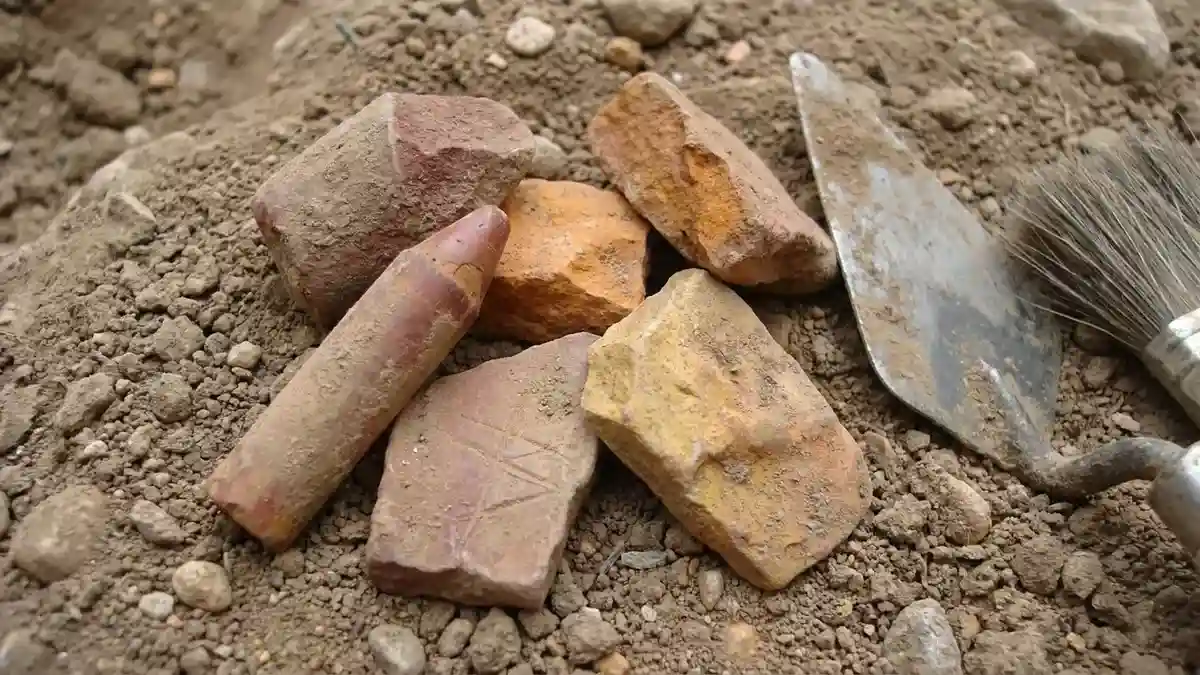
The most remarkable piece in the collection is an elongated fragment of vibrant yellow ochre measuring approximately 4.5 centimeters in length. Under intense microscopic evaluation, the researchers discovered that this piece had been purposefully carved and scraped into a tapered, pencil-like shape with a distinct pointed tip.
Even more fascinating were the micro-wear patterns at the tip. The scanning electron microscopy revealed clear signs of pressure wear and microscopic striations consistent with repeated drawing or marking on surfaces. Furthermore, the analysis showed that the Neanderthals had repeatedly resharpened the point as it wore down, proving that this was a highly valued, curated tool meant for continuous artistic or communicative output.
The Fractured Red Pencil
The second standout artifact is a rich red ochre fragment. Though smaller and partially broken when recovered, its contours and edge faceting indicate that it originally comprised a larger, intentionally elongated crayon-shaped tool. The uniform grinding along its sides suggests that its user shaped the mineral to fit comfortably in a human hand, optimizing it for controlled line-drawing or body painting.
The Engraved Orange Slate
The final exceptional piece is a flat, orange-hued stone that served as a canvas for deliberate geometric modifications. This specimen features heavily polished surfaces that could only be achieved through prolonged, intentional friction. Carved directly into the polished surface are distinct, engraved grooves. These markings do not align with accidental butchery scratches or practical processing; instead, they represent an intentional layout, signaling a clear grasp of design and abstract patterning.
Complex Cognition and Communication: Why This Matters
The existence of these heavily curated, repeatedly modified ochre crayons directly challenges the long-held paradigm of cognitive evolution, which asserted that complex symbolic behavior emerged exclusively within Homo sapiens.
Symbolic thought is a massive evolutionary milestone. It requires the capacity to create an abstract concept in the mind and project it onto the physical world using an external medium. When a Neanderthal shaped an ochre crayon, maintained its point, and carried it from camp to camp, they were investing significant cultural value into an object designed solely to leave visual marks.
What were they marking? While the specific surfaces they decorated have long since decayed or weathered away, anthropologists hypothesize several highly plausible purposes:
Body Modification and Identity: Painting the skin to signify tribal affiliation, hunting status, or coming-of-age rituals.
Canvas Decoration: Drawing motifs on cave walls, tree bark, or animal skins to mark territory or recount historical events.
Information Transmission: Utilizing basic visual codes to pass vital tracking or survival information to subsequent generations.
This discovery seamlessly aligns with other recent, revolutionary findings across Europe, such as ancient cave wall engravings and subterranean hand stencils that have been confidently attributed to Neanderthals. It proves that our evolutionary cousins possessed a rich internal world, a capacity for language or complex communication, and an appreciation for visual aesthetics.
A New Chapter in Human Prehistory
The meticulously shaped ochre crayons of Crimea provide an intimate bridge across millennia, allowing us to see Neanderthals not as evolutionary failures, but as intelligent, imaginative kin. By demonstrating that abstract thinking, forward planning, and artistic curation were well within the cognitive toolkit of the Neanderthal, this study forces us to redefine what it truly means to be human. The line separating Homo sapiens from other ancient hominids continues to blur, revealing a prehistoric world that was far more culturally diverse and intellectually vibrant than we ever dared to imagine.
Frequently Asked Questions
How do scientists know these ochre pieces weren’t just used for processing animal hides?
While ochre was frequently used for practical tasks like tanning leather or formulating adhesives, the specific micro-wear on these three standout pieces tells a different story. The presence of a intentionally tapered tip, repeated resharpening marks, pressure faceting, and non-functional engraved grooves all indicate that these objects were designed specifically to create lines or markings, rather than being ground down into powder for utilitarian tasks.
Exactly how old are these Neanderthal crayons?
The study analyzed a collection of 16 ochre fragments spanning different occupational layers within the Middle Paleolithic era, with some pieces dating back as far as 70,000 years. The key crayon-shaped specimens point to an active period of symbolic behavior roughly 42,000 years ago.
What tools were used to analyze the microscopic details of the artifacts?
The research team employed advanced forensic archaeology technology, specifically portable X-ray fluorescence (which identifies the exact elemental and chemical makeup of the minerals) and scanning electron microscopy (SEM). SEM allows scientists to view surface structures at extreme magnification to identify the precise mechanical causes of microscopic scratches and wear.
Did Neanderthals develop these artistic skills on their own or copy Homo sapiens?
The dating of these Crimean artifacts, alongside older Neanderthal cave art sites across Europe, strongly indicates that Neanderthals developed symbolic behaviors independently. These behaviors were already deeply embedded in their cultures long before Homo sapiens made widespread incursions into these specific geographical regions.
What color marks did these prehistoric crayons make?
The ochre fragments discovered at the Crimean sites provide a rich, warm palette. Depending on the exact iron oxide concentrations and mineral mixtures of the specific pieces, they were capable of producing distinct yellow, vibrant orange, and deep red markings.