
Table of Contents
**Ancient Finnish Ochre Trade Reveals Prehistoric Social Networks**
Archaeologists have uncovered compelling evidence of sophisticated social connections among ancient hunter-gatherers in Finland through the chemical analysis of red ochre. Between 6,000 and 5,500 years ago, members of the Typical Comb Ware culture used this vibrant iron-rich pigment not just for decoration, but as a powerful symbol of identity, ritual, and long-distance relationships.
This new research shows how specific types of ochre traveled hundreds of kilometers across Finland, linking distant communities through shared exchange networks. Far from being a simple local resource, ochre played a key role in funerary practices that reinforced social bonds and cultural traditions among these early foragers.
Ancient Finnish Ochre Trade Reveals Prehistoric Social Networks

### The Typical Comb Ware Culture of Ancient Finland
Around 6,000 to 5,500 years ago, Finland was home to skilled hunter-fisher-gatherer societies known as the Typical Comb Ware culture. These prehistoric people built semi-subterranean houses, navigated extensive waterway systems, and sustained themselves through fishing, hunting, and the careful use of wild plants. Their lives were intimately connected to the rhythms of forests, lakes, and rivers in a post-glacial landscape.
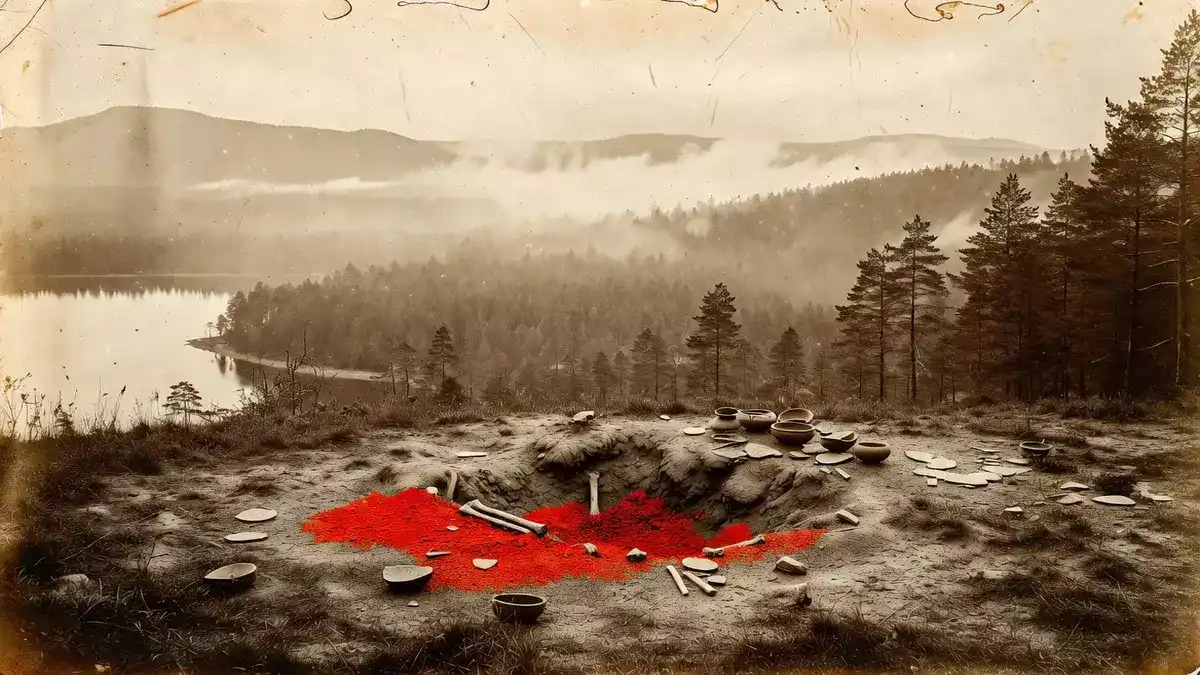
Burial practices stood out for their use of bright red ochre. Graves were often marked or filled with this pigment, creating striking visual and symbolic statements. Ochre, derived from iron-rich earth deposits, held deep ritual significance across many ancient cultures worldwide, but the Finnish examples reveal nuanced local and regional patterns of procurement and use.

### Groundbreaking Chemical Analysis of Ochre Samples
A detailed study examined ochre from eight archaeological sites across Finland, drawing samples from both graves and nearby settlement areas. Researchers employed non-invasive techniques, including energy dispersive X-ray fluorescence (ED-XRF) and scanning electron microscopy with energy dispersive spectrometry (SEM-EDS). These methods allowed precise elemental analysis while preserving the precious artifacts.
The results identified three primary chemical groups of ochre rather than distinct signatures tied to individual sites. This diversity indicates that people deliberately selected pigments from multiple sources instead of relying solely on whatever was locally available.
Particularly striking is the discovery of chemically matching ochre samples at locations up to 500 kilometers apart. Such distances demonstrate organized long-distance movement of materials, requiring planning, travel, and established social relationships.
### Long-Distance Exchange Networks in Prehistoric Finland
The ochre trade fits into broader exchange systems that connected communities across the Baltic region. Similar patterns appear in the distribution of Baltic amber and slate ornaments sourced from the Lake Onega area in Russia. Ochre participated in the same networks that moved valuable goods, ideas, and perhaps people over vast territories.
This mobility highlights the adaptability and connectivity of Typical Comb Ware groups. Waterways served as natural highways, facilitating canoe travel and seasonal gatherings where goods, stories, and rituals could be shared. The presence of non-local ochre in graves suggests these pigments carried symbolic weight tied to alliances, marriages, or shared spiritual beliefs.
Regional patterns also emerge. Some chemical groups cluster in specific parts of Finland, pointing to favored local sources that nearby communities knew and exploited regularly. At the same time, bidirectional movement between regions shows a dynamic network rather than simple one-way supply chains.
### Ritual Choices: Ochre in Graves vs. Daily Life
One of the study’s most revealing findings involves differences between ochre used in domestic contexts and that placed in burials. At several sites, the chemical composition of pigment from graves differed significantly from samples recovered from living areas. This suggests intentional selection for funerary purposes, where the source and properties of the ochre mattered deeply.
Within individual cemeteries, people buried close together sometimes received ochre from entirely different chemical groups. Even inside a single grave, different objects or body areas occasionally featured pigment from distinct sources. Such careful placement indicates that color was only part of the equation—origin stories, social meanings, and ritual appropriateness guided choices.
These patterns reveal ochre as a medium for expressing identity and relationships. Bringing distant pigment to a burial site could honor connections to faraway kin or ancestors, strengthening communal memory and territorial claims in a landscape without fixed borders.
### The Symbolic Power of Red Ochre in Prehistory
Red ochre has fascinated archaeologists for decades due to its widespread use in early human societies. From Neanderthal sites to Australian Aboriginal traditions and African rock art, the pigment consistently appears in ritual contexts. Its vivid color, association with blood and life force, and permanence made it ideal for marking significant moments, especially death.
In ancient Finland, ochre transformed ordinary graves into powerful statements. The act of covering or surrounding the deceased with specially chosen pigment likely served multiple purposes: protecting the spirit, signaling status, or linking the individual to broader social webs. The effort required to transport heavy loads of ochre over long distances underscores its cultural importance.
Stereomicroscope analysis of samples from sites like Kolmhaara and Vaateranta provided visual details of texture and composition, complementing the chemical data. These examinations confirmed that people processed and applied the material with care, further emphasizing its special role.
### Implications for Understanding Forager Societies
This research challenges older views of hunter-gatherers as isolated and highly localized. Instead, it portrays Typical Comb Ware communities as active participants in extensive social landscapes. Long-distance ochre exchange reflects sophisticated knowledge of the environment, navigation skills, and the ability to maintain relationships across generations.
The deliberate differentiation between settlement and burial ochre points to complex belief systems. Funerary practices were not random but followed cultural rules that integrated material resources with spiritual and social needs. By selecting specific ochres, families and communities expressed affiliations that extended beyond daily life.
Such insights contribute to a richer picture of prehistoric Europe during the transition toward more settled ways of life. While agriculture had not yet arrived in Finland, these foragers already demonstrated organizational complexity often associated with later farming societies.
### Modern Scientific Methods Unlocking the Past
The use of non-invasive analytical techniques represents an important advance in archaeological science. Preserving original samples allows future researchers to apply new methods as technology improves. Combining chemical data with detailed contextual information from excavations creates a multidimensional understanding that purely textual or typological studies cannot achieve.
This interdisciplinary approach—merging materials science, archaeology, and cultural interpretation—sets a strong example for similar studies worldwide. As more ochre sources are sampled and mapped, researchers will refine models of prehistoric mobility and interaction.
### Ochre’s Role in Memory, Identity, and Community
Beyond practical exchange, ochre helped construct social memory. Placing non-local pigment in graves tied individuals to distant places and people, embedding personal identities within larger networks. In societies without writing, material symbols like ochre became crucial carriers of history and belonging.
The study illustrates how everyday resources could gain extraordinary significance in ritual contexts. What began as earth dug from the ground became a connector of lives, landscapes, and legacies.
For contemporary audiences, these findings resonate with universal human experiences. The desire to honor the dead with meaningful objects, maintain connections across distances, and express identity through symbols feels strikingly familiar across thousands of years.
### Environmental and Cultural Context of Finnish Prehistory
Finland’s post-glacial environment shaped these developments. Rising sea levels, changing forests, and abundant lakes created opportunities for resource-rich lifeways. Typical Comb Ware pottery, with its distinctive comb impressions, reflects cultural innovation and shared styles that paralleled the ochre networks.
Cemeteries and settlements often clustered near productive fishing waters, underscoring the centrality of aquatic resources. Seasonal movements likely facilitated the ochre trade, with groups meeting at key locations to exchange goods and reinforce alliances.
### Why This Research Matters Today
Discoveries like this deepen appreciation for the complexity of ancient societies and the sophistication of forager lifeways. They counter notions of prehistoric simplicity and highlight continuity in human behaviors—trade, ritual, and social bonding—that persist in modern cultures.
For Finland, the research strengthens connections to deep ancestral heritage. It also contributes to global discussions on prehistoric mobility, gender roles in ritual, and the symbolic economy of materials.
As climate change and development threaten archaeological sites, studies that maximize information from existing collections become increasingly valuable. Non-invasive methods help balance research needs with preservation ethics.
### Conclusion: Ochre as a Thread Connecting Ancient Lives
The chemical characterization of ochre from ancient Finnish graves illuminates a world of interconnected communities where pigment choice signaled far more than aesthetic preference. Through deliberate selection and long-distance exchange, Typical Comb Ware people wove social networks that spanned hundreds of kilometers, using ochre to honor the dead and affirm living relationships.
This research transforms our understanding of hunter-gatherer complexity in northern Europe. It reveals how materials like ochre served as vehicles for identity, memory, and cultural continuity in a dynamic prehistoric landscape. As new analyses build on these foundations, we gain ever-richer insights into the lives, beliefs, and connections of Finland’s earliest known ceramic-using foragers.
The red ochre that once marked graves continues to color our view of the past, reminding us of humanity’s enduring capacity for meaning-making, cooperation, and symbolic expression across vast distances and deep time.
### FAQ: Ancient Finnish Ochre and Prehistoric Social Networks
**What is the Typical Comb Ware culture?**
A hunter-fisher-gatherer society that lived in Finland approximately 6,000 to 5,500 years ago, known for distinctive pottery, semi-subterranean houses, and extensive use of waterways.
**Why was ochre important in ancient Finnish burials?**
Ochre served as a ritual pigment with symbolic power, often used to mark graves and signal social identity, connections, and beliefs about death and the afterlife.
**How far did ochre travel in prehistoric Finland?**
Chemically similar ochre appears at sites up to 500 kilometers apart, indicating well-established long-distance exchange networks.
**Did different ochre types have special meanings?**
Yes. Choices varied between graves and settlements, and even within single burials, suggesting deliberate selection based on source, properties, and ritual significance rather than availability alone.
**What methods did researchers use to analyze the ochre?**
Non-invasive techniques including energy dispersive X-ray fluorescence and scanning electron microscopy allowed detailed chemical characterization without damaging samples.
**How does this study change views of hunter-gatherers?**
It demonstrates greater social complexity, mobility, and symbolic behavior than traditionally assumed, showing interconnected networks rather than isolated groups.