
Table of Contents
- 1. A Textbook Recovery in the Gdańsk Forest
- 2. Anatomy of a Bronze Age Treasure
- 3. The Ultimate Status Symbol: More Valuable Than a Herd of Cattle
- 4. Haunted Landscapes: The Ghostly History of the Gdańsk Forest
- 5. Frequently Asked Questions
- 5.1. Why was the sword buried standing completely upright?
- 5.2. What is a tang-hilted sword?
- 5.3. How old is the sword and what group of people made it?
- 5.4. Why is the sword green if it is made out of bronze?
- 5.5. What happened to the other swords found in this forest?
2,700-Year-Old Bronze Sword Found Standing Upright in Polish Forest
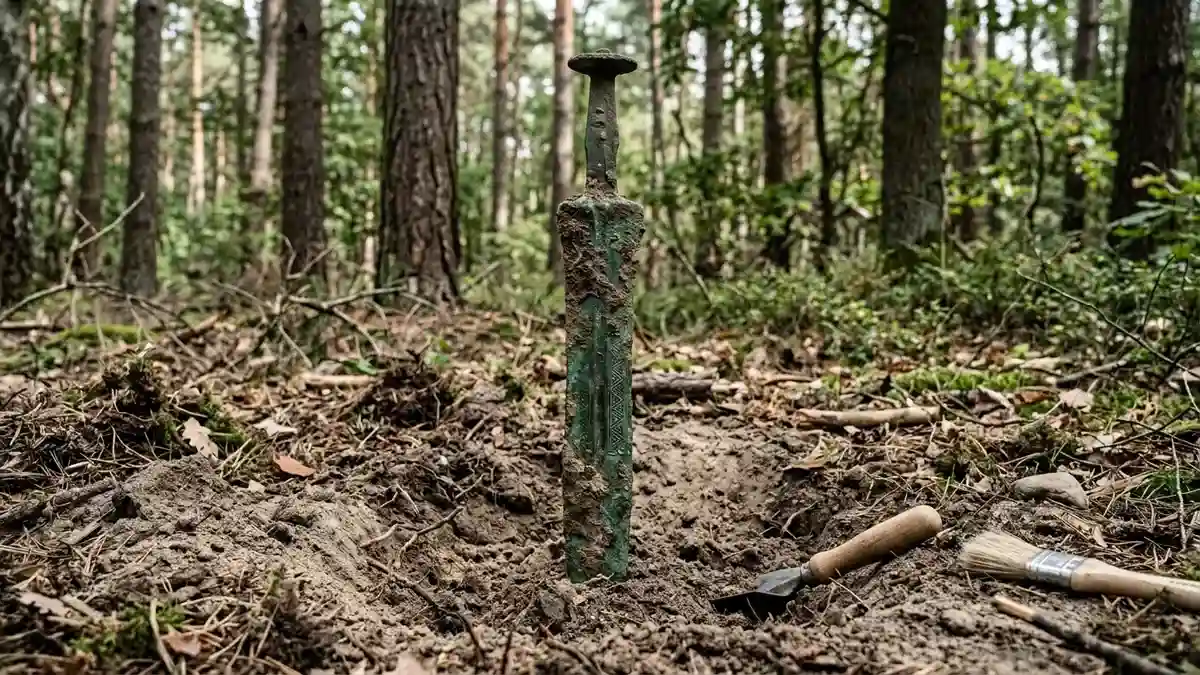
Deep within a quiet forest near Gdańsk, Poland, a stunning discovery has emerged from the sandy soil. During a legal metal-detecting survey, a beautifully preserved bronze sword dating back approximately 2,700 years was discovered hidden beneath the forest floor. What makes this find remarkably rare is not just its age, but its unique vertical orientation: the weapon was found standing completely upright in the ground, pointing to a deliberate, ancient ritual sacrifice of wealth.
Dating to the final centuries of the European Bronze Age (between 900 and 700 BCE), this exceptional weapon offers archaeologists an invaluable look into the spiritual and social lives of the people who inhabited pre-Roman Poland.
2,700-Year-Old Bronze Sword Found Standing Upright in Polish Forest
A Textbook Recovery in the Gdańsk Forest
The artifact came to light during an official, permitted archaeological survey within the Gdańsk Forest District. Experienced metal detectorist Marcin Wiśniewski was exploring the area when his equipment registered a strong signal. As he carefully swept away the top layer of sandy soil, he spotted the tip of a metallic object wedged vertically into the ground.
Recognizing that the precise, undisturbed position of an object provides critical context for historians, Wiśniewski resisted the urge to pull the sword from the earth. Instead, he marked the exact coordinates, protected the site from potential looters, and immediately reported the find to local forestry officials and regional heritage authorities.
When professional archaeologists arrived to excavate the site, they confirmed the unusual vertical orientation of the weapon. A meticulous sweep of the surrounding area revealed no other artifacts, buried bones, or hidden structures. This isolation, combined with the fact that the heavy sword was buried vertically rather than dropped flat, strongly suggests that the weapon was not an accidental loss but a deliberate, intentional deposit.
Anatomy of a Bronze Age Treasure
Measuring roughly 60 centimeters (about 24 inches) in length, the weapon is categorized by weapon experts as a tang-hilted sword. It features a narrow, flat metal tang at the base of the blade where a decorative handle would have been securely attached.
While the blade itself has survived the millennia, the handle has completely vanished. During the Late Bronze Age, handles were typically fashioned from organic materials such as wood, carved animal bone, or deer antler. Over nearly three chapters of a millennium, these materials decomposed in the acidic forest soil.

Despite the loss of its grip, the bronze blade itself remains in spectacular condition. It is covered in a vibrant green patina—a layer of copper carbonate oxidation that naturally forms over bronze and protects the underlying metal from deep rust and decay. Beneath this protective layer, intricate decorative engravings are still clearly visible, including:
Symmetrical geometric grooves running parallel down the length of the blade
Delicately engraved arcs near the hilt
Short, precise crosswise accent lines near the edges
These distinct styling choices match production techniques from the fourth and fifth periods of the regional Bronze Age, helping researchers narrow down the sword’s origin.
The Ultimate Status Symbol: More Valuable Than a Herd of Cattle
To understand the weight of this offering, one must understand the immense economic value of metalwork during this era. In the Late Bronze Age, a masterfully forged bronze sword was not a standard infantry weapon; it was the ultimate luxury item, reserved exclusively for elites, warlords, and high-ranking tribal leaders.
According to data shared by Poland’s State Forests agency, a bronze sword of this craftsmanship was an immense concentration of wealth. Fabricating a single blade required rare copper and tin, specialized smelting infrastructure, and the highly guarded skills of a master metalsmith.
Historians estimate that owning a sword like this was the economic equivalent of possessing an entire herd of cattle. Depositing such an object permanently into the earth was a display of immense financial power, indicating that the person or community responsible could afford to surrender a small fortune to the landscape.
Haunted Landscapes: The Ghostly History of the Gdańsk Forest
This newly discovered sword is not the first ancient weapon yielded by this specific stretch of Polish woodland. The Gdańsk Forest has a long history of archaeological anomalies that point to its enduring status as a sacred or significant geographic landscape.
During the 1920s, local workers recovered two unique bronze antenna-hilted swords from a deep peat bog located within the exact same forested region. Those weapons were safely transferred to the Provincial Museum in Gdańsk, where they became prized exhibits. Tragically, during the chaos and heavy destruction of World War II, both of those historical swords vanished from the museum collection and have never been recovered.
The discovery of this new tang-hilted sword restores an invaluable piece of this lost regional heritage. The artifact has been safely secured by specialists from the regional archaeological heritage office. Following careful chemical conservation to stabilize the metal and detailed microscopic analysis, the Provincial Heritage Conservator will determine which public museum will become the permanent home for this ancient relic.
Frequently Asked Questions
Why was the sword buried standing completely upright?
The vertical placement of the sword is the primary reason archaeologists suspect a ritual offering. If a sword had been lost during a battle or dropped accidentally by a traveler, it would lie flat on the ground and eventually be covered horizontally by leaves and dirt. Placing a sword vertically deep into the sand required intentional digging and placement, a common practice in ancient European water and earth deity rituals.
What is a tang-hilted sword?
A tang-hilted sword is a style of ancient blade where the metal of the blade extends down into a narrow, structural strip called a “tang.” A separate handle made of wood, bone, or horn was then pinned or wrapped around this metal core to provide a secure grip for the wielder.
How old is the sword and what group of people made it?
The sword is approximately 2,700 years old, dating back to the Late Bronze Age (specifically between 900 and 700 BCE). It was created during a time when various interconnected agricultural and metalworking cultures flourished across Central Europe, long before the arrival of the Roman Empire or the formal recording of written history in Poland.
Why is the sword green if it is made out of bronze?
Bronze is an alloy consisting primarily of copper mixed with tin. When copper is exposed to oxygen, water, and minerals in the soil over centuries, it undergoes a chemical reaction called oxidation. This forms a hard, green outer crust known as a patina, which actually shields the interior metal from further corrosion.
What happened to the other swords found in this forest?
In the 1920s, two distinct Bronze Age swords were pulled from a nearby peat bog within the same forest. They were stored in a museum in Gdańsk, but like many cultural treasures in Eastern Europe, they completely disappeared during the military occupations and looting of World War War II.