
Table of Contents
- 1. The Open-Access Discovery: Sifting Through Medieval DNA
- 1.1. A Thousand-Year Timeline
- 2. North African Roots Pre-Date the Islamic Conquest
- 3. Inside the Islamic Cemeteries: A Global Melting Pot
- 4. The Norman Conquest: New Rulers, Same Diverse Society
- 5. A Gradual Transition to the Modern Era
- 6. Conclusion: The Unwritten History Preserved in Bone
- 7. Frequently Asked Questions
- 7.1. What did the ancient DNA study reveal about medieval Sicily?
- 7.2. Did North African migration to Sicily begin with the Islamic conquest?
- 7.3. Does a person’s religion in medieval Sicily match their genetic background?
- 7.4. What exotic ancestries were discovered from the Islamic period?
- 7.5. Why is ancient DNA useful for studying historical populations?
Ancient DNA Rewrites the History of Medieval Sicily: A Permanent Genetic Crossroads
For millennia, the strategic island of Sicily sat like a crown jewel in the center of the Mediterranean Sea. Coveted by empires, it shifted violently from Roman hands to Byzantine control, fell to Islamic emirates, and was later conquered by fierce Norman crusaders. To traditional historians, these transitions were viewed as sharp, disruptive chapters where one ruling elite systematically replaced another.
However, a revolutionary new ancient DNA study has shattered this narrative. By extracting genetic material from medieval skeletons, scientists have discovered that while rulers, languages, and official religions changed at the whim of kings and caliphs, the actual population of Sicily remained deeply diverse, resilient, and interconnected. The island did not experience mass ethnic replacements; instead, it served as a permanent genetic crossroads where Europeans, North Africans, and Near Easterners lived, mingled, and built families together across generations.
Ancient DNA Rewrites the History of Medieval Sicily A Permanent Genetic Crossroads
The Open-Access Discovery: Sifting Through Medieval DNA
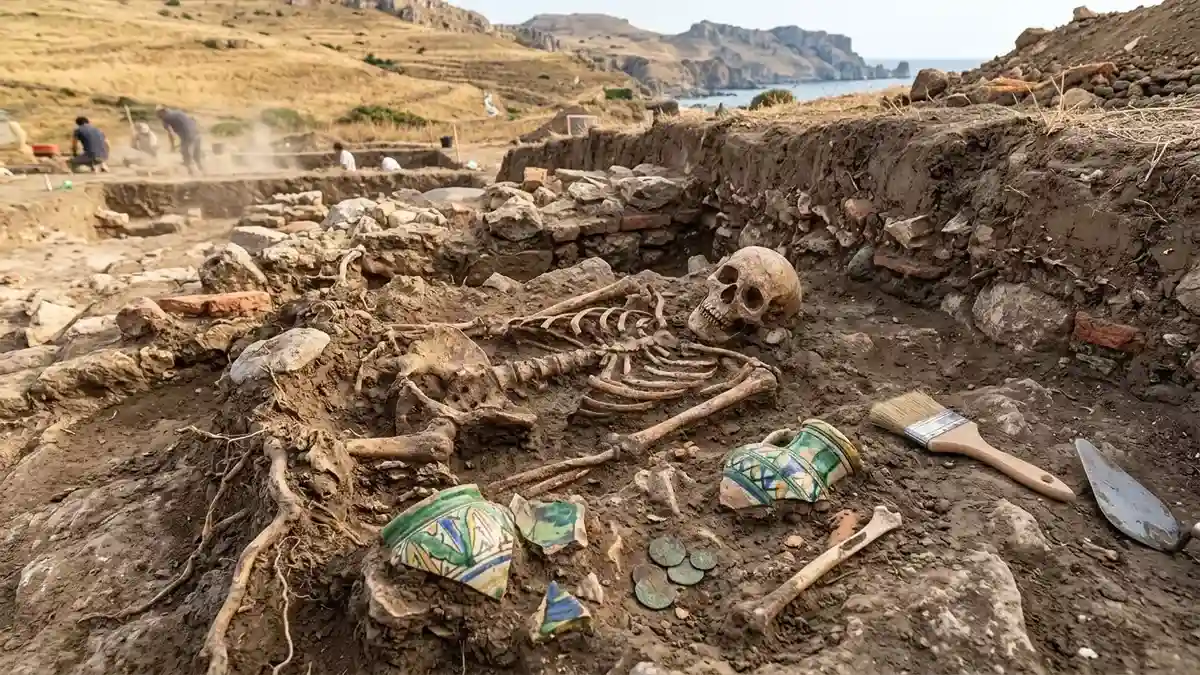
Published in the scientific journal PLOS One, the study represents one of the most comprehensive genetic mappings of a medieval Mediterranean population. An international research team managed to analyze the skeletal remains of 111 individuals excavated from 19 distinct archaeological sites scattered across Sicily.
A Thousand-Year Timeline
The studied remains span a vast chronological window from the 5th to the 15th century CE, allowing scientists to track genetic shifts across multiple critical historical epochs:
The Late Roman and Byzantine Era: An age of deep Christian entrenchment.
The Islamic Period (9th–11th Centuries): Initiated by the Aghlabid invasion in 827 CE and later ruled by the Fatimid Caliphate.
The Norman and Swabian Reigns (11th–13th Centuries): A period of Northern European Christian dominance.
The Late Middle Ages: Marked by Angevin kings and the gradual transition into modern Italian geopolitics.


Through meticulous laboratory work, the team successfully recovered mitochondrial DNA (maternal lineages) from 67 individuals and high-resolution, genome-wide DNA from 32 individuals. The data revealed a striking truth: Sicily’s genetic melting pot was constantly simmering, independent of whoever occupied the palace.
North African Roots Pre-Date the Islamic Conquest
One of the most surprising revelations of the study completely upends the traditional timeline of migration between Italy and Africa. Conventionally, historians assumed that the distinct North African genetic signatures found in southern Italy arrived primarily with the Muslim armies during the conquests of the 9th century.
The ancient DNA tells a completely different story. Several individuals who lived and died during the Byzantine period—centuries before the Islamic invasion—already carried substantial North African ancestry.
This proves that regular, peaceful commercial networks, migration, and marital alliances were actively shaping the local Sicilian population long before any military banners were unfurled. The Mediterranean Sea was not a barrier between rival worlds; it was an open highway.
Inside the Islamic Cemeteries: A Global Melting Pot
When researchers examined individuals buried in Islamic-style cemeteries between the 9th and 11th centuries, they expected to find a sudden influx of uniform Middle Eastern or North African genomes. Instead, they found a stunning tapestry of human backgrounds.
Many of the individuals buried according to Islamic customs shared identical, long-term genetic profiles with the earlier Christian populations of the island. This strongly implies that a vast portion of Islamic Sicily consisted of local Sicilians who had converted to Islam over time or intermarried with incoming settlers.
Furthermore, the Islamic era expanded Sicily’s horizons to an unprecedented degree. The team identified specific individuals whose genetic heritage stretched all the way to West Africa and Northern Europe. These far-reaching genetic markers paint a vivid picture of trans-Saharan trade routes and vast European mercantile connections converging on Sicilian markets.
The Norman Conquest: New Rulers, Same Diverse Society
In 1061 CE, Norman knights launched a successful invasion of Sicily, forcefully returning the island to Christian governance. Yet, the genetic data proves that this political and religious shift did not result in the expulsion or eradication of the existing population.
During the Norman period, Christian, Muslim, and Jewish burial grounds existed simultaneously. When scientists analyzed the bones within these separate, faith-based cemeteries, they found something remarkable: religious identity did not dictate genetic ancestry.
A person buried in a Christian cemetery could possess heavy North African or Near Eastern ancestry, while an individual in an Islamic cemetery might display European roots. People of vastly different genetic backgrounds were fully integrated into the same multi-faith, highly connected medieval society.
A Gradual Transition to the Modern Era
It was only during the Late Middle Ages that the genetic profile of Sicily began to gradually shift. As the island became more tightly bound to mainland European politics and experienced waves of migration from northern Italy and continental Europe, the ancestry patterns slowly began to mirror those seen in modern European populations.
However, the study explicitly stresses that this was a slow, multi-generational blend rather than a sudden, violent population replacement. Modern Sicilians carry within their DNA the living archive of this ancient crossroads—a genetic record built by centuries of maritime travel, trade, and coexistence.
Conclusion: The Unwritten History Preserved in Bone
By combining advanced genetics with traditional archaeology, this study highlights the limitations of relying solely on written historical texts. Medieval chronicles, often written by court scribes or religious zealots, frequently emphasized conflict, holy wars, and rigid divisions between faiths.
The ancient DNA provides an unbiased counter-narrative. It reminds us that beneath the chaotic rise and fall of kings, emperors, and caliphs, the everyday people of Sicily chose connection over isolation, turning an island battlefield into one of the most vibrant genetic tapestries in human history.
Frequently Asked Questions
What did the ancient DNA study reveal about medieval Sicily?
The study revealed that medieval Sicily maintained an incredibly diverse and interconnected population for hundreds of years. Despite violent political changes and shifts between Byzantine Christian, Islamic, and Norman Christian rule, there was no massive genetic replacement of the population. Instead, people of different ancestries continuously intermarried and lived together.
Did North African migration to Sicily begin with the Islamic conquest?
No. The genetic data proved that substantial North African ancestry was already present in the Sicilian population during the Byzantine period, centuries before the official Islamic conquest of 827 CE. This shows that maritime migration and trade across the Mediterranean were active long before any military invasions.
Does a person’s religion in medieval Sicily match their genetic background?
Surprisingly, no. The study found that genetic ancestry did not correlate cleanly with religious burial styles during the Norman period. Diverse genetic backgrounds—ranging from Northern European to North African—were found across both Christian and Muslim cemeteries, proving that medieval Sicilian society was deeply integrated across religious lines.
What exotic ancestries were discovered from the Islamic period?
In addition to local European and Mediterranean lineages, researchers identified specific individuals in Islamic-era cemeteries whose ancestry traced back to West Africa and Northern Europe, highlighting the massive scope of trade and migration networks operating at the time.
Why is ancient DNA useful for studying historical populations?
Written historical records from the Middle Ages were often biased, focusing primarily on the exploits of rulers, wars, and the elite. Ancient DNA allows scientists to study the actual, everyday populations who left behind no written journals, providing an objective look at migration, marriage habits, and daily life.