
Table of Contents
- 1. The Discovery at the Heart of Legio VI Victrix
- 2. An Unconventional Grave: The Tegula Burial
- 3. Forensic and Skeletal Revelations of Gestational Stress
- 4. Law versus Reality: Challenging the Imperial Marriage Ban
- 5. Spiritual Protection and the Magic of the Threshold
- 6. Conclusion
- 7. Frequently Asked Questions
- 7.1. Where exactly was this Roman infant burial discovered?
- 7.2. How old is the burial site?
- 7.3. What is a tegula and why was it used in the burial?
- 7.4. Why does this discovery surprise historians?
- 7.5. What was the spiritual purpose of burying an infant under a workshop floor?
First Infant Burial Found in Roman Camp Rewrites Military History
A remarkable archaeological discovery in northern Spain is fundamentally changing our understanding of life, family dynamics, and spiritual rituals within the ancient Roman army. For centuries, historians have pictured Roman military encampments as austere, highly disciplined, and exclusively male bastions where legions focused solely on the mechanics of war. However, the discovery of a perinatal infant burial deep inside an active military fortress has shattered this rigid stereotype, proving that women, children, and complex domestic rituals were deeply woven into the fabric of frontline military life.
The pioneering study, published in the journal Childhood in the Past, details the excavation of a newborn infant buried beneath the floorboards of a Roman legionary workshop. Led by researcher Marta Fernández-Viejo of León University and Burgos University, the investigation provides the very first physical proof of an infant burial within a Roman military fort on the Iberian Peninsula. The find reveals a complex, hidden world where imperial military regulations clashed with the human realities of family life and traditional spiritual beliefs.
First Infant Burial Found in Roman Camp Rewrites Military History
The Discovery at the Heart of Legio VI Victrix
The physical setting for this historical breakthrough is the ancient castrum (military fortress) of Legio VI Victrix, located in the modern city of León, Spain. Legio VI Victrix was an elite, battle-hardened unit originally established by Octavian—the future Emperor Augustus—in 41 BCE during the turbulent final years of the Roman Republic. Stationed permanently in the province of Hispania Tarraconensis by 29 BCE, the legion played a vital strategic role in conquering and monitoring the rebellious tribes of the Asturian mountains, guarding critical mountain passes near the strategic confluence of the Bernesga and Torío rivers.
The priceless skeletal remains were originally brought to light during a series of urgent emergency salvage excavations conducted in 2006. The digs took place beneath the sacristy of the historic convent of Siervas de Jesús and along the adjacent Francisco Regueral Street. This area sits directly atop the ancient footprint of the primary Roman barracks and industrial workspaces.
An Unconventional Grave: The Tegula Burial
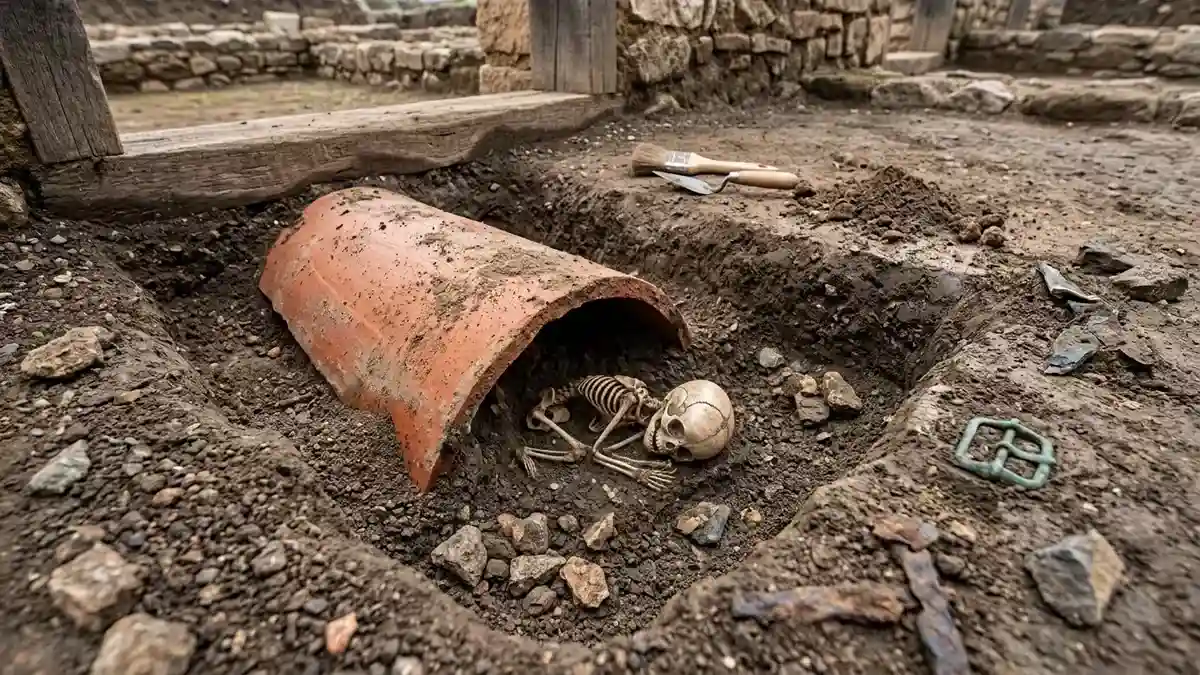
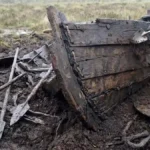
When researchers excavated a sector designated as Area 1, they noticed an anomaly beneath the packed earth floor of a contubernium workshop—a dual-purpose space where a small squad of Roman soldiers lived, slept, and manufactured or repaired military gear. Buried carefully beneath the floorboards was a tegula, a heavy, kiln-fired ceramic roof tile that was a staple of Roman architectural engineering.
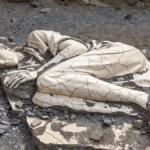
When the archaeologists cleared away the sediment around the tile, they discovered it was acting as a crude, makeshift protective coffin for the delicate skeleton of a newborn child. Utilizing clay roof tiles as protective coverings for deceased infants was a highly recognized and widespread custom across the broader Roman Empire. However, these specialized tile burials were almost universally restricted to designated civic cemeteries or hidden domestic gardens behind civilian homes.
Finding a child buried inside a strictly regulated, active government military workshop—positioned deliberately right next to a busy interior doorway—is entirely unprecedented in the Iberian archaeological record. While rare infant graves have been documented in civilian settlements sprawling outside British fortresses along Hadrian’s Wall, finding an infant resting directly inside the active workspaces of the soldiers themselves marks a radical departure from known historical patterns.
Forensic and Skeletal Revelations of Gestational Stress
To understand the tragic circumstances surrounding the child’s short life, the research team subjected the fragile bones to exhaustive osteological and anthropological laboratory testing. The forensic data yielded a bittersweet biography of the unnamed infant.
The skeletal analysis confirmed that the pregnancy had reached full term, with the child dying at an estimated gestational age of between 38 and 42 weeks. However, a closer inspection of the skeletal architecture revealed profound developmental discrepancies. Key structural elements of the infant’s pelvis and cranial skull vault had failed to fully form and ossify at the expected rate for a full-term birth.
According to Dr. Fernández-Viejo, these distinct bone development delays are definitive biological indicators of extreme physiological stress. The mother likely endured severe illness, physical trauma, or profound nutritional deficiencies during the final months of her pregnancy, compromises that directly impacted the unborn child’s development.
From a forensic standpoint, the bones exhibited absolutely no signs of external fractures, cutting marks, or physical trauma, allowing scientists to confidently rule out active infanticide. However, researchers note that non-violent causes of unnatural death common in the ancient world, such as intentional exposure to the elements or smothering, leave no permanent signatures on skeletal tissue and cannot be entirely discounted. Advanced radiocarbon dating subsequently pinned the timing of the burial to a historical window stretching between 47 BCE and 61 CE, placing the event squarely during the foundational decades of the Roman Empire.
Law versus Reality: Challenging the Imperial Marriage Ban
The chronological dating of the León burial makes its location particularly scandalous. This specific era coincided directly with the sweeping military overhauls enacted by Emperor Augustus. In an effort to maintain a highly mobile, professional, and hyper-focused standing army, Augustus instituted a strict legal ban prohibiting active-duty soldiers from marrying.
Under imperial law, a soldier’s focus belonged entirely to the Emperor and the legion. Wives, concubines, and children were legally non-existent within the fortress gates, and women were theoretically barred from setting foot inside the official military barracks.
For decades, modern historians took these written imperial decrees at face value, viewing Roman bases as sterile, hyper-masculine environments. However, the León discovery joins a growing body of subtle archaeological clues suggesting that Roman soldiers routinely flouted these regulations. In distant frontier provinces like Britannia and Germania, excavations have occasionally recovered delicate women’s leather slippers and miniature children’s shoes discarded in military trash heaps.
The presence of a full-term infant burial inside a legionary workshop provides undeniable proof that women and children were not just camp followers living in the civilian villages outside the walls; they were actively living, working, and dying inside the secure heart of the military base alongside the troops.
Spiritual Protection and the Magic of the Threshold
To explain why hard-nosed Roman legions would permit an infant to be buried directly beneath their workshop floor, researchers must look through the lens of ancient Roman spiritualism and superstitious architecture. In the Roman religious mindset, children who passed away during birth or in early infancy were viewed with a mixture of profound sorrow and spiritual caution.
Because these perinatal infants had died before experiencing life or receiving formal civic naming rituals, their souls were believed to possess a volatile, highly potent spiritual energy. If handled correctly through specific magical traditions, the remains of a newborn could be transformed into a powerful talisman of protection.
Placing the infant’s tile coffin directly beneath the threshold or doorway of the workshop served a dual ritualistic purpose:
Securing the Boundary: Doorways and thresholds were viewed by Romans as highly vulnerable spiritual transition zones where bad luck, curses, and evil spirits could easily enter a building.
The Foundation Blessing: By interring the potent soul of the child beneath the entryway, the builders executed what anthropologists call a “foundation burial.” The infant’s spirit effectively acted as a metaphysical guardian, sanctifying the space, locking out malevolent forces, and ensuring safety, prosperity, and good fortune for the soldiers laboring within the active industrial workshop.
Conclusion
The discovery of the León infant burial serves as a powerful reminder that history is rarely as neat or rigid as ancient legal codes suggest. By looking past the official imperial propaganda of the Augustan age, archaeologists have exposed a far more human, complex, and empathetic reality. The Roman army was not just a cold, automated war machine; it was a living community where the domains of domestic family life, intense industrial labor, and deep spiritual magic intersected under the floorboards of the empire’s frontiers.
Frequently Asked Questions
Where exactly was this Roman infant burial discovered?
The infant burial was discovered during an emergency salvage excavation beneath the sacristy of the Siervas de Jesús convent and along Francisco Regueral Street in León, Spain, which sits directly on top of the ancient Roman fortress of Legio VI Victrix.
How old is the burial site?
Radiocarbon dating of the organic material and bone tissue places the burial within a specific historical window between 47 BCE and 61 CE, dating back to the dawn of the Roman Empire.
What is a tegula and why was it used in the burial?
A tegula was a standard clay roof tile used extensively in Roman architecture. In ancient funerary practices, it was common to use these large, curved ceramic tiles as a simple, affordable coffin to shield the delicate bodies of deceased infants.
Why does this discovery surprise historians?
Emperor Augustus had established a strict legal ban that prevented active-duty Roman soldiers from marrying or keeping families inside military bases. Finding an infant buried directly inside a soldier’s barracks workshop proves that women and families lived inside the fortresses despite official imperial laws.
What was the spiritual purpose of burying an infant under a workshop floor?
Ancient Romans believed that newborns who died at birth possessed unique spiritual energy. Burying the infant beneath a doorway or threshold functioned as a protective “foundation burial,” transforming the child’s spirit into a supernatural guardian to protect the building and the soldiers working inside from bad luck or evil forces.