
Table of Contents
- 1. A Snapshot of Bronze Age Industry
- 2. How the Warp-Weighted Loom Worked
- 3. Domestic Life: Where Industry Met Home
- 4. Why This Discovery Matters
- 5. Frequently Asked Questions
- 5.1. What is a “warp-weighted” loom?
- 5.2. Why is finding this loom in a house significant?
- 5.3. What kind of materials were the Bronze Age people weaving?
- 5.4. How did the archaeologists know the loom was still “in place”?
- 5.5. Does this tell us anything about the economy of Cabezo Redondo?
Bronze Age Loom Discovery Unlocks Secrets of Ancient Textile Work
Archaeologists working at the historic site of Cabezo Redondo in southeastern Spain have made a discovery that offers a rare, direct connection to the daily lives of Bronze Age inhabitants. A recent study published in the journal Antiquity details the identification of a perfectly preserved warp-weighted loom, found exactly as it was left inside an ancient home near the modern town of Villena.
Bronze Age Loom Discovery Unlocks Secrets of Ancient Textile Work
A Snapshot of Bronze Age Industry
The Cabezo Redondo settlement is a remarkably dense archaeological site characterized by tightly clustered homes, specialized storage areas, and domestic workspaces. While archaeologists have previously recovered scattered loom weights across the site, this specific discovery is unique.
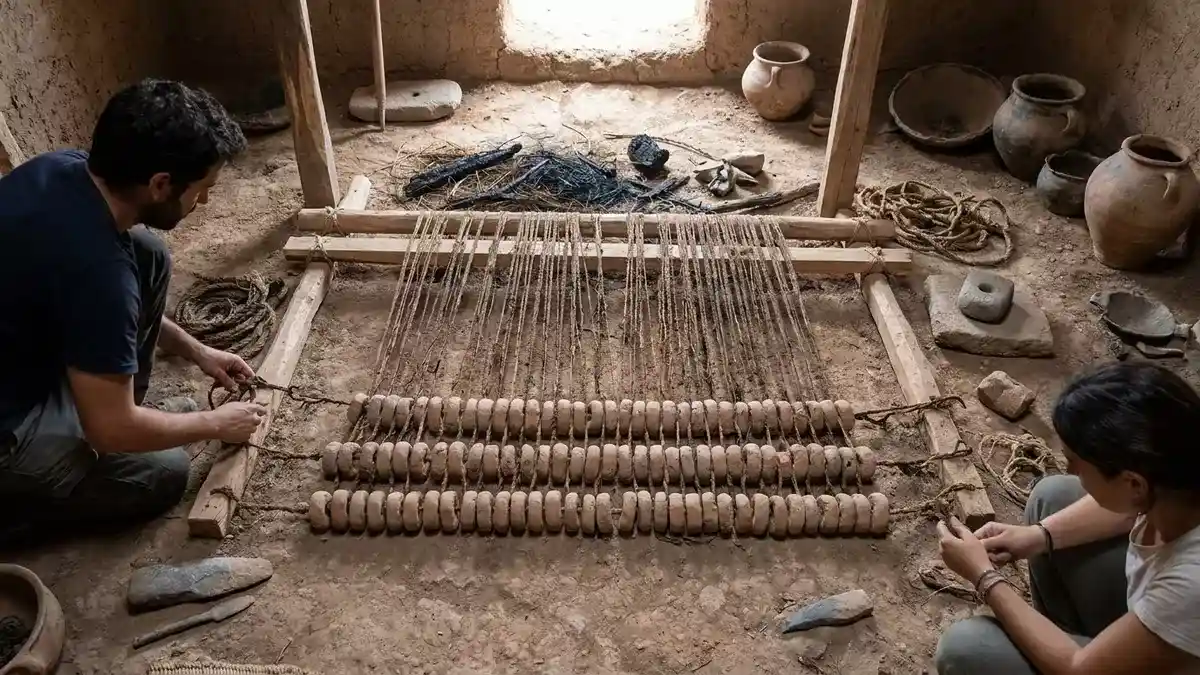
Inside a single domestic room, researchers identified dozens of clay weights arranged in precise, parallel rows on the floor. Unlike other finds where objects were discarded or piled, the layout of these weights perfectly matches the tension-based structure of a vertical warp-weighted loom. The alignment is so distinct that experts are certain the loom was not a collection of stored tools, but a functional machine that stood in place when the building was last occupied.

How the Warp-Weighted Loom Worked
The warp-weighted loom was a cornerstone of ancient textile production. In this system, warp threads (the vertical base threads) hang downward, kept taut by the weight of clay objects tied to their ends.
The team’s analysis of the Cabezo Redondo loom provides several key insights into the sophistication of Bronze Age weaving:
Precision Engineering: The clay weights were remarkably uniform in size and shape, suggesting a standardized approach to production.
Tactile History: Microscopic wear marks on the weights provide physical evidence of the constant tension applied by the fibers during the weaving process.
Technical Adaptability: Variations in the weight of the clay pieces suggest that the weavers could adjust the spacing and tension of the threads, allowing them to create fabrics of different thicknesses and textures.
Raw Materials: The discovery was further supported by the presence of charred esparto grass and remnants of ropes, confirming the specific plant-based fibers used by these ancient weavers.


Domestic Life: Where Industry Met Home
Perhaps the most significant takeaway from this discovery is the location of the loom. Rather than being housed in a segregated workshop or industrial district, the loom was integrated into a multi-purpose living area.
Surrounded by household items and storage jars, the loom indicates that textile production was a deeply embedded aspect of daily domestic routine. Weaving was not just a commercial endeavor; it was an essential household task, likely performed in shared spaces alongside other daily chores. This suggests that the production of cloth was a central pillar of the Bronze Age economy, requiring both significant time and specialized skill from the members of the household.
Why This Discovery Matters
For archaeologists, finding an object in its original “in situ” context is the gold standard of research. Because the loom remained in its original configuration, the team could accurately reconstruct the machine’s dimensions and the space required for its operation.
This site serves as a vital case study for Bronze Age Iberia. It moves our understanding beyond static descriptions of pottery and stone tools, providing a dynamic view of how Bronze Age people organized their living spaces, managed raw materials, and sustained their communities through skilled labor. As research continues at Cabezo Redondo, this loom serves as a testament to the sophistication of prehistoric domestic life, showing that the home was truly the center of both social life and industrial production.
Frequently Asked Questions
What is a “warp-weighted” loom?
A warp-weighted loom is a vertical structure where the vertical (warp) threads hang down, weighted by clay or stone objects to keep them taut. This tension is necessary for weaving the horizontal (weft) threads across them to create cloth.
Why is finding this loom in a house significant?
Finding the weights in their original, aligned rows is extremely rare. It proves that textile production was a routine domestic activity rather than an exclusively specialized, large-scale industrial operation.
What kind of materials were the Bronze Age people weaving?
The presence of esparto grass fibers at the site indicates that people were utilizing locally harvested plant materials. However, they likely also used wool, which would have been a primary fiber for clothing and blankets.
How did the archaeologists know the loom was still “in place”?
The weights were found in straight, parallel rows on the floor. If they had been stored or discarded, they would have been found in a pile or scattered randomly. Their alignment matches the mechanical requirements of a loom that was actively in use.
Does this tell us anything about the economy of Cabezo Redondo?
Yes. It indicates that these households were self-sufficient, possessing the skill and the tools to produce their own textiles, which were likely valuable commodities in the Bronze Age trade landscape.