
Table of Contents
- 1. The Frozen Timeline of an Archaeological First
- 2. Fighting the Elements: The August Breakthrough
- 3. The Glacial Time Capsule: Preserving Organic History
- 4. Packhorses: The Heavy Lifters of Viking Commerce
- 5. A Growing Multi-Millennium Archive of Mountain Life
- 6. Frequently Asked Questions
- 6.1. What makes this packhorse net discovery so special?
- 6.2. Where exactly was the net found?
- 6.3. How did the net survive for over 1,000 years without rotting?
- 6.4. Why did the Vikings use nets on their horses?
- 6.5. What other items have been found in the Norwegian ice?
Melting Ice in Norway Yields Only Known Viking Cargo Net
Deep within the high-altitude peaks of Norway, a retreating glacier has given up another piece of an extraordinary archaeological puzzle. Glacier archaeologists have uncovered new fragments of what is believed to be the world’s only surviving Viking Age packhorse net.
Discovered within the frozen expanse of Jotunheimen National Park, these rare organic artifacts add an invaluable chapter to a groundbreaking discovery made more than a decade ago. As climate change accelerates the melting of Norway’s permanent ice patches, the mountain passes are acting as a retreating curtain, revealing how Viking traders and their animals conquered Europe’s most brutal terrain.
Melting Ice in Norway Yields Only Known Viking Cargo Net

The Frozen Timeline of an Archaeological First
The saga of the packhorse net began in 2011. While surveying a remote, high-altitude ice patch, glacier archaeologists with the “Secrets of the Ice” program spotted an unusual cluster of preserved wooden rods and bound leather straps.
Upon closer inspection and laboratory conservation, researchers realized they were looking at the skeletal remains of a specialized, framed leather cargo net. This device was designed to be strapped directly onto a packhorse’s wooden saddle framework to securely transport bulk goods across treacherous mountain ridges.
Subsequent radiocarbon dating confirmed that the organic materials were approximately 1,000 years old, placing the artifact squarely within the Viking Age. It remains the absolute only packhorse net from this era ever discovered anywhere in the world.

Fighting the Elements: The August Breakthrough
Following the initial discovery, heavy winter snowfall and uncooperative weather patterns routinely hampered further investigation. The team attempted to conduct follow-up excavations at the exact coordinates in 2012, but excessive snow cover sealed the site away, keeping further finds to a bare minimum.
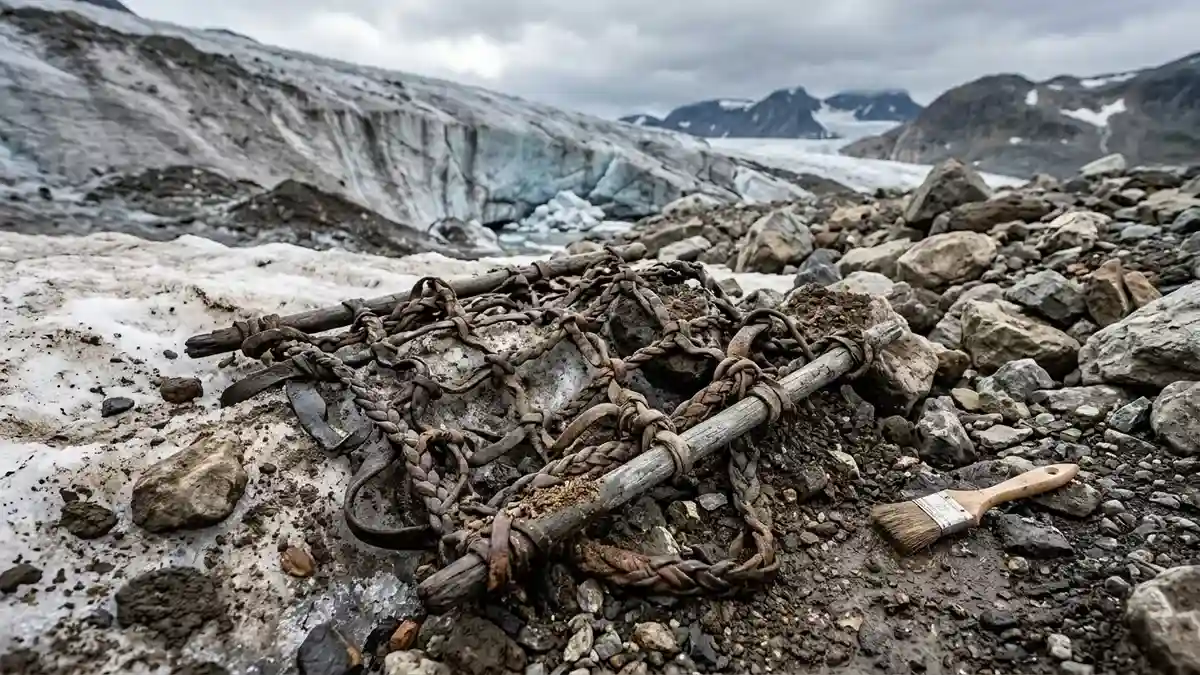
However, during a recent field season in August, lighter snow accumulation and significant glacial retreat allowed the “Secrets of the Ice” team to return to the original find site. Their multi-year patience was rewarded when they discovered several fresh fragments of woven leather wedged tightly between raw boulders right at the melting edge of the glacier.
Forensic photographs released by the project show frayed yet structurally sound leather loops and complex knotted sections. Lead archaeologist Lars Pilø confirmed that due to the precise coordinates and matching material degradation, these new pieces are almost certainly missing fragments belonging to the exact same 1,000-year-old net discovered in 2011.
The Glacial Time Capsule: Preserving Organic History
In standard lowland archaeological digs, items made from wood, hide, and leather disintegrate completely within a matter of decades due to soil acidity, bacteria, and insect activity. Finding intact Viking-era textiles or leather goods is an extreme anomaly.
High-altitude ice patches, however, serve as nature’s ultimate deep-freeze storage units. The permanent ice creates a stable, anaerobic (oxygen-free) microclimate with sub-zero temperatures. This environment completely halts the natural processes of decay, locking organic artifacts in a state of suspended animation. The objects remain perfectly preserved for centuries—until the surrounding ice melts, exposing them to the open air and kicking off a race against time for archaeologists to recover them before they rot.
Packhorses: The Heavy Lifters of Viking Commerce
While popular history focuses heavily on the iconic Viking longship, land-based transportation was equally critical to the economic survival of early Scandinavian society. Mountainous terrain, jagged rocky passes, and roaring glacial rivers made wheeled wagons completely useless across the interior of Norway.
To move iron, pelts, timber, and imported goods across the country, the Vikings relied heavily on hardy native packhorses.
Packhorses allowed traders to ferry immense loads over high-altitude mountain routes that would otherwise be completely impassable to foot travelers.
Interestingly, the use of framed rope and leather cargo nets for horseback transport persisted in rural, isolated pockets of Norway until the dawn of the industrial era, providing modern ethnographers and archaeologists with the perfect contextual clues needed to decipher the exact function of the 1,000-year-old find.
A Growing Multi-Millennium Archive of Mountain Life
The newly recovered net fragments join an incredibly rich, expanding collection of historical artifacts rescued by the Secrets of the Ice project as global temperatures climb. The shifting ice has yielded items spanning multiple millennia of human high-altitude activity, including:
Hunting Gear: Well-preserved wooden bows, feathered arrows, and iron-tipped spears frozen mid-hunt.
Ancient Footwear: A remarkably intact, 3,400-year-old hide shoe dating all the way back to the Bronze Age.
Daily Garments: Woven Viking mittens and complete Iron Age tunics dropped by ancient travelers.
Domestic Utensils: A delicate, hand-carved wooden kitchen whisk used to prepare meals on the trail.
As surveys continue across the melting expanses of Jotunheimen National Park, archaeologists remain certain that more historic treasures are waiting just beneath the surface, ready to tell the stories of the ancient people who carved a living out of the ice.
Frequently Asked Questions
What makes this packhorse net discovery so special?
This artifact is currently the world’s only known surviving packhorse cargo net from the Viking Age. Because it is made of highly perishable leather and wood, it would normally have decayed centuries ago, making its survival an incredibly rare archaeological event.
Where exactly was the net found?
The net fragments were discovered inside the high-altitude mountain passes of Jotunheimen National Park, a rugged wilderness region located in south-central Norway.
How did the net survive for over 1,000 years without rotting?
The net was trapped inside a permanent glacial ice patch. The low temperatures and total lack of oxygen inside the ice created a natural time capsule, protecting the organic leather and wood from bacteria, rot, and decay for an entire millennium.
Why did the Vikings use nets on their horses?
Because Norway’s interior is incredibly steep, rocky, and devoid of flat roads, wheeled wagons could not be used. Traders relied on packhorses equipped with specialized saddles and leather nets to safely balance and secure heavy bulk goods across treacherous mountain trails.
What other items have been found in the Norwegian ice?
The Secrets of the Ice project has recovered an incredible variety of ancient items preserved by the cold, including 3,400-year-old leather shoes, Iron Age wool tunics, hunting bows, arrows, and even basic domestic tools like wooden cooking whisks.