
Table of Contents
- 1. The Monolithic Value of the Donington-on-Bain Discovery
- 1.1. An Unconventional Discovery Site
- 1.2. Breaking Down the Vaulted Masterpieces
- 2. Decoding the Mystery: Why Was the Gold Buried?
- 2.1. 1. The Traveling Goldsmith’s Recycling Cache
- 2.2. 2. The Phenomenon of “Ritual Killing”
- 2.3. 3. A Hidden Cache Born of Wartime Chaos
- 3. A Century of Cultural and Spiritual Transition
- 4. Frequently Asked Questions
- 4.1. Where is the Anglo-Saxon gold-and-garnet hoard currently kept?
- 4.2. Why is finding this jewelry on a hillside considered so unusual?
- 4.3. What are garnets, and why were they so important to the Anglo-Saxons?
- 4.4. What does the term “ritual killing” mean in archaeology?
- 4.5. How did researchers determine the age of the hoard?
Anglo-Saxon Gold Hoard Unearths Secret Early Medieval Rituals
An extraordinary collection of Anglo-Saxon gold-and-garnet jewelry discovered on an English hillside is transforming our understanding of early medieval society. Found on a slope near the village of Donington-on-Bain in Lincolnshire, these high-status ornaments offer a rare glimpse into the wealth, recycling habits, and secretive ritual practices of seventh-century Britain.
The rare artifacts, which date back over 1,300 years, challenge long-held archaeological assumptions about how early medieval elites handled their most valuable possessions. Rather than being recovered from a traditional cemetery, this treasure was intentionally buried in isolation, leaving experts to decode a fascinating historical mystery.

Anglo-Saxon Gold Hoard Unearths Secret Early Medieval Rituals
The Monolithic Value of the Donington-on-Bain Discovery
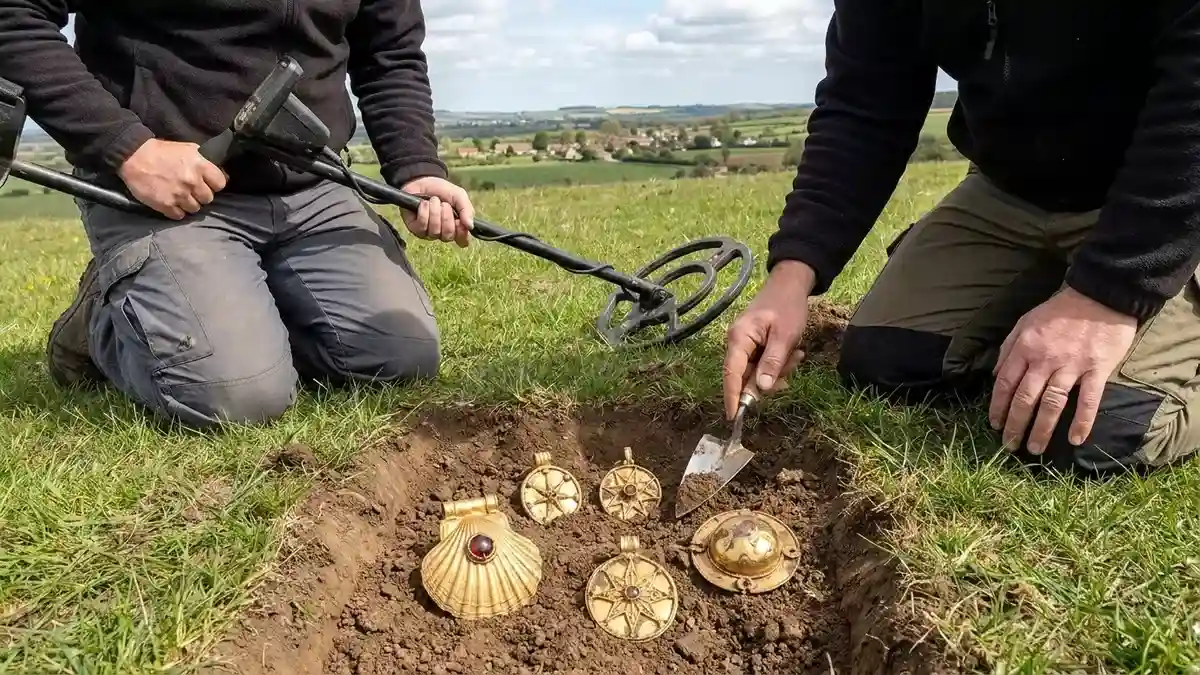
The story of the hoard began in the spring of 2023 when two metal detectorists scanning the Lincolnshire countryside made the discovery of a lifetime. The group of objects consists of four intricate gold pendants and the central portion of a complex gold brooch. Following extensive scientific validation, the collection was officially declared Treasure under U.K. law and safely acquired by the Lincoln Museum in 2025.

An Unconventional Discovery Site
Gold-and-garnet jewelry pieces from this era are highly prized by museums, but they are almost universally excavated from lavish pagan graves. The Donington-on-Bain hoard completely breaks this rule.
Found exposed on a hillside without any human skeletal remains, coffin hardware, or typical accompanying grave goods, the site points to a deliberate deposition independent of a funeral. Microscopic analysis of the jewelry reveals heavy surface wear, ancient structural damage, and various historic modifications. This indicates that the pieces were not newly minted for a ceremony; they had been cherished, worn, and altered over several decades before their ultimate burial.
Breaking Down the Vaulted Masterpieces
The craftsmanship of the artifacts demonstrates the incredible skill of Anglo-Saxon goldsmiths, who combined imported precious stones with complex metalwork techniques.
 Ancient DNA links 400-year-old Finland burial to Sámi ancestry and possible Iceland journey
The Scalloped D-Pendant: The crowning achievement of the hoard is a D-shaped gold pendant featuring a massive centerpiece garnet. The gemstone is cradled within a delicate, scallop-shaped gold mount. Historians frequently associate this specific shell motif with ancient fertility symbolism, and during the seventh century, it may have begun carrying early Christian meanings.
The Star-Burst Pendants: The remaining circular pendants feature radiant star patterns and meticulously applied beaded gold wire details.
The Repurposed Brooch Dome: The final object is unique—it is the central dome of a large composite brooch that had been intentionally pried away from its original base frame. Finding a single component carefully harvested for secondary use is an exceptionally rare archaeological occurrence.

Decoding the Mystery: Why Was the Gold Buried?
Because the artifacts do not include the glass beads or metal spacers typically required to form a wearable necklace, researchers have ruled out a standard grave context. Instead, they are investigating three compelling theories regarding why these treasures were committed to the earth.
1. The Traveling Goldsmith’s Recycling Cache
By the mid-seventh century, the trade networks that brought high-quality garnets from regions as far away as India and Asia began to collapse, causing a severe gemstone shortage in Western Europe. To survive, itinerant Anglo-Saxon smiths had to become master recyclers.
The collection could represent a craftsman’s raw material cache. A jeweler may have gathered damaged, outdated heirlooms to melt down the gold and extract the precious garnets for new commissions. To secure these materials, some unscrupulous artisans may have even engaged in grave robbing, a documented problem during the early medieval period that frequently targeted the richly furnished burials of wealthy women.
2. The Phenomenon of “Ritual Killing”
A second, highly persuasive theory suggests that the hillside hoard was an intentional spiritual offering. In many early medieval traditions, valuable items could undergo a process known as “ritual killing.” By purposefully damaging, dismantling, or permanently burying priceless status symbols, the owner broke their connection to the physical world.
This act transformed worldly wealth into a sacred sacrifice, shifting the purpose of the gold from personal vanity to a profound spiritual or social statement.
3. A Hidden Cache Born of Wartime Chaos
The third possibility is rooted in survival. The seventh century was a time of immense political and military upheaval in eastern England. The local region of Lindsey was a volatile buffer zone, constantly shifting hands between the warring, rival kingdoms of Northumbria and Mercia.
Simultaneously, the steady spread of Christianity was creating massive cultural friction. Amid the constant threat of cross-border raids and political instability, a wealthy aristocratic woman may have buried her most portable assets on the hillside for safekeeping, intending to return once the danger passed—a return she was ultimately unable to make.
A Century of Cultural and Spiritual Transition
The Donington-on-Bain hoard serves as a perfect material reflection of a society suspended between two eras. The seventh century saw Anglo-Saxon England transition away from its fragmented, pagan tribal roots and move toward consolidated Christian kingdoms.
The hybrid imagery found on the jewelry—blending traditional Germanic animal and star motifs with potential Christian symbols like the scallop shell—captures a fluid moment in time where old and new belief systems were actively merging.
Frequently Asked Questions
Where is the Anglo-Saxon gold-and-garnet hoard currently kept?
Following its official designation as Treasure, the entire collection was purchased by the Lincoln Museum in 2025, where it is preserved for public display and ongoing academic research.
Why is finding this jewelry on a hillside considered so unusual?
The vast majority of high-status Anglo-Saxon jewelry is recovered directly from intact burial grounds. Finding a cluster of modified, worn gold items hidden away on an isolated hill with no signs of human remains is highly irregular.
What are garnets, and why were they so important to the Anglo-Saxons?
Garnets are deep-red precious gemstones. In early medieval England, they were the ultimate status symbol, often set into gold foil backings to catch the light. By the seventh century, supplies became incredibly scarce due to disrupted global trade routes, making existing stones highly valuable for recycling.
What does the term “ritual killing” mean in archaeology?
“Ritual killing” refers to the practice of intentionally damaging, altering, or burying valuable items to remove them from circulation. Rather than destroying the item out of malice, this act repurposed the object as a dedicated offering to the spiritual realm or marked a major social transition.
How did researchers determine the age of the hoard?
Stylistic analysis of the star patterns, the specific brooch construction, and the regional context places the creation and subsequent burial of these gold-and-garnet pieces firmly within the seventh century (the 600s CE).