
Table of Contents
- 1. The Sambaqui Societies: Beyond Basic Fishing
- 1.1. Preserving History via Museum Archives
- 2. High-Tech Identification of Marine Giants
- 3. Anatomy of a 5,000-Year-Old Whaling Weapon
- 4. Scavengers vs. Hunters: The Evidence for Organized Whaling
- 4.1. Systematic Butchery Marks
- 4.2. Deep Cultural Integration
- 4.3. Staple Resource Balance
- 5. Redrawing the Global Whaling Map
- 6. Ecological Insights and Conservation Baselines
- 7. Conclusion
- 8. Frequently Asked Questions
- 8.1. How do these harpoons change our understanding of history?
- 8.2. How do scientists know the Indigenous people didn’t just use naturally stranded whales?
- 8.3. What are sambaquis, and why are they important to this study?
- 8.4. What species of whales did the ancient Brazilians hunt?
- 8.5. How does this archaeological discovery help modern whale conservation?
Ancient Harpoons Reveal Prehistoric Whale Hunting in Brazil Happened 1,000 Years Earlier Than Thought
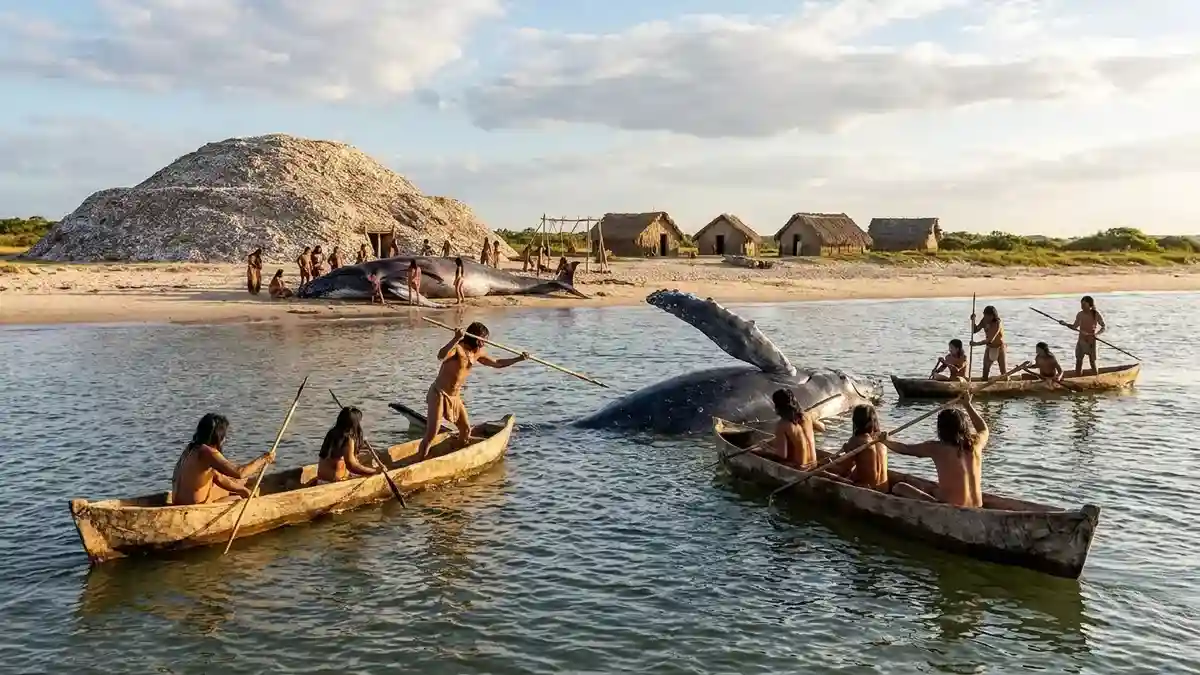
A groundbreaking study has completely upended the historical timeline of marine megafauna hunting. New archaeological evidence reveals that Indigenous populations in southern Brazil actively hunted large whales roughly 5,000 years ago. This discovery places complex whaling practices in the subtropical Atlantic a full millennium earlier than well-documented examples from the Arctic and North Pacific, shifting long-held theories on where and when these advanced maritime skills first emerged.
The research, published in Nature Communications, relies on a meticulous combination of biomolecular testing and structural analysis of ancient bones and weapons. The results show that early South American coastal societies possessed sophisticated maritime organization long before European contact.
Ancient Harpoons Reveal Prehistoric Whale Hunting in Brazil Happened 1,000 Years Earlier Than Thought

The Sambaqui Societies: Beyond Basic Fishing
The extraordinary discoveries were traced back to ancient coastal settlements known as sambaquis—massive shell mounds engineered over generations by Indigenous communities in Babitonga Bay, located in the southern Brazilian state of Santa Catarina.
For decades, conventional historical narratives categorized these sambaqui builders as simple hunter-gatherers who subsisted primarily on shellfish, small fish, and coastal foraging. However, the discovery of specialized whaling weaponry proves their economy was far more complex. Actively hunting massive cetaceans required seaworthy watercraft, durable specialized weaponry, long-term coastal stability, and highly coordinated crews working in unison.
Preserving History via Museum Archives
Because rapid modern urban development along the Brazilian coastline has destroyed many original sambaqui mounds, researchers from the Universitat Autònoma de Barcelona and partner institutions turned to legacy museum collections, primarily preserved at the Museu Arqueológico de Sambaqui de Joinville. By applying modern, high-tech diagnostic tools to artifacts excavated decades ago, the international team extracted revolutionary data that was technologically impossible to retrieve during the initial excavations.

High-Tech Identification of Marine Giants
The multi-institutional research team analyzed hundreds of ancient cetacean bones and bone-carved tools using an array of advanced scientific methods:
Zooarchaeology: Inspecting skeletal remains for physical alterations.
Typological Analysis: Classifying the exact design, shape, and intended function of crafted tools.
ZooMS (Zooarchaeology by Mass Spectrometry): Utilizing molecular species identification to analyze tiny peptide sequences in bone collagen, allowing precise identification of species that look identical as fragmented bone.

Through these methods, scientists successfully identified a diverse array of marine mammal remains, including southern right whales, humpback whales, blue whales, sei whales, sperm whales, and dolphins.
Anatomy of a 5,000-Year-Old Whaling Weapon
The definitive proof of active hunting—rather than the passive scavenging of occasionally stranded beach whales—lies within the recovered tool kits. Scientists identified fifteen distinct heavy harpoon components, including harpoon heads and foreshafts, meticulously carved from the sturdy ribs of large whales.
+-----------------------------------------------------------------+
|               ANCIENT HARPOON DESIGN FEATURES                   |
+-----------------------------------------------------------------+
|                                                                 |
|   [ Shaped Tip ] ======= [ Hollowed Socket ] === (Wooden Shaft) |
|   (For deep marine       (Engineered to fit                     |
|     penetration)          interlocking base)                    |
|                                                                 |
+-----------------------------------------------------------------+
These weapons featured advanced engineering characteristics explicitly designed to secure massive, thrashing marine prey. The bone foreshafts contained precisely hollowed-out sockets intended to cradle thick wooden shafts, alongside heavily tapered, shaped tips optimized for deep hide penetration.
Direct radiocarbon dating performed on two of these whale-bone harpoon foreshafts placed their construction between 4,710 and 4,970 years ago.
Scavengers vs. Hunters: The Evidence for Organized Whaling
To verify whether these communities were truly hunting or simply butchering dead whales that washed ashore, researchers analyzed the condition and distribution of the faunal remains. The evidence strongly points to an active, organized harvest:
Systematic Butchery Marks
A massive portion of the un-crafted whale bones recovered from the kitchen refuse piles displayed sharp, deep cut marks. These incisions match the precise physical patterns left behind by systematic butchering, skinning, and meat-stripping operations.
Deep Cultural Integration
Whale bones were not just treated as food waste; they held deep social and spiritual value. Archaeologists discovered whale bones deliberately arranged within human burial contexts inside the sambaquis. This indicates that successful whale hunts were monumental communal events, tied closely to ritual traditions, social status, and spiritual beliefs.
Staple Resource Balance
The vast majority of the analyzed whale bones came from everyday food refuse rather than ornamental carvings. This indicates that whale meat and blubber served as a predictable, staple resource for the community, rather than a rare, symbolic luxury.
Redrawing the Global Whaling Map
For over a century, the history of early whaling was viewed as a strictly northern phenomenon, deeply tied to cold or temperate environments. Prior archaeological frameworks highlighted early deer-bone harpoons in South Korea from 6,000 years ago, followed by Arctic and sub-Arctic whaling traditions clustering between 3,500 and 2,500 years ago.
The Babitonga Bay finds completely disrupt this geographic bias. By proving that advanced whaling was alive and well in a subtropical Atlantic climate nearly 5,000 years ago, this study demonstrates that complex maritime technologies evolved independently across different hemispheres and ecosystems.
Ecological Insights and Conservation Baselines
The molecular identification of the bones also provides critical historical baselines for modern marine ecology. The high concentration of humpback whale remains indicates that Babitonga Bay served as a major mid-Holocene breeding or calving ground.
In the modern era, humpback calving grounds are located much further north along the Brazilian coast, a shift caused by the near-total collapse of whale populations during industrial-era commercial whaling. The recent, encouraging rise in humpback sightings along Brazil’s southern shores may actually represent a long-term recolonization of ancient ancestral territories. Reconstructing these prehistoric ranges gives conservationists an accurate picture of what a fully recovered marine ecosystem should look like.
Conclusion
The 5,000-year-old harpoons of Santa Catarina prove that Brazil’s ancient coastal populations were not passive observers of the sea, but masters of it. Through shared labor, specialized engineering, and a profound understanding of cetacean migration patterns, these sambaqui societies successfully harvested the largest creatures on Earth—rewriting the global history of maritime innovation in the process.
Frequently Asked Questions
How do these harpoons change our understanding of history?
Previously, the oldest well-documented evidence of active, complex whale hunting came from northern, cold-water regions like the Arctic and North Pacific, dating back 2,500 to 3,500 years. The Brazilian harpoons push the timeline of active large-whale hunting back by at least 1,000 years and prove that advanced whaling techniques independently developed in a subtropical climate.
How do scientists know the Indigenous people didn’t just use naturally stranded whales?
While stranded whales were likely utilized, the presence of specialized hunting weaponry provides clear proof of active hunting. The site yielded fifteen distinct harpoon components (heads and foreshafts) specifically engineered with hollowed sockets to attach to wooden shafts and sharpened tips meant for deep penetration. Furthermore, the sheer volume of bones from specific inshore species points to an organized, targeted hunt near the coast.
What are sambaquis, and why are they important to this study?
Sambaquis are massive coastal shell mounds built over thousands of years by ancient Indigenous communities in Brazil. They served as domestic living spaces, disposal sites for food waste, and sacred burial grounds. The waterlogged and calcium-rich environment of these mounds helped preserve organic materials, like bone tools, that would normally rot away in acidic tropical soils.
What species of whales did the ancient Brazilians hunt?
Using biomolecular ZooMS testing, scientists identified a wide variety of marine mammals at the site, including humpback whales, southern right whales, blue whales, sei whales, sperm whales, and dolphins. Humpbacks and right whales were likely the primary targets because they frequently enter shallow, inshore waters to breed and calve, making them accessible to coastal hunters.
How does this archaeological discovery help modern whale conservation?
The high volume of prehistoric humpback whale bones in southern Brazil proves that this region was an essential breeding ground before industrial commercial whaling wiped out the population. This historical data helps modern marine biologists establish a more accurate conservation baseline, showing that recent increases in whale sightings in southern Brazil are actually a natural return to their ancient, native habitats.