
Table of Contents
- 1. The Gungervaa Shrine: A Lost Religious Tradition
- 2. A High-Tech Solution to a Fragile Problem
- 3. Decoding the Script: Technology Meets Ancient Wisdom
- 4. The Power of Non-Destructive Conservation
- 5. The Future of the Gungervaa Shrine
- 6. Frequently Asked Questions
- 6.1. What are dharani scrolls?
- 6.2. Why couldn’t the scrolls be unrolled physically?
- 6.3. What mantra was found on the scrolls?
- 6.4. How does virtual unrolling work?
- 6.5. What is the significance of the metal particles in the ink?
- 6.6. Where can I see the Gungervaa shrine?
Virtual Unrolling of Buddhist Scrolls Gives Historians Insights Into Lost Faith
For nearly a century, a collection of delicate, tightly wound scrolls remained sealed within the Gungervaa shrine, a relic of Mongolia’s nomadic religious past. These tiny, fragile rolls of paper were never intended to be opened; doing so would likely have crumbled the ancient material into dust. However, thanks to a pioneering fusion of high-energy physics and advanced digital imaging, these silent witnesses to history have finally been made to speak. Researchers in Berlin have successfully “virtually unrolled” these Buddhist artifacts, revealing sacred Sanskrit mantras that have been hidden away since the early 20th century.
This breakthrough not only rescues lost knowledge from the pages of history but also highlights how cutting-edge technology—originally designed for materials science and battery research—is revolutionizing the field of cultural heritage conservation.
Virtual Unrolling of Buddhist Scrolls Gives Historians Insights Into Lost Faith
The Gungervaa Shrine: A Lost Religious Tradition
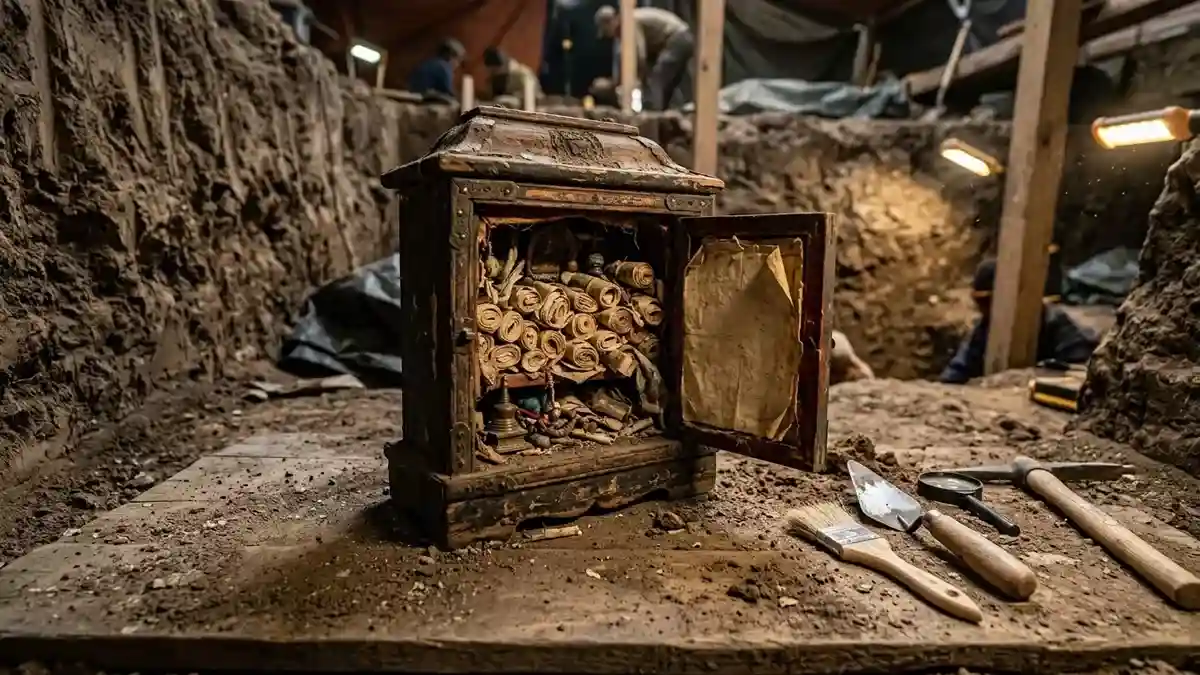
To understand the magnitude of this discovery, one must first appreciate the cultural significance of the Gungervaa shrine. In the context of Mongolian nomadic Buddhism, these shrines functioned as portable, spiritual anchors. They were intimate containers for the sacred, holding a variety of religious items including statues, votive fabric flowers, relics, and, crucially, dharani scrolls.
Dharani are specialized Buddhist mantras or phrases believed to possess protective and transformative powers. These scrolls were not meant to be read as books; they were objects of spiritual accumulation, handed down from generation to generation as blessings. They were the physical embodiments of prayers, intended to safeguard and consecrate the bearer or the household.
However, the history of these shrines is as turbulent as the history of the region itself. During the tumultuous years of Mongolia’s revolutionary period, between 1921 and 1930, the country underwent radical political and ideological shifts. In many regions, religious institutions were systematically targeted, and shrines were destroyed in an effort to eradicate traditional practices. As a result, the survival of this particular Gungervaa shrine is an anomaly. Finding scrolls that have remained intact and undisturbed for nearly a hundred years is a rarity that provides a precious link to a culture that was pushed to the brink of disappearance.
A High-Tech Solution to a Fragile Problem
The scrolls within this specific shrine were wrapped tightly in silk and stored in such a way that physical intervention was out of the question. Museum restorer Birgit Kantzenbach, who spearheaded the examination of the disordered shrine, faced a monumental dilemma: how to study the contents of the scrolls without destroying the very thing she aimed to preserve.
The structural integrity of the paper had been compromised by decades of time, humidity, and environmental fluctuations. Any attempt to physically unroll the scrolls would have been catastrophic. Recognizing the need for a non-destructive approach, Kantzenbach collaborated with physicist Tobias Arlt at the Helmholtz-Zentrum Berlin (HZB). They chose to bypass physical restoration entirely, opting instead for the power of 3D X-ray tomography.
The team utilized the BESSY II synchrotron facility, a massive particle accelerator complex capable of generating high-brilliance X-rays. By placing the scrolls within the BAMline at BESSY II, the researchers could capture high-resolution images of the internal structures of the scrolls, layer by layer, winding by winding. This is essentially the same technology used in medical CT scans, but calibrated with the extreme precision necessary to distinguish between layers of paper that are incredibly thin and brittle.
Decoding the Script: Technology Meets Ancient Wisdom
Once the 3D data was captured, the challenge shifted from physics to computation. A single scroll contained approximately 50 dense windings. Unraveling these digital layers required sophisticated software. Using Amira software, the team at the Konrad Zuse Institute developed a complex workflow to digitally flatten the scrolls. To manage the sheer volume of data, they employed artificial intelligence to accelerate the process, identifying the curves and folds of the paper to “unwrap” them into a legible two-dimensional surface.

The results were astonishing. As the digital scroll unspooled, traces of ink became visible. The researchers were able to identify the famous Buddhist mantra: “Om mani padme hum.” This is one of the most significant and widely recognized mantras in Tibetan Buddhism, associated with Avalokiteshvara, the embodiment of compassion.
However, the discovery carried a linguistic twist that surprised the experts. While the mantra itself was in Sanskrit—the liturgical language of early Buddhism—it was written using Tibetan characters. This blending of traditions speaks to the complex religious landscape of Mongolia, where Tibetan Buddhist influence was profound.
Furthermore, the team made an unexpected material discovery. While analyzing the ink traces, they observed that the ink did not behave like traditional carbon-based Chinese soot ink. Instead, the images suggested that the ink contained metal particles. This raises intriguing questions about the artisan who created the scroll: Did they use a specific metallic pigment for its durability, for its aesthetic shimmer, or perhaps for its ritual significance? This is a detail that would likely have remained hidden forever had the scroll been unrolled using conventional physical methods.
The Power of Non-Destructive Conservation
The success of the Berlin project serves as a masterclass in modern conservation ethics. It demonstrates that the future of archaeology is increasingly digital. By utilizing methods derived from battery research and materials science, institutions can perform “virtual excavations” that leave the original artifacts entirely untouched.
This project was not merely a technical exercise; it was an act of cultural recovery. As Tobias Arlt noted, the process is laborious and requires intense collaboration between physicists, computer scientists, and museum professionals, but the payoff is immense. It allows historians to access sacred texts that were effectively lost to time without compromising their physical or spiritual integrity. For the Buddhist community, this preservation is vital, as it respects the sanctity of the object while expanding our collective human knowledge.
The Future of the Gungervaa Shrine
The Gungervaa shrine and its contents, including the now-digitally-readable scrolls, are currently on public display at the Humboldt Forum in Berlin. The exhibition, titled Restoration in Dialogue, invites the public to witness not only the artifacts themselves but also the sophisticated restoration and imaging processes that brought them back into the light. The exhibition is scheduled to run until June 1, 2026.
Following the conclusion of the exhibition, museum officials have outlined plans to return the shrine to Mongolia. This repatriation is a crucial final step, ensuring that this piece of Mongolian heritage is once again accessible to the people and the culture from which it originated. The digital records created by the Berlin team will remain as a lasting scientific legacy, ensuring that the “Om mani padme hum” mantra and the secrets of the scroll are preserved for future generations, even after the physical object returns home.
Frequently Asked Questions
What are dharani scrolls?
Dharani scrolls are small, tightly rolled papers inscribed with Buddhist mantras or sacred phrases. In many Buddhist traditions, they are considered to be vehicles of spiritual power and are stored within shrines or statues to provide protection, blessings, and consecration to the site.
Why couldn’t the scrolls be unrolled physically?
Physical unrolling was deemed too risky. Because the scrolls are extremely old and fragile, the paper had become brittle over time. Attempting to manually flatten or open them would have almost certainly resulted in the material fracturing or crumbling into dust, destroying the text forever.
What mantra was found on the scrolls?
The researchers discovered the mantra “Om mani padme hum,” one of the most sacred and widely recited mantras in Tibetan Buddhism. The text was unique because, although the language was Sanskrit, it was transcribed using Tibetan characters.
How does virtual unrolling work?
Virtual unrolling uses 3D X-ray tomography, similar to a medical CT scan. The scroll is placed in an X-ray beam, and the scanner takes thousands of images from different angles. Powerful software then reconstructs these images into a 3D model, allowing researchers to “peel away” the layers of the paper digitally without ever touching the original artifact.
What is the significance of the metal particles in the ink?
The presence of metal particles in the ink is a significant finding because traditional Buddhist ink was typically made from soot and animal glue. The use of metallic ink suggests a deliberate choice by the scribe, potentially for increased longevity, decorative effect, or to add extra ritual value to the mantra inscribed on the scroll.
Where can I see the Gungervaa shrine?
The shrine is currently part of the Restoration in Dialogue exhibition at the Humboldt Forum in Berlin, Germany. The exhibition is open to the public until June 1, 2026, after which plans are in place to return the shrine to Mongolia.