
Table of Contents
- 1. An Accidental Discovery in the Heart of the Jungle
- 1.1. Navigating Untracked Wilderness
- 2. Decoding the Ancient Art: Geometric Lines and Three-Finger Motifs
- 2.1. The Symbolic Engravings
- 3. Contextualizing Thailand’s Enigmatic Metal Age
- 4. Mapping a Broader Network of Prehistoric Activity
- 5. The Intersection of Conservation and Cultural Heritage
- 6. Conclusion: A Protected Treasure Awaiting Scientific Analysis
- 7. Frequently Asked Questions
- 7.1. Where exactly was the new cave discovered?
- 7.2. How old is the rock art inside Ta Kueng Cave?
- 7.3. What do the carvings inside the cave look like?
- 7.4. Who discovered the cave?
- 7.5. Is Ta Kueng Cave open to public tourism?
2,000-Year-Old Rock Art Found in Hidden Thai Cave
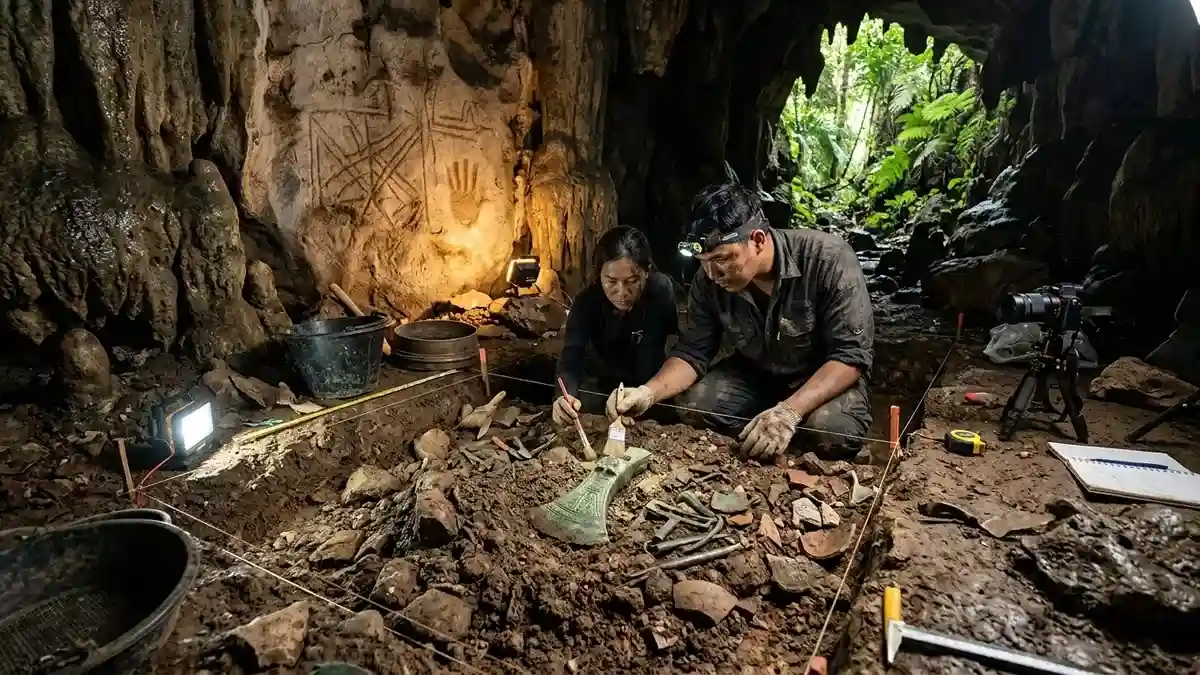
A routine anti-poaching patrol through a densely forested wildlife sanctuary in northern Thailand has led to an extraordinary archaeological discovery. Deep within the rugged wilderness of the Khao Noi–Khao Pradu Wildlife Sanctuary, located in the Phitsanulok province, park rangers have stumbled upon an uncharted sandstone cave containing remarkably preserved prehistoric rock art.
The site, officially designated as Tham Ta Kueng (Ta Kueng Cave), houses ancient engravings and petroglyphs estimated to be roughly 2,000 years old. Experts believe this hidden sanctuary could completely reshape our current understanding of prehistoric human migration, settlement patterns, and spiritual practices within the Khwae Noi River basin.
2,000-Year-Old Rock Art Found in Hidden Thai Cave

An Accidental Discovery in the Heart of the Jungle
The remarkable find occurred during a standard three-day forest patrol conducted by a dedicated team of rangers from the Phu Khat Wildlife Sanctuary. The expedition was originally planned to monitor local wildlife populations and deter illegal poaching operations across the hyper-diverse Khwae Noi River basin, an area celebrated for its dense, pristine ecosystems.
Navigating Untracked Wilderness
The rangers were navigating a remote sector of the sanctuary when they encountered a hidden sandstone rock formation shrouded in thick tropical vegetation. Key features of the location include:
Extreme Isolation: The cave is situated approximately two kilometers deep in the jungle from the nearest sanctuary headquarters.
No Trails: There are zero human tracks or established paths leading to the site. The area is so well concealed that it is reachable only by navigating thick undergrowth using GPS coordinates.
Natural Concealment: The mouth of the cave was entirely masked by decades of natural forest growth, keeping it perfectly protected from modern human interference and vandalism for centuries.
Upon stepping inside the sandstone cavity, the rangers noticed distinct, unnatural markings carved directly into the stone walls, prompting them to document the coordinates and alert regional heritage authorities immediately.
Decoding the Ancient Art: Geometric Lines and Three-Finger Motifs
Following the initial report, specialists from the Fine Arts Office 6 in Sukhothai—the governmental body responsible for preserving Thailand’s cultural artifacts—were brought in to conduct a preliminary analysis of the markings.
The Symbolic Engravings
While the total number of engravings inside Ta Kueng Cave is relatively small, their structural integrity remains exceptionally high due to the cave’s stable, sheltered microclimate. Archaeologists have highlighted two main artistic styles present on the walls:
Complex Geometric Patterns: Symmetrical linear arrangements and interconnected grid-like motifs that are highly characteristic of early tribal symbolic languages.
The Three-Finger Motif: A highly distinctive engraving depicting a hand-like or claw-like shape featuring only three fingers. This specific iconographic element has sparked intense curiosity among researchers, as hand stencils and abstract digital prints from this era often carry deep ritualistic, territorial, or spiritual meaning.
Contextualizing Thailand’s Enigmatic Metal Age
Preliminary estimates suggest that the artwork dates back to Southeast Asia’s Metal Age—a critical transitional era spanning the Bronze and Iron Ages, occurring centuries before the dawn of written Thai history.
During this period, early human communities in what is now Thailand were transitioning from nomadic hunter-gatherer lifestyles toward settled agricultural societies. These populations mastered advanced metallurgy, established extensive regional trade networks, and developed complex spiritual belief systems.
The Khwae Noi River basin, with its abundant freshwater resources and fertile soils, would have been an ideal environment for these early communities. The presence of sacred rock art in a secluded cave suggests that the landscape was heavily utilized not just for survival, but for spiritual or communal rituals designed to appease nature spirits or mark territorial boundaries.
Mapping a Broader Network of Prehistoric Activity
The discovery of Ta Kueng Cave does not stand entirely alone; rather, it adds a massive piece to an emerging regional puzzle. In recent years, independent teams of archaeologists have uncovered similar prehistoric rock art at the nearby Pratu Mueang Cliff, alongside several smaller satellite sites scattered across northern Thailand.
When mapped together, these sites indicate a widespread, interconnected network of early human activity flowing throughout the Phitsanulok province. The recurring themes in regional rock art suggest that these early societies shared a cohesive cultural or religious identity, moving through the valleys and using these hidden sandstone caves as permanent landmarks for ritualistic gatherings, seasonal shelters, or sacred burial zones.
The Intersection of Conservation and Cultural Heritage
For regional authorities, the discovery of Ta Kueng Cave serves as a powerful reminder of the dual value of environmental conservation. Regular, intensive forest patrols do far more than just guard endangered wildlife; they actively safeguard the hidden, physical archives of human history.
“The cave is a significant natural resource, and it remains a vital cultural and historical landmark,” stated Mongkol Khamsuk, the head of the Phu Khat Wildlife Sanctuary. “More comprehensive research will enable us to know more about the stories of this land, its unique ecosystems, and the ancient people who may have lived here in the past.”
The Department of National Parks, Wildlife and Plant Conservation (DNP) echoed this enthusiasm, branding the find as a major breakthrough for Thai archaeology that opens up a brand-new dimension of specialized field research.
Conclusion: A Protected Treasure Awaiting Scientific Analysis
To prevent looting and preserve the fragile state of the engravings, the exact location of Ta Kueng Cave remains heavily guarded by park rangers and hidden by the natural jungle canopy. In the coming months, a multi-disciplinary team consisting of professional archaeologists, geologists, and epigraphers is scheduled to enter the cave to execute high-resolution 3D scanning, soil sampling, and pigment analysis.
Until then, the silent walls of Ta Kueng Cave stand as an enduring monument to Thailand’s deep past, proving that the country’s untamed wilderness still holds profound secrets about the origins of human expression.
Frequently Asked Questions
Where exactly was the new cave discovered?
The cave, named Tham Ta Kueng (Ta Kueng Cave), was discovered deep within the Khao Noi–Khao Pradu Wildlife Sanctuary in the Phitsanulok province of northern Thailand, situated within the fertile Khwae Noi River basin.
How old is the rock art inside Ta Kueng Cave?
Initial archaeological assessments estimate that the rock engravings are approximately 2,000 years old, placing their creation squarely within Southeast Asia’s prehistoric Metal Age, centuries before written records began in Thailand.
What do the carvings inside the cave look like?
The artwork primarily consists of two distinct styles: intricate geometric line patterns and a unique, stylized three-finger hand or claw pattern etched directly into the cave’s natural sandstone walls.
Who discovered the cave?
The site was discovered accidentally by a team of wildlife rangers from the Phu Khat Wildlife Sanctuary during a routine, three-day forest patrol aimed at preventing illegal poaching and monitoring local biodiversity.
Is Ta Kueng Cave open to public tourism?
No. To preserve the fragile engravings from humidity changes, oil contamination from human hands, and potential vandalism, the cave is currently closed to the public and remains protected by forest law while scientific teams prepare for formal excavations.