
Table of Contents
- 1. The Discovery Near the Wholesale Market
- 2. Hierapolis: The Sacred City of the Syrian Goddess
- 2.1. The Cult of Atargatis
- 3. A Decade of Chaos: The Tragedy of Syrian Looting
- 4. The Smuggling Pipeline: How Manbij Became a Trade Hub
- 4.1. The Evolution of Black-Market Plunder
- 5. Conclusion: A New Chapter for Syrian Heritage
- 6. Frequently Asked Questions
- 6.1. What exactly was found in Manbij, Syria?
- 6.2. What was the original purpose of this stone stele?
- 6.3. What was Manbij called in ancient times?
- 6.4. Why is there a Greek inscription on a Roman monument in Syria?
- 6.5. How has the Syrian Civil War affected the country’s ancient artifacts?
Ancient Inscription Found in Syria Marks Major Cultural Win
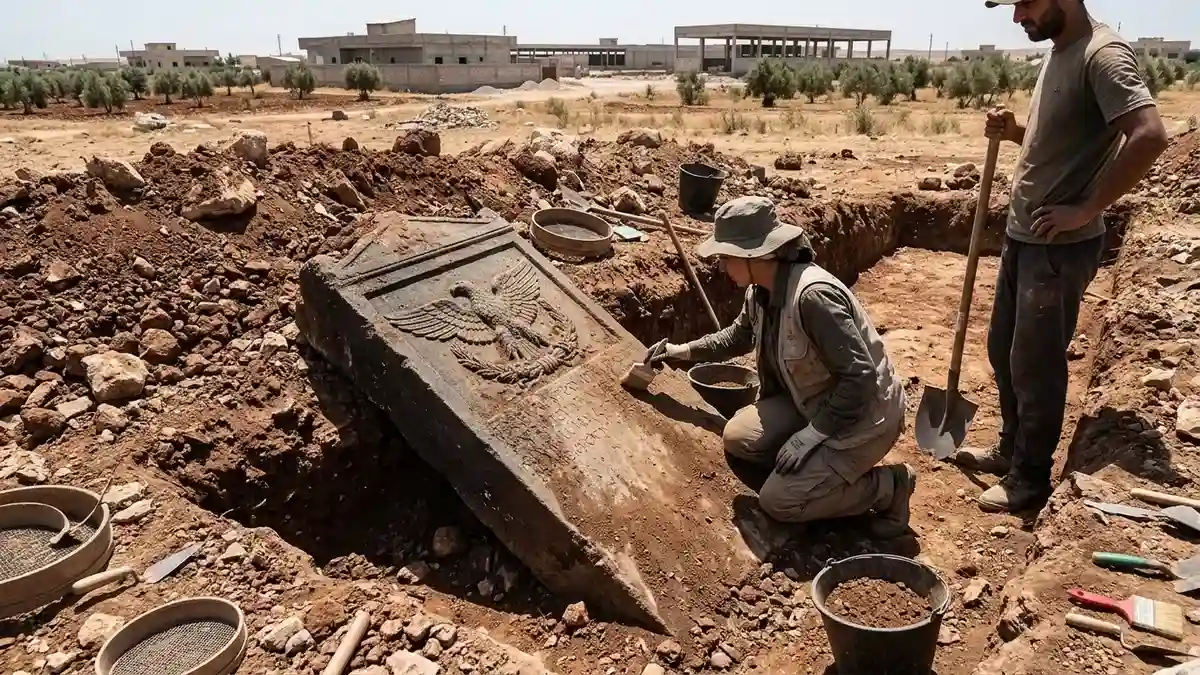
Against all odds, a breathtaking piece of the ancient Mediterranean world has emerged from the war-torn soil of northern Syria. In the bustling city of Manbij, located east of Aleppo, a local resident accidentally stumbled upon a stunning, 2,000-year-old Roman-era stele (an upright stone slab used as a monument or marker).
Carved from dense, dark volcanic basalt, the monumental slab features an eagle with outspread wings clutching a ritual wreath in its talons, accompanied by a beautifully preserved Greek inscription. For a country that has seen its ancient history systematically looted and destroyed over the last fifteen years, this surprise recovery stands as a monumental victory for global heritage preservation.
Ancient Inscription Found in Syria Marks Major Cultural Win
The Discovery Near the Wholesale Market
The initial discovery occurred entirely by chance near Manbij’s bustling Cardamom wholesale market. Recognizing that the heavy black stone bore the markings of an ancient civilization, the finder immediately notified the Directorate of Museums and Antiquities.
An expeditionary team was quickly deployed to the busy commercial district to secure and excavate the artifact. At present, local authorities are guarding the stone locally, completing preliminary documentation before its scheduled transfer to the museum facilities in Aleppo for deep academic study and professional conservation.
Preliminary analysis by epigraphers (scholars who study ancient inscriptions) and archaeologists suggests that the 60-centimeter-tall stone functioned as a funerary marker during the height of the Roman Empire. The combination of the imperial eagle—a symbol often linked to power, protection, and the journey of the soul to the heavens—with Greek text was a common artistic style among wealthy families in the Roman East.
Hierapolis: The Sacred City of the Syrian Goddess
To truly understand the historical weight of this artifact, one must look at the deeply layered history of Manbij itself. Long before Roman legions marched into Syria, the city was a thriving urban hub. Known in earlier centuries as a vital cultural center for the Aramaic and Assyrian civilizations, the settlement underwent a dramatic transformation following the conquests of Alexander the Great.
Under the subsequent Greek Seleucid dynasty, the city was renamed Hierapolis, which translates literally from Greek as the “Sacred City.” It quickly evolved into one of the most famous spiritual sanctuaries in the ancient Near East, drawing thousands of pilgrims from across the Mediterranean basin.
The Cult of Atargatis
Hierapolis owed its immense fame and wealth to the massive temple complex of Atargatis, the great Syrian fertility and water goddess. The temple grounds featured a sacred lake filled with untouched fish, towering phallic pillars, and a highly organized priesthood.
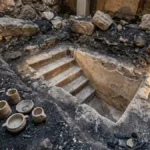
The bizarre, ecstatic rituals held within the city were famously documented by Lucian of Samosata, a Syrian-born Roman essayist of the 2nd century CE. In his famous treatise De Dea Syria (“On the Syrian Goddess”), written in Ionic Greek, Lucian described a bustling, multi-cultural metropolitan center where religious devotion blended seamlessly with international trade—a historical reality perfectly mirrored by the discovery of this newly unearthed Greek inscription.
A Decade of Chaos: The Tragedy of Syrian Looting
The recovery of the basalt stele is a rare bright spot in what has otherwise been a catastrophic era for Middle Eastern archaeology. Since the outbreak of the Syrian civil war, the country’s ancient sites have been treated as open-air strip mines for international antiquities smuggling.
The Directorate-General of Antiquities and Museums estimates that between 2011 and 2019, up to one million individual artifacts were illegally plundered from Syrian soil, with more than 700 major archaeological sites suffering severe, irreversible damage from bulldozers and amateur treasure hunters.
The Smuggling Pipeline: How Manbij Became a Trade Hub
Because of its strategic geographic location near the Turkish border and major regional highway networks, Manbij unfortunately evolved into a primary staging area and black-market clearinghouse for illicit antiquities. As control of the city shifted across various factions throughout the conflict, the exploitation of history shifted as well.
The Evolution of Black-Market Plunder
The Pre-War Regime Era: Prior to 2011, illegal excavations were tightly monopolized and controlled by highly connected, corrupt elites within the political establishment.
The Rebel Fracturing (2012): When the Free Syrian Army captured the city, centralized control dissolved entirely. Looting became an chaotic free-for-all as impoverished locals dug up surrounding fields to survive the economic collapse.
The ISIS Licensing Scheme (2014): When Islamic State forces seized Manbij, they industrialized the plunder. The group created an official bureaucratic licensing system, allowing locals to dig provided they paid a heavy tax on their finds. Artifacts featuring human or animal imagery were systematically confiscated—some were smashed for propaganda, while others were secretly sold to Western markets through underground pipelines.
The Modern Era (2016–Present): Following the capture of the city by the Syrian Democratic Forces (SDF), illegal digging shifted again. Local military figures and their civilian associates took control of major historical sectors, demanding cuts of up to 60 percent of an artifact’s value to traffic it across the border.
Throughout this period, Manbij functioned as a massive warehouse hub where stolen treasures from world-famous sites like Palmyra, Raqqa, and Hasakah were consolidated before being illegally smuggled into regional neighboring countries and international private collections.
Conclusion: A New Chapter for Syrian Heritage
The successful rescue of the Roman eagle stele represents a crucial turning point for local preservation efforts. Rather than vanishing into the shadow economy of international smuggling, this priceless piece of Hierapolis’s history will remain in public hands where it belongs.
The recovery was made possible in part by the newly established Archaeological Office in Manbij, a local initiative dedicated to cataloging, restoring, and protecting the city’s remaining historical architecture. By saving this single block of basalt, local communities are proving that even after years of war, the roots of Syria’s ancient heritage run too deep to be erased.
Frequently Asked Questions
What exactly was found in Manbij, Syria?
Archaeologists recovered a 2,000-year-old Roman-era stone stele made of heavy black basalt. The stone features a detailed carving of an eagle spreading its wings while holding a wreath, alongside an ancient Greek inscription.
What was the original purpose of this stone stele?
Historical experts believe the stone served as a funerary marker (a tombstone) for a wealthy or prominent citizen living in the region during the Roman Empire, as the eagle was a common symbol used to represent the soul’s journey to the afterlife.
What was Manbij called in ancient times?
In the ancient Greek and Roman worlds, the city was known as Hierapolis, which means “Sacred City.” It was a massive commercial hub and a highly revered pilgrimage destination, famous for its massive temple complex dedicated to the Syrian fertility goddess Atargatis.
Why is there a Greek inscription on a Roman monument in Syria?
Following the conquests of Alexander the Great, the Greek Seleucid dynasty ruled Syria for centuries, making Greek the dominant language of administration, culture, and trade across the eastern Mediterranean. Even after the Roman Empire conquered the region, Greek remained the primary written language for locals in Syria.
How has the Syrian Civil War affected the country’s ancient artifacts?
The conflict has been devastating for global heritage. It is estimated that up to one million artifacts were illegally looted and smuggled out of Syria between 2011 and 2019 alone, with over 700 historic sites severely damaged by illegal digging, military combat, and industrial-scale theft.