
Table of Contents
- 1. The Prehistoric Lakeside Oasis of Marathousa 1
- 1.1. How Nature Preserved Organic History
- 2. A Detailed Look at the Ancient Wooden Artifacts
- 2.1. The Alder Digging Stick (Specimen ID 39)
- 2.2. The Miniaturized Finger Tool (Specimen ID 13)
- 2.3. A Mysterious Third Specimen
- 3. Coexisting with Apex Predators: The Bear Evidence
- 4. Redefining the Paleolithic Timeline
- 5. Conclusion
- 6. Frequently Asked Questions
- 6.1. What makes the Marathousa 1 wooden tools so significant to history?
- 6.2. Why did these specific wooden tools survive for nearly half a million years?
- 6.3. What types of trees were used to create these ancient tools?
- 6.4. What were the functions of the discovered wooden tools?
- 6.5. What does the bear claw evidence tell us about early human life?
430,000-Year-Old Wooden Tools Discovered in Greece Alter History
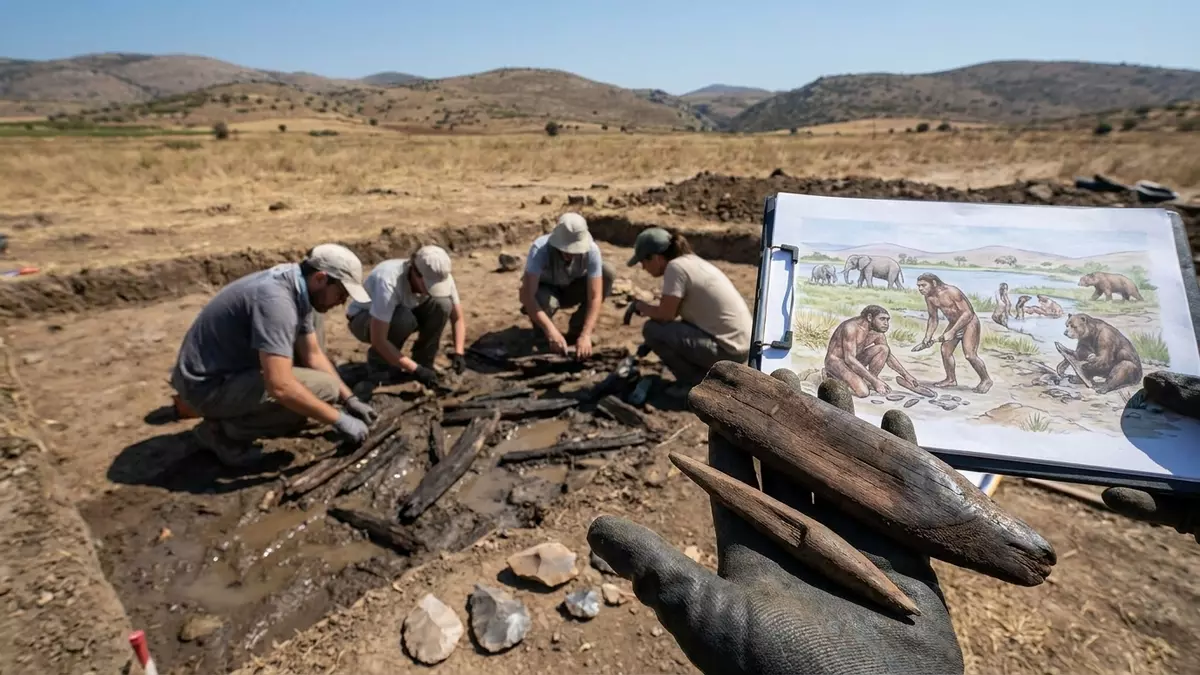
An extraordinary archaeological breakthrough in southern Greece has rewritten our understanding of early human ingenuity. Excavators working at the Marathousa 1 site in the Megalopolis Basin have unearthed the oldest known handheld wooden tools in human history. Dated to approximately 430,000 years ago, these remarkably well-preserved artifacts push the known timeline for shaped wooden implements back by at least 40,000 years, offering an unprecedented glimpse into the technical skills of Middle Pleistocene hominins.
The discovery, published in the Proceedings of the National Academy of Sciences (PNAS), provides the earliest definitive evidence of ancient humans shaping wood for specific, handheld tasks in southeastern Europe. The findings suggest that our ancient ancestors possessed a sophisticated understanding of natural materials long before previously thought.
430,000-Year-Old Wooden Tools Discovered in Greece Alter History
The Prehistoric Lakeside Oasis of Marathousa 1
During the Middle Pleistocene—a geological epoch spanning from roughly 774,000 to 129,000 years ago—the Megalopolis Basin in the central Peloponnese looked vastly different than it does today. Marathousa 1 was once a thriving lakeshore environment, teeming with wildlife and rich plant resources.
Archaeologists have established that early humans repeatedly visited this ancient waterfront. The site has yielded an abundance of archaeological treasures, including sharp stone flakes and animal bones bearing distinct butchery cut marks. Notably, the remains of an ancient straight-tusked elephant indicate that these hominins were highly capable of processing massive animal carcasses near the water’s edge.
How Nature Preserved Organic History
Wooden artifacts from half a million years ago are vanishingly rare because organic matter typically rots away within decades. The survival of the Marathousa tools is entirely due to unique geological conditions:

Waterlogged Sediments: The ancient lakeshore environment buried dropped items quickly in wet mud.
Anoxic Environment: The heavy, water-saturated layers created a low-oxygen environment.
Microbial Arrest: Without oxygen, the bacteria and fungi responsible for wood decay could not survive, effectively freezing the wooden fragments in time.

A Detailed Look at the Ancient Wooden Artifacts
To separate genuine human craftsmanship from natural wear and tear—such as damage caused by animal activity, root growth, or shifting sediment pressure—researchers subjected dozens of recovered wood fragments to rigorous microscopic analysis. They evaluated internal cellular structures, wood species, and superficial surface markings.
Ultimately, three specific fragments stood out, revealing a complex story of human survival, tool manufacturing, and ecological competition.
The Alder Digging Stick (Specimen ID 39)
The first major artifact is fashioned from alder wood, a tree species known for thriving in damp, riparian zones. Microscopic examination revealed clear cut marks across its surface, left behind by ancient stone tools used to shave and shape the branch.
Furthermore, the tool features distinctly rounded, smoothed edges on one end. This specific wear pattern is consistent with repeated, forceful friction against soil. Researchers conclude that this implement served as a prehistoric digging stick, an essential piece of foraging technology used to loosen compacted wet earth, harvest nutritious underground roots and tubers, or dig for freshwater resources along the lake margin.
The Miniaturized Finger Tool (Specimen ID 13)
The second breakthrough discovery is a remarkably small artifact crafted from either willow or poplar wood. This diminutive piece features intentionally carved margins and localized smoothing, which micro-wear analysis attributes to consistent contact with human skin.
Because of its tiny dimensions, experts believe this was a finger-held precision tool. Hominins likely utilized this micro-implement for delicate, high-dexterity tasks. A primary theory suggests it was used as a pressure flaker or a modifier to fine-tune and sharpen the edges of stone flakes during the production of lithic weaponry and butchery tools.
A Mysterious Third Specimen
Archaeologists also identified a third distinct wooden object during the sorting process. While its exact initial utility remains a subject of ongoing research, its unique surface characteristics have provided profound context regarding the daily hazards faced by Middle Pleistocene humans.
Coexisting with Apex Predators: The Bear Evidence
The third alder fragment offered a dramatic twist to the excavation narrative. Rather than showing exclusive signs of human modification, the microscopic analysis of this piece revealed deep, parallel grooves running crosswise across the grain, accompanied by severely crushed plant fibers along the borders of the marks.
Scientists successfully matched these indentations to the claw and bite signatures of a large carnivore, most likely a prehistoric bear species.
Ecological Insight: The presence of both hominin butchery marks on elephant bones and carnivore damage on wood at the exact same sedimentary layer proves that early humans and apex predators shared the Marathousa lakeshore.
This spatial overlap indicates intense environmental competition. Ancient humans processing megafauna carcasses had to remain constantly vigilant, defending their calorie-rich kills from massive opportunistic scavengers and predators drawn to the waterfront.
Redefining the Paleolithic Timeline
Prior to the validation of the Marathousa 1 artifacts, the oldest known handheld wooden tools came from scattered paleolithic sites across Africa, Asia, and Europe, all of which dated to periods significantly more recent than 430,000 years ago.
While an older wooden structure discovered at Kalambo Falls in Zambia dates back roughly 476,000 years, that find represents stationary, interlocking logs interpreted as part of a permanent dwelling or walkway rather than a mobile, handheld implement. Therefore, the Greek discoveries represent a massive leap forward in our understanding of personal, portable technology.
The discovery proves that early humans possessed:
Selective Harvesting Skill: They specifically selected tree species like alder, willow, and poplar based on their unique structural flexibility and weight.
Multidisciplinary Crafting: Hominins seamlessly combined stone, bone, and wooden technologies to maximize their foraging efficiency.
Adaptive Innovation: The creation of customized, task-specific tools shows a capacity for abstract planning and problem-solving.
Conclusion
The 430,000-year-old wooden tools from Marathousa 1 challenge traditional narratives of human evolution by demonstrating that Middle Pleistocene hominins were not merely primitive hunters relying on basic stones. Instead, they were resourceful artisans with a deep comprehension of the botanical world. By masterfully shaping local timber to create both robust digging sticks and delicate precision instruments, these early humans secured their survival in a high-stakes, predator-dense paradise.
Frequently Asked Questions
What makes the Marathousa 1 wooden tools so significant to history?
The Marathousa 1 tools are the oldest known handheld wooden implements ever discovered, dating back 430,000 years. They extend the documented timeline of human wooden tool craftsmanship by at least 40,000 years and offer the earliest evidence of this technology in southeastern Europe.
Why did these specific wooden tools survive for nearly half a million years?
Wood normally decomposes rapidly due to fungi and bacteria. These tools survived because they were discarded in the waterlogged lakeshore sediments of the Megalopolis Basin. The mud created a sealed, low-oxygen (anoxic) environment that prevented the microorganisms responsible for decay from destroying the organic material.
What types of trees were used to create these ancient tools?
The tools were made from tree species that naturally grew in wet, lakeside environments, specifically alder, willow, and poplar. This indicates that early humans deliberately selected specific local timbers based on their availability and physical properties.
What were the functions of the discovered wooden tools?
The larger alder tool features smoothed, rounded wear patterns indicating it was used as a digging stick to extract roots, tubers, or water from the earth. The smaller willow or poplar tool was designed to be held by the fingers, likely used for intricate tasks such as shaping and sharpening stone tools.
What does the bear claw evidence tell us about early human life?
One of the recovered alder fragments features deep parallel grooves made by a large carnivore, likely a bear. This confirms that early humans and dangerous apex predators frequented the exact same lakeshore areas, suggesting they competed directly for access to water and large animal carcasses, such as the straight-tusked elephants found at the site.