
Table of Contents
- 1. The Discovery at Thung Binh Cave
- 2. Forensic Reconstruction of a Prehistoric Crime Scene
- 3. Surviving the Strike: A Story of Ancient Nursing Care
- 4. Mapping the Genetics of Prehistoric Vietnam
- 5. Conclusion
- 6. Frequently Asked Questions
- 6.1. How old is the skeleton found in the Vietnamese cave?
- 6.2. Where exactly was this archaeological discovery made?
- 6.3. How did the prehistoric hunter-gatherer die?
- 6.4. Why does this discovery change our view of Southeast Asian history?
- 6.5. What did the DNA testing reveal about this ancient individual?
12,000-Year-Old Quartz Arrowhead Uncovers Prehistoric Violence in Vietnam
A spectacular archaeological discovery in northern Vietnam has provided the earliest definitive proof of deadly interpersonal violence ever documented in mainland Southeast Asia. Digging deep into a prehistoric cave system, an international team of scientists recovered the remarkably well-preserved skeleton of a young hunter-gatherer who was struck down by a high-velocity projectile point. While ancient conflict has been heavily studied across Europe and the Americas, this groundbreaking find offers an unprecedented look into the dark realities of tribal warfare, communal medical care, and human migration at the tail end of the last Ice Age.
The comprehensive study, published in the prestigious journal Proceedings of the Royal Society B: Biological Sciences, details how the prehistoric victim survived the initial, brutal attack. However, the deeply embedded stone weapon triggered a catastrophic, slow-moving infection that ultimately claimed his life months later. The find is challenging old anthropological assumptions about early hunter-gatherer societies, proving that early human life in the tropics was marked by a complex mix of tribal warfare and profound communal compassion.
12,000-Year-Old Quartz Arrowhead Uncovers Prehistoric Violence in Vietnam
The Discovery at Thung Binh Cave
The physical setting for this historical milestone is the Thung Binh 1 cave, nestled safely within the breathtaking limestone karsts of the Tràng An Landscape Complex. Located in the Ninh Bình Province of northern Vietnam, Tràng An is celebrated globally as a UNESCO World Heritage site due to its dense concentration of prehistoric human occupation layers.
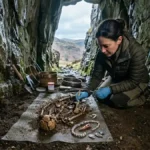
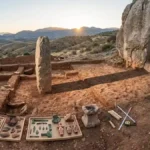
The ancient skeleton, cataloged by researchers under the registration name TBH1, was originally brought to light during a meticulous series of field excavations stretching between late 2017 and early 2018. When the archaeological team cleared away the deep layers of Terminal Pleistocene sediment, they discovered the man’s body placed carefully in a tight, fetal position with his face resting gently on his cupped hands.
This specific positioning is highly significant. Rather than the careless concealment of a murder victim, the intentional posture proves that the deceased was given a deeply respectful, deliberate burial by his immediate community. Although the weight of the shifting cave earth had completely collapsed his skull over the millennia, specialized lab technicians successfully reassembled the fragments of his cranium and teeth, revealing a nearly complete anatomical blueprint.
 Ancient Shamanic Mask Unveils Hidden Dynamic Between Europe’s First Farmers and Hunter-Gatherers
Forensic Reconstruction of a Prehistoric Crime Scene
Forensic mapping indicates that TBH1 was approximately 35 years old—a mature adult for his era—when he met his violent fate toward the end of the Terminal Pleistocene, roughly 12,000 to 12,500 years ago. An exhaustive osteological examination of his skeletal framework quickly yielded an unexpected anatomical anomaly: the man possessed a supernumerary cervical rib, meaning he had an extra rib growing near the base of his neck. This rare congenital condition is present in less than one percent of the modern human population.
It was precisely within this ultra-rare extra rib that the forensic evidence of a brutal attack came to light. The bone tissue around the neck rib displayed severe signs of localized trauma and advanced infection, characterized by a distinct drainage gap or hollow channel formed over time by the accumulation and exit of pus.
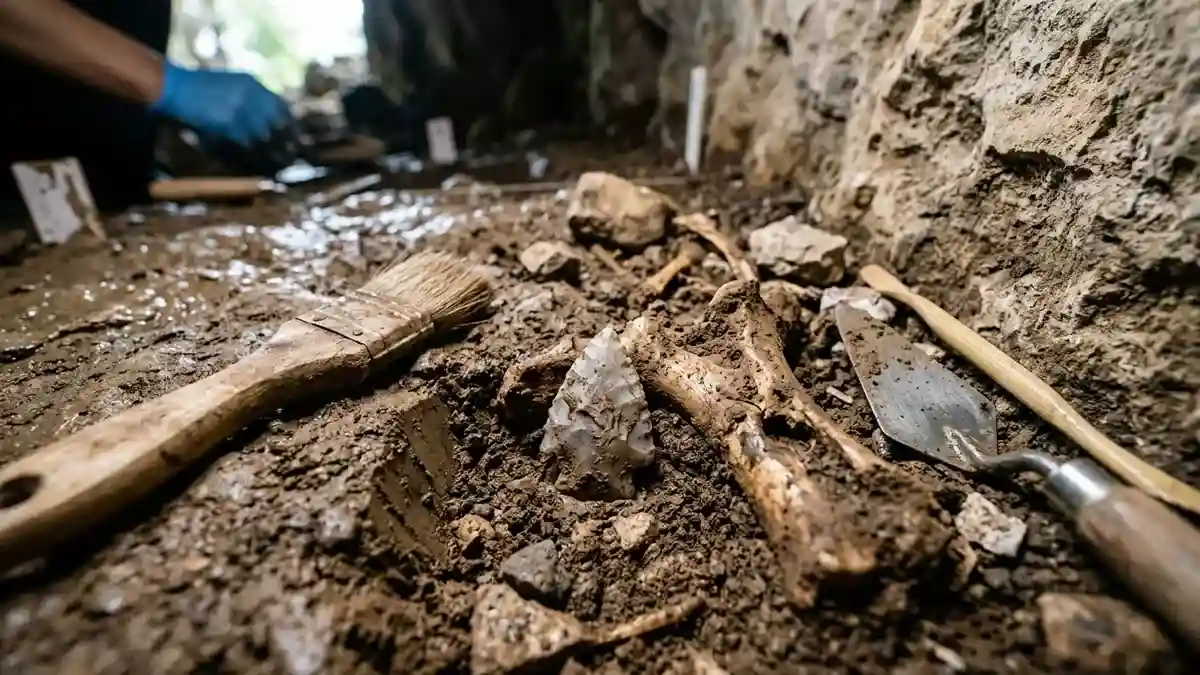
Resting directly adjacent to this compromised bone, investigators discovered a miniature, triangular flake of pure quartz measuring no longer than 18 millimeters (about 0.7 inches). A microscopic examination of the quartz revealed deliberate, human-made modifications, including notched edges indicating that it had functioned as a lethal barb attached to a fast-moving projectile shaft, such as an arrow or a hunting dart.
Surviving the Strike: A Story of Ancient Nursing Care
According to study co-author Christopher Stimpson, a zooarchaeologist at the Natural History Museum in London, the precise trajectory of the embedded stone fragment proves that the attacker shot the man directly in the front of his neck or upper chest. The arrow sliced through muscle tissue and slammed hard into the base of his throat, fracturing the extra cervical rib.
Remarkably, the weapon did not strike a major artery, allowing the hunter-gatherer to survive the immediate mechanical impact. The healing patterns etched into the bone prove that TBH1 managed to live for several months after the initial assault took place. In the hot, humid tropical environment of prehistoric Vietnam, a deep, unsterilized puncture wound of this nature would rapidly breed dangerous bacteria.
Without access to modern antibiotics, a slow-moving, systemic bone infection ensued. Over weeks and months, the infection steadily compromised his upper respiratory system and immune defenses, eventually resulting in a agonizing, fatal termination.
“TBH1 lived for several months after the injury occurred. This prolonged survival proves he was completely incapable of hunting and required intense, daily nursing care from his tribal family before his eventual death.” — Research Team Analysis, Proceedings B
This months-long survival window tells a beautiful story of early human empathy that contrasts sharply with the violence of the attack. Because a wound to the base of the neck would have completely incapacitated the man, rendering him unable to gather food, defend himself, or travel across the rugged limestone terrain, he would have perished within days if left alone. His survival proves that his group did not abandon him; instead, they fed him, cleaned his wounds, and kept him safe until he finally succumbed to the infection, culminating in his respectful burial inside the sacred cave.
Mapping the Genetics of Prehistoric Vietnam
Beyond the forensic mystery, the TBH1 skeleton has provided a massive breakthrough for global genetics. The research team successfully extracted ancient mitochondrial DNA from the remains, marking the oldest human genetic sequence ever recovered from mainland Vietnam.
The genetic data revealed that TBH1 belonged to the M macrohaplogroup, an ancient maternal lineage that directly links him to the earliest indigenous hunter-gatherer populations of South and Southeast Asia. This specific genetic footprint places the skeleton right at the center of an intense academic controversy regarding how modern East Asian populations originally formed.
Current migration models are split:
The Isolation Model: Suggesting modern populations evolved directly from localized Ice Age lineages.
The Immigrant Mixture Model: Suggesting modern populations are a complex genetic blend resulting from ancient, indigenous Southeast Asian hunter-gatherers intermarrying with massive waves of agricultural immigrants migrating from northern China thousands of years later.
The presence of the foreign quartz point embedded in TBH1’s neck rib adds heavy fuel to the theory of intense intergroup competition during this transition period. Because quartz tools of this specific design are completely absent from the local archaeological record of the Tràng An region, it strongly implies that TBH1 was targeted by an outside tribe possessing completely different weapon technologies. This points to violent border skirmishes and territorial conflicts as different hunter-gatherer clans competed for dwindling resources during the dramatic climate shifts at the end of the Pleistocene.
Conclusion
The tragic story of TBH1 provides an invaluable, multi-dimensional view of early human history. His skeleton stands as a silent monument to the dual nature of our species: our capacity for lethal, calculated violence against our neighbors, balanced perfectly by our deep, instinctual commitment to care for the vulnerable members of our families. As scientists continue to scan the caves of northern Vietnam, this 12,000-year-old hunter-gatherer ensures that the deep roots of human society will never be viewed as simple or peaceful again.
Frequently Asked Questions
How old is the skeleton found in the Vietnamese cave?
The human skeleton, known as TBH1, dates back roughly 12,000 to 12,500 years ago, placing his life at the end of the Terminal Pleistocene epoch.
Where exactly was this archaeological discovery made?
The remains were uncovered inside the Thung Binh 1 cave, which is located within the famous Tràng An Landscape Complex in the Ninh Bình Province of northern Vietnam.
How did the prehistoric hunter-gatherer die?
He was shot in the neck or upper chest with an arrow or dart tipped with a small, triangular quartz arrowhead. While he survived the physical strike, the wound became severely infected, causing his death several months later.
Why does this discovery change our view of Southeast Asian history?
This find represents the earliest indisputable physical evidence of interpersonal violence and intergroup conflict ever discovered in mainland Southeast Asia, proving that prehistoric hunter-gatherer societies engaged in territorial warfare.
What did the DNA testing reveal about this ancient individual?
The team successfully extracted the oldest mitochondrial DNA ever recovered from Vietnam. The results showed he belonged to the M macrohaplogroup, linking him directly to the region’s original indigenous hunter-gatherers and shedding light on the ancestry of modern East Asians.