
Table of Contents
- 1. The Architecture of Rebirth: How Çatalhöyük Was Built
- 1.1. The 80-Year Life Cycle of a Mud-Brick Home
- 1.2. From Houses to Mounds
- 2. Uncovering the Sacred Complex on the East Mound
- 3. Inside the “House of the Dead”
- 4. Painted Walls and Elaborate Ritual Platforms
- 5. A Lasting Legacy for Human Evolution
- 6. Frequently Asked Questions
- 6.1. What is Çatalhöyük and why is it famous?
- 6.2. What is the “House of the Dead”?
- 6.3. Did the people buried in the “House of the Dead” die there?
- 6.4. Why did the people of Çatalhöyük build their town in layers?
- 6.5. What else was discovered in the new ceremonial complex?
“House of the Dead” Discovered at Çatalhöyük Redefines Ancient Rituals
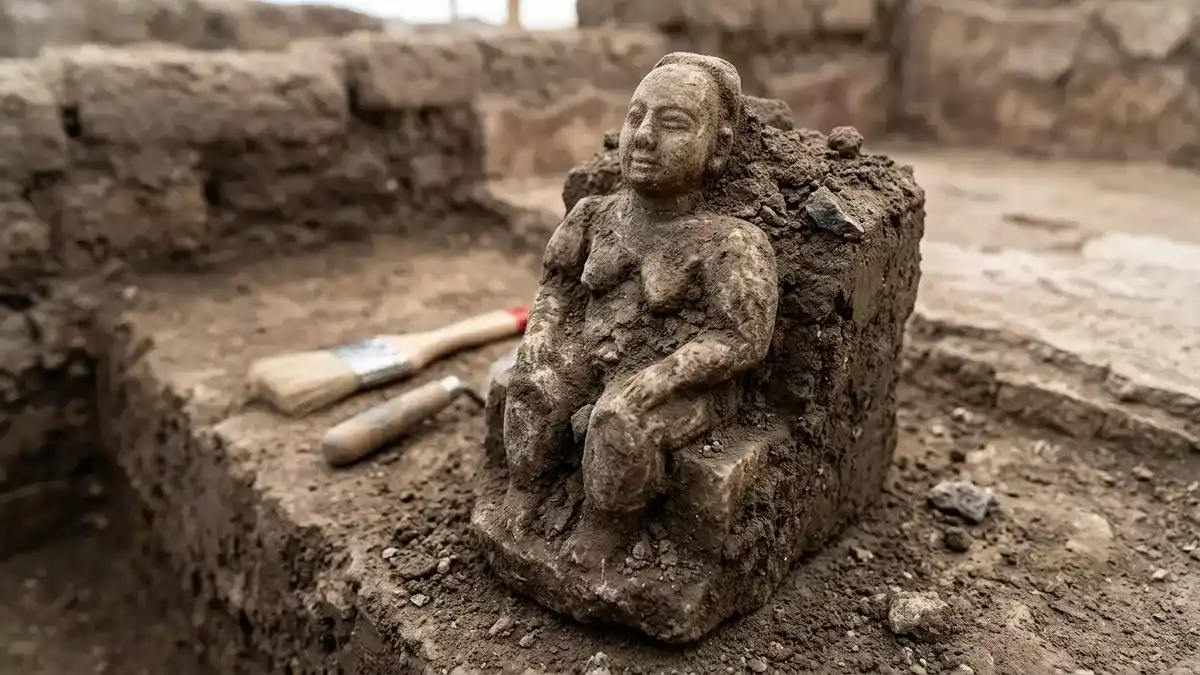
A spectacular archaeological discovery at the prehistoric site of Çatalhöyük in central Türkiye is providing a profound new look into the spiritual lives of our early ancestors. Excavators have unearthed a specialized structure dubbed the “House of the Dead,” containing the carefully arranged remains of twenty individuals. This groundbreaking find offers fresh insights into the complex funerary customs, collective memory, and ritual practices that bound one of the world’s earliest human settlements together.
Located on the edge of the Konya Plain near the modern city of Konya, Çatalhöyük is globally recognized as a premier “proto-city”—a critical stepping stone between nomadic hunter-gatherer bands and the birth of fully developed urban centers. Occupied continuously from roughly 7100 to 5950 BCE, this sprawling 34-acre settlement was home to a thriving community of 3,000 to 8,000 residents at its peak, all living in a unique, tightly packed architectural landscape.
“House of the Dead” Discovered at Çatalhöyük Redefines Ancient Rituals
The Architecture of Rebirth: How Çatalhöyük Was Built
To appreciate the significance of the newly discovered spiritual complex, one must understand the distinct way this ancient town grew. Çatalhöyük did not expand outward like a modern suburb; instead, it grew vertically through a cyclical process of structural death and rebirth.
The 80-Year Life Cycle of a Mud-Brick Home
The prehistoric residents constructed their homes out of sun-dried mud bricks, packing them so closely together that the settlement lacked traditional streets or alleyways. People moved across flat rooftops and entered their dwellings via wooden ladders descending through holes in the ceiling. A typical house served its family for approximately 80 years.
From Houses to Mounds
When a house reached the end of its structural life, it was not simply abandoned. The community systematically dismantled the dwelling, carefully collapsing the upper walls inward and compacting the mud and clay to create a solid, level foundation. A brand-new house was then constructed directly on top of the ruins of the old one. Over more than a millennium, this relentless stacking created the massive, artificial clay mounds that dominate the Turkish landscape today, within which modern archaeologists have identified at least eighteen distinct layers of historical occupation.
 Seizure of Carthaginian Bronze Coins Highlights Ancient Economy and Illicit Antiquities Trade
Uncovering the Sacred Complex on the East Mound
The latest phase of field operations, led by Prof. Dr. Arkadiusz Marciniak from the Poznań University Institute of Prehistory in Poland, focused heavily on the eastern sector of the settlement. Rather than uncovering more of the standard residential dwellings that characterize the site, the team struck an entirely different kind of neighborhood.
The archaeologists exposed a large, coordinated complex of buildings arranged deliberately around a central courtyard. Unlike the domestic spaces found elsewhere at Çatalhöyük, these structures completely lacked the everyday signatures of domestic life, such as cooking hearths, food-processing stones, or household trash dumps. Instead, everything about the architecture pointed toward a purely communal and ceremonial function.
Inside the “House of the Dead”
The crown jewel of this non-residential zone is the “House of the Dead.” When researchers excavated beneath the plastered floor of this enigmatic building, they discovered a massive communal burial containing twenty individuals.
“The architectural layout and skeletal positioning indicate that these twenty individuals did not die inside this building, nor were they buried immediately after death. They were brought here from elsewhere for a highly coordinated, ceremonial group burial.” — Field Excavation Report
Forensic analysis suggests that this structure functioned as a centralized spiritual mausoleum. The fact that bodies were collected, kept elsewhere, and then brought to this specific room for collective burial highlights a sophisticated multi-stage funeral tradition. It suggests that the “House of the Dead” was a sacred space dedicated to ancestral veneration, where the community gathered to reinforce shared history and group identity through complex burial pageantry.
Painted Walls and Elaborate Ritual Platforms
The “House of the Dead” was not the only ceremonial marvel uncovered in this newly exposed sector. The team also revealed a massive, dedicated ritual building featuring heavily painted plaster walls and fourteen distinct earthen platforms built into the floors and walls. These platforms traditionally served as seating areas for elders, stages for rituals, or bases for symbolic artwork, and they are slated for deeper excavation in the upcoming field season.
Adjacent to this large monument, specialists uncovered:
A Plastered Non-Domestic Structure: A smaller, heavily plastered building that saw intense, long-term human use but completely lacked any evidence of cooking, sleeping, or daily domestic chores.
An Ancient Triple Burial: In one of the deepest, oldest architectural layers of the complex, investigators uncovered three additional bodies buried beneath building platforms. The team is currently utilizing advanced radiocarbon dating to determine exactly how many centuries older these burials are compared to the twenty individuals found in the main house.
These diverse architectural elements paint a vivid picture of a society where the physical world and the spiritual realm were seamlessly intertwined. The citizens of Çatalhöyük did not relegate their religion to remote, isolated temples; instead, they integrated their sacred spaces, vivid symbolic murals, and deceased ancestors right into the physical heart of their daily neighborhoods.
A Lasting Legacy for Human Evolution
Designated as a UNESCO World Heritage Site in 2012, Çatalhöyük continues to be one of the most vital archaeological archives on Earth. This latest discovery of a dedicated spiritual quarter, anchored by the “House of the Dead,” fundamentally challenges old assumptions about how early farming communities organized themselves.
It proves that the transition from hunting and gathering to settled village life required far more than just domesticating wheat and raising sheep. It demanded the creation of complex social networks, shared belief systems, and highly structured rituals to maintain peace and unity among thousands of people living tightly together for the very first time in human history.
Frequently Asked Questions
What is Çatalhöyük and why is it famous?
Çatalhöyük is an ancient “proto-city” in central Türkiye that was occupied between 7100 and 5950 BCE. It is globally famous for its unique layout, where mud-brick houses were packed tightly together without streets, requiring residents to move across rooftops and enter homes through holes in the ceiling.
What is the “House of the Dead”?
The “House of the Dead” is a newly discovered, non-residential building at Çatalhöyük used exclusively for spiritual and funerary purposes. Beneath its floor, archaeologists discovered the ceremonial burials of twenty individuals.
Did the people buried in the “House of the Dead” die there?
No, evidence suggests that the twenty individuals passed away elsewhere. Their bodies were collected and brought to this specific spiritual house to be buried together as part of a highly coordinated, symbolic community ritual.
Why did the people of Çatalhöyük build their town in layers?
Every house was lived in for roughly 80 years. When a structure grew old, the residents dismantled the walls, filled in the lower rooms to create a flat clay foundation, and built a new house directly on top, eventually creating a massive hill or mound over 1,000 years.
What else was discovered in the new ceremonial complex?
In addition to the “House of the Dead,” archaeologists uncovered a massive ritual building featuring painted walls and fourteen distinct platforms, a smaller heavily plastered non-domestic building, and three deeply buried skeletons in an older layer of the site.